Why Roulette Strategy Starts With Understanding the Game Itself
Roulette has attracted players for centuries, and with that history comes a long tradition of systems and theories marketed as ways to beat the wheel. Most of that folklore overpromises. Effective roulette strategy is not about predicting where the ball lands — that is mathematically impossible — but about making informed decisions regarding bet selection, version choice, and bankroll management across a session.
Beneath the game’s apparent simplicity lie meaningful structural differences depending on which version is played, and a wide range of bet types carrying very different odds. Understanding those elements is the foundation of any sensible approach. This article examines the practical side of roulette strategy — not magic systems, but the genuine decisions a player can make that affect how long a session lasts, how much is at risk, and what realistic outcomes look like over time.
Inside Bets, Outside Bets, and What the Odds Actually Mean
The roulette betting layout divides into two broad categories: inside bets and outside bets. Each serves a different purpose, and understanding the distinction is one of the first practical steps any player should take before sitting down at a table.
Inside Bets: Higher Payouts, Lower Probability
Inside bets are placed on specific numbers or small groups of numbers within the numbered grid. A straight-up bet on a single number pays 35 to 1 — attractive when it wins, but the probability of hitting any single number on a European wheel is just 1 in 37. Split bets cover two adjacent numbers, street bets cover three, corner bets cover four, and line bets span six. As coverage increases, the payout decreases proportionally.
Inside bets suit players comfortable with longer losing runs between wins who find the possibility of a larger payout engaging. They are not a more profitable choice in the long run — the house edge remains the same regardless of bet type — but they do change the rhythm and feel of a session considerably.
Outside Bets: Broader Coverage, Steadier Returns
Outside bets cover large portions of the wheel and pay at lower odds. Red or black, odd or even, and high or low each cover 18 of the 37 numbers on a European wheel and pay 1 to 1. Dozen and column bets each cover 12 numbers and pay 2 to 1. These are the bet types most commonly associated with structured strategies, partly because their near-even payouts make them easier to incorporate into staking systems like the Martingale or D’Alembert.
Outside bets do not remove the house edge, but they offer a more gradual bankroll curve, with wins and losses arriving in smaller increments. For a beginner still learning the pace of the game, that steadier rhythm can be genuinely useful — it allows more rounds of play per session without requiring a large single stake.
European vs American Roulette: A Structural Difference That Actually Matters
The choice between European and American roulette is one of the most consequential decisions a player can make before a single chip is placed. European roulette uses a wheel with 37 pockets: numbers 1 through 36 plus a single zero. American roulette adds a double zero, bringing the total to 38. That one additional pocket shifts the house edge from 2.7 percent to 5.26 percent — meaning the expected loss on an American table is nearly double that of a European game for every hundred dollars wagered.
On any individual spin this distinction may not feel dramatic, but roulette is played across many rounds and the house edge erodes bankrolls gradually. Choosing the American wheel without understanding the cost of that second zero is, quite simply, giving away money unnecessarily.
The La Partage Rule and Its Practical Value
Some European tables — particularly in French casinos and certain online variants — apply a rule known as La Partage. When the ball lands on zero, players who have placed even-money outside bets receive half their stake back rather than losing the full amount. This effectively halves the house edge on those bets, bringing it down to approximately 1.35 percent.
La Partage does not apply to inside bets and is not offered at every European table. But when available, it represents the most favorable mathematical conditions a roulette player can find. For players who favor even-money bets, seeking out a La Partage table is a straightforward and meaningful way to reduce the rate at which the house edge works against a session bankroll.
Bankroll Management: The Practical Framework Behind Every Sound Strategy
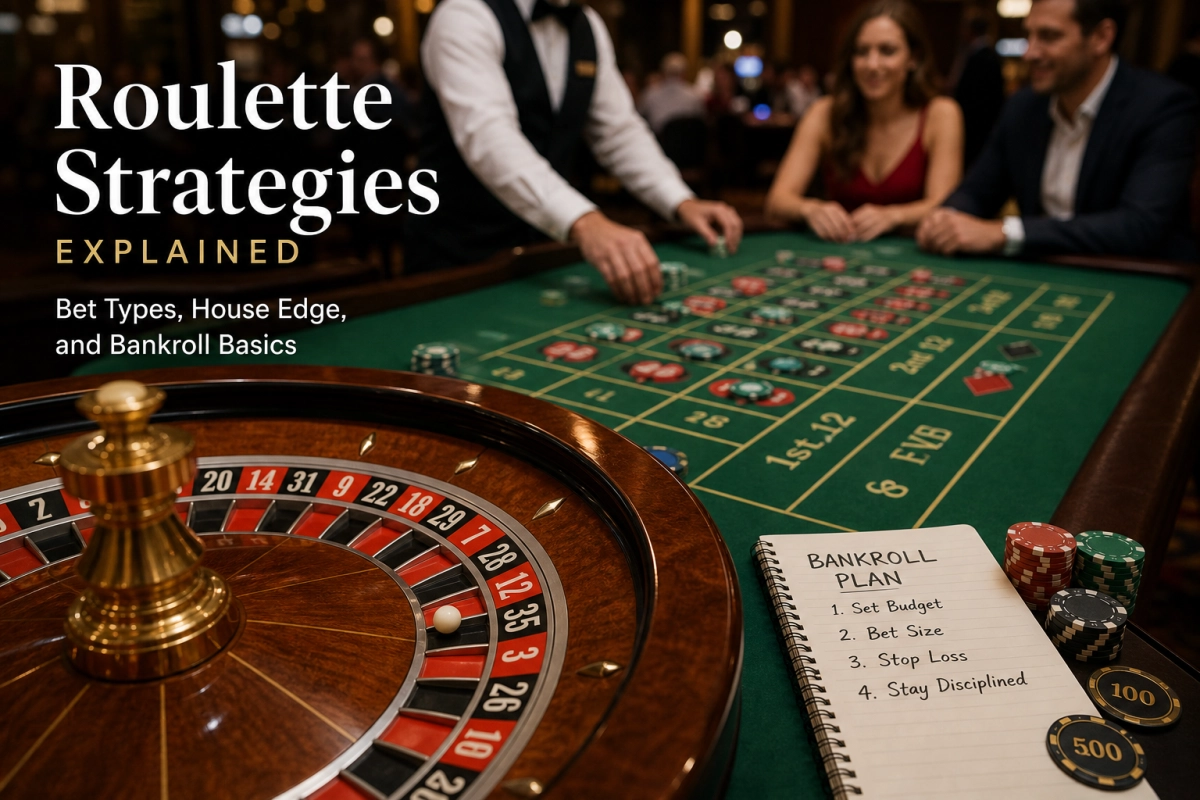
Roulette strategy discussions often fixate on staking systems while glossing over the more fundamental discipline that makes any system workable: bankroll management. Without a clear framework for how much money is allocated to a session and when to walk away, even the most elegant staking system collapses under the pressure of a losing streak.
Responsible bankroll management begins with a number fixed before any play begins — the total amount a player is genuinely comfortable losing without financial consequence or emotional distress. Treating the session bankroll as an entertainment budget rather than an investment changes the psychological framing entirely and leads to more measured decision-making under pressure.
Sizing Bets Relative to the Session Bankroll
Once a session budget is established, individual bet sizes should follow a consistent ratio. A commonly cited principle is to keep each standard bet between one and five percent of the total session bankroll. At one percent, a player with a hundred-unit bankroll has a minimum of twenty rounds before the budget is exhausted even if every spin is a loss. This approach extends playtime, reduces the risk of early elimination, and provides genuine room for the natural variance of the game to play out.
Larger bets relative to the bankroll accelerate both winning and losing runs. A short sequence of losses — entirely normal in roulette — can end a session before it has meaningfully begun, which rarely serves the beginner well.
- Set a fixed session budget before play begins and treat it as a defined limit, not a starting point for negotiation mid-session.
- Keep individual bets small relative to the total bankroll to allow sufficient rounds for normal variance to unfold.
- Decide on a win target and a loss threshold in advance, and commit to leaving the table when either is reached.
- Avoid increasing bet sizes impulsively after losses — emotion-driven escalation operates without structure and accelerates losses.
Playing Roulette Well Has Less to Do With Systems Than Most Players Expect
The enduring appeal of roulette systems is understandable — they offer structure, and structure feels reassuring in a game governed by chance. But every system operates within the same mathematical boundaries: the house edge does not bend for a staking pattern, and no sequence of bets changes the probability of any individual spin. What systems can do, when applied within sensible bankroll limits, is shape the rhythm of a session and impose a discipline that pure instinct rarely provides.
That discipline separates players who enjoy roulette as entertainment from those who find it a source of frustration. The former group tends to have made conscious decisions before sitting down: which version offers better conditions, what the session budget is, how large each bet will be, and at what point they will leave regardless of outcome. The latter group tends to make those decisions reactively — mid-session, under the influence of a losing streak or an unexpectedly good run — precisely when judgment is least reliable.
For a beginner, the most productive roulette strategy is a clear-eyed understanding of what the game actually offers: a modest but persistent house edge, genuine short-term variance, and real entertainment value when approached with realistic expectations. European roulette, where available with La Partage, provides the most favorable structural conditions. Outside bets extend a session and smooth the variance curve. A fixed, proportionate bankroll framework keeps the experience within bounds that remain genuinely enjoyable.
None of that guarantees profit — nothing does in roulette, and anyone suggesting otherwise is selling something. What it does guarantee is a more informed experience, with fewer unwelcome surprises and a clearer sense of what each decision actually costs. For most players, that is enough to make the game worth playing on its own terms.