Why Good Blackjack Strategies Start With the Basics
Blackjack is one of the few casino games where your choices change the result. That is exactly why sound blackjack strategies matter, and why they are so often oversold. Before any chart or shortcut makes sense, you need a firm grip on how a hand works, what each decision does, and what a strategy can realistically achieve.
The goal is simple: build a hand closer to 21 than the dealer’s without going over. Go over 21 and you “bust,” losing the hand immediately. Card values are easy to learn:
- Cards 2 to 10 count at face value.
- Jacks, queens and kings count as 10.
- An ace counts as 1 or 11, whichever helps the hand more.
A hand containing an ace counted as 11 is called “soft,” because it cannot bust on the next card. Without such an ace, it is “hard.” You will see these two terms constantly in strategy guides.
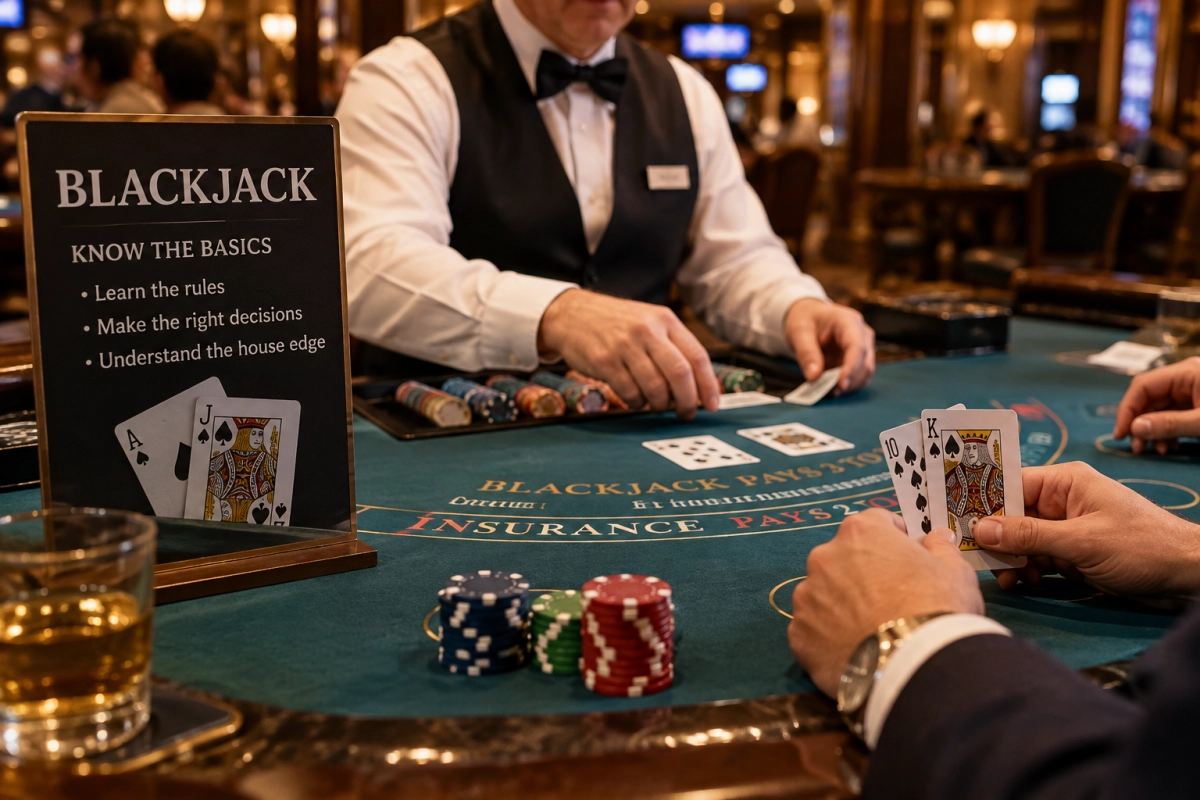
Each round starts with your bet. You and the dealer receive two cards, and you see one of the dealer’s, called the upcard. An ace plus a ten-value card on your first two cards is a blackjack, which most tables pay at 3:2. Some tables pay only 6:5, which is a worse deal for you, so check the payout printed on the table or in the game rules before you sit down.
The Five Decisions You Can Make on a Hand
Once your cards are dealt, you choose how to play. Not every option is available every time, but these are the core moves:
- Hit: take another card.
- Stand: keep your current total and end your turn.
- Double down: double your bet, receive exactly one more card, and then stand.
- Split: when your first two cards match in value, separate them into two hands. This requires a second bet equal to the first.
- Surrender: where offered, give up the hand and lose half your bet instead of playing it out.
Every choice balances risk against opportunity. Hitting a hard 16 risks a bust, but standing on it often loses to a strong dealer card. Doubling puts more money on a favourable spot, but you cannot take another card afterwards. Understanding this trade-off is the foundation of everything that follows.
Insurance and Side Bets
Beyond the main wager, many tables offer insurance and side bets. Insurance is a separate bet offered when the dealer shows an ace, and it carries a house edge of roughly 7% in a six-deck game. Side bets vary widely by casino and are usually more costly than the main game. Beginners are generally better off ignoring both while they learn.
What the House Edge Means, and Why It Never Disappears
The house edge is the average percentage of each wager the casino expects to keep over a very large number of hands. It does not predict your next session. You can win on any given night, and you can lose, sometimes heavily.
Playing by basic strategy, a fixed set of mathematically derived decisions for every hand and dealer upcard, lowers the edge. In a six-deck game with the dealer standing on soft 17, doubling after a split allowed and a 3:2 blackjack payout, the edge is roughly 0.42%. Guesswork typically costs the house advantage of about 2% to 4%. Even so, basic strategy reduces expected losses; it does not guarantee a profit.
That difference makes the rules at your table important, and it leads to the practical question of how to put these decisions into action, starting with a quick look at a worked hand.
A Worked Hand and Quick-Reference Decision Rules
Suppose you bet 10 units and are dealt a 6 and a 5, a hard 11. The dealer’s upcard is a 6. Basic strategy says to double down here, since any ten-value card, the most common in the deck, gives you a strong 21. You add 10 units and receive a 9, making 20. The dealer turns over a 10 for a total of 16 and must hit, drawing an 8 and busting. You win 20 units.
That is the happy ending, but the same decision could just as easily have produced a 2 for you, a dealer 21, and a bigger loss. A good decision does not guarantee a good result. These simplified rules cover many common situations, though the exact chart varies with table rules:
- Hard 8 or less: always hit.
- Hard 9 to 11: double against weak dealer cards, otherwise hit.
- Hard 12 to 16: stand against a dealer 2 to 6, hit against 7 or higher.
- Hard 17 or more: always stand.
- Pairs: always split aces and eights; never split tens or fives.
- Surrender: where offered, a hard 16 against a dealer 10 is a classic candidate.
Myths That Cost Beginners Money
Two ideas dominate beginner conversations: card counting and betting systems. Both deserve a sceptical look.
Card counting tracks the ratio of high to low cards remaining in the shoe. It is not illegal, but casinos can ask counters to leave, and it demands sustained accuracy, discipline and a large bankroll. Online games that reshuffle constantly offer no realistic opening, so treat it as a skill to understand, not a shortcut to learn in a weekend.
Betting systems, such as doubling after every loss, are even less reliable. They change how much you wager, not the underlying odds of each hand. Table limits and your own bankroll can end a losing streak before the “recovery” arrives. Likewise, the belief that a win is “due” after several losses ignores that each hand is dealt from a freshly shuffled or randomised deck.
Habits for Your First Sessions
Good habits matter as much as good decisions, and they are easier to build before you play.
- Pick a clear table. Look for 3:2 blackjack payouts, readable rules and limits that suit your budget. Avoid tables where the rules are hard to find.
- Set your limits first. Decide a bankroll you can afford to lose, plus a time limit, before the first card is dealt. Treat that money as the cost of entertainment, not as income.
- Compare formats. Online blackjack is faster and often allows low stakes, which suits practice. Live dealer games run at a slower, more social pace, with a real dealer streamed to you. Either way, the same house edge applies.
- Know when to stop. Leave when your time is up, your budget is spent, or you are playing to chase losses. Do not top up after hitting your limit.
Blackjack outcomes are uncertain, and losses are always possible, even with perfect play. If gambling stops being fun, or you find yourself hiding it or chasing losses, pause and contact a support service in your country, such as a local problem gambling helpline.
Playing Smart From the First Hand
Good blackjack strategy is quieter than the myths suggest. It means learning the rules until they feel natural, following a basic strategy chart instead of guessing, and choosing tables with clear terms and fair payouts. None of it removes the house edge, but it keeps the edge as small as the game allows, and it lets you play with confidence instead of confusion.
The habits around the cards matter just as much. A budget set before you sit down, a time limit you respect, and a willingness to walk away when either runs out will do more for your experience than any shortcut or betting system. Treat early sessions as practice. Focus on making each decision correctly, not on the result of any single hand.
Keep one point in mind: blackjack is entertainment with an uncertain outcome, and losses are a normal part of it. Play only with money you can afford to lose, and never use gambling to solve a financial problem. If it stops being enjoyable, take a break and reach out to a local support service. Played with clear rules, firm limits, and a calm head, blackjack is at its best as a game of skill and decision-making, not a promise of profit.