Why Baccarat Strategies Start With Money, Not Patterns
Search for baccarat strategies and you will find plenty of promises: streak-reading, chart-tracking, staking ladders with tidy names. None of them change the underlying maths. Baccarat is a game of chance, and the cards do not remember what came before. What you can control is how much you stake, how long you play and when you walk away. That is the focus of this guide.
Baccarat is also unusually simple. You do not make drawing decisions, because fixed rules decide whether each hand takes a third card. Your only real choices are which bet to place and how much to wager. That makes those two decisions matter more than they might in a game like blackjack.
Banker, Player and Tie: How the Three Bets Differ
Every hand offers the same three outcomes. The figures below assume a standard eight-deck game with a 5% commission on Banker wins and a Tie paying 8:1.
- Banker: wins about 45.86% of hands, with a house edge of roughly 1.06%.
- Player: wins about 44.62% of hands, with a house edge of roughly 1.24%.
- Tie: occurs about 9.52% of the time, with a house edge of roughly 14.36%.
House edge is the average share of each wager the casino keeps over a very large number of hands. At a 1.06% edge, you would expect to lose about 1.06 units for every 100 units wagered. That is an average over the long run, not a prediction for your next hour. A single session can finish well ahead or well behind.
Why Banker Costs Less, and What Commission Does
Banker wins slightly more often than Player, which is why the casino charges a commission, usually 5%, on winning Banker bets. Even after that charge, Banker carries the lower edge. The commission is part of the price of playing, so check it before you sit down.
Some tables drop the commission but pay only half on a Banker win with a total of 6. That raises the Banker edge to about 1.46%. Variants such as Lightning Baccarat have their own payout rules and a different edge, about 1.41%. The label on the table tells you little, so read the paytable.
The Tie Bet and Side Bets
Tie looks tempting because of its larger payout, but a 14.36% edge is more than ten times the cost of Banker. Even a table paying 9:1 still leaves the house with about 4.84%. Side bets vary by table, so look up their stated edges before wagering on them.
Why No Betting Pattern or Staking System Beats the House
Scorecards show recent results, but each hand is dealt from a shuffled shoe, and a run of Player wins does not make Banker “due”. Staking systems that raise bets after losses, or after wins, change how your results are distributed. They can produce more frequent small wins and rarer, larger losses. They do not reduce the edge, because every individual bet still carries the same disadvantage. Raising stakes after a loss also speeds up your losses and can put you at risk of chasing them.
Whatever you play, a loss is always possible, and no approach guarantees a profit. Treat any spending as the cost of entertainment, and only use money you can afford to lose.
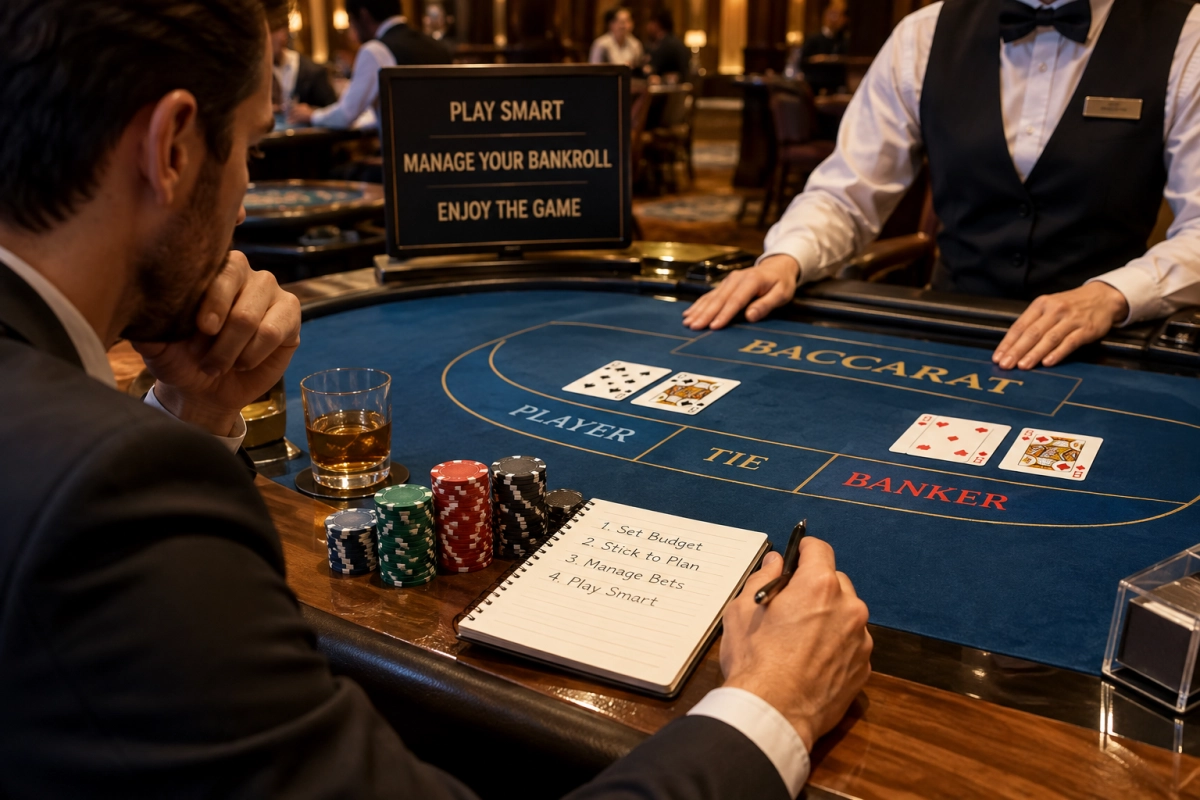
If the edge cannot be beaten, the practical question is how to keep its cost predictable. That starts before the first hand is dealt, with a session budget and a flat bet size that fits it.
Setting a Session Budget and a Flat Bet Size
A session budget is the amount you are prepared to lose for the sake of the entertainment, decided before you sit down. It should come from spare money, never from rent, savings or borrowed funds. Once you have the figure, treat it as spent. Anything you leave with is a bonus, not a return.
The budget then determines your bet size. A common rule of thumb is to divide it into at least 40 to 50 units, so one unlucky stretch does not end the session in minutes. With a budget of 100, that means betting around 2 per hand. Keep the stake flat. Staying on a single amount, placed on Banker or Player, keeps the cost per hand predictable and removes the temptation to escalate after a loss.
Stop-Loss and Time Limits: Deciding the Exit in Advance
Your budget is effectively a stop-loss, but it helps to say it out loud: when the budget is gone, the session is over. Do not top up mid-session. Reloading is how a planned expense turns into a larger one.
A time limit works alongside it. Baccarat moves quickly, and the longer you play, the more hands you wager on and the more the edge takes. Set a timer for 30 or 60 minutes and stop when it sounds, even if you are ahead. Some players also set a win goal, though the key point is the same: the exit is chosen while you are calm, not while you are in the middle of a streak.
A Worked Example of Bet Size and Session Length
Expected loss is simple to estimate: number of hands × bet size × house edge. The examples below assume Banker bets at the 1.06% edge, and the hand counts are illustrative, since dealing speed varies by table.
- 50 hands at 2 units: 100 units wagered, expected loss about 1.06 units.
- 50 hands at 5 units: 250 units wagered, expected loss about 2.65 units.
- 200 hands at 2 units: 400 units wagered, expected loss about 4.24 units.
- 200 hands at 5 units: 1,000 units wagered, expected loss about 10.60 units.
Doubling either the bet size or the number of hands roughly doubles the expected cost. Raising both multiplies it. These are averages, though, and they hide the real picture. Variance means a single session can swing by many times the expected loss in either direction. A 50-hand session with an expected loss of about 1 unit could easily end several bet units up or down, and larger bets stretch those swings further.
That is why the budget matters more than the arithmetic. The expected loss describes the long run, while the stop-loss protects you from the short run. Neither guarantees a particular result, and a loss, including one larger than average, is always possible.
Choosing Low-Edge Tables and Reading the Rules
Once your budget and bet size are set, the table is the next lever. Look for a standard game that offers Banker, Player and Tie with clearly stated payouts. Before placing a chip, check three things:
- Commission: confirm whether Banker wins are charged 5% or whether the table uses a no-commission variant with reduced payouts on certain totals.
- Tie payout: 8:1 and 9:1 are both common, and both still leave the house with a far larger edge than Banker or Player.
- Side-bet costs: each side bet lists its own payouts, and the implied edge is often higher than the 1.06% on Banker. If a figure is not published, treat that as a reason for caution.
Table minimums matter too. Your flat bet should sit comfortably at or above the minimum, so you are not forced to stake more than your plan allows.
Using Deposit Limits, Reminders and Cooling-Off Tools
A plan made with a clear head is easier to keep when the platform backs it up. Most licensed operators offer tools that enforce your own rules, though what is available varies by operator and jurisdiction.
- Deposit limits cap how much you can add over a day, week or month, so a bad session cannot turn into a bigger one.
- Session reminders alert you to how long you have been playing, which is useful in a game that moves as quickly as baccarat.
- Cooling-off periods pause your account for a set time when you want a break.
- Self-exclusion blocks access for a longer period, and it is the right step if gambling stops feeling like entertainment.
Set these limits when you are calm, not after a loss. If you feel you are chasing losses or spending more than planned, stop and contact a local gambling support service. Baccarat is intended for adults of legal gambling age only.
Playing Baccarat With a Plan, Not a Prediction
Baccarat rewards discipline more than cleverness. The edge cannot be beaten by tracking patterns or reshaping your stakes, but its cost can be understood and kept within limits you chose in advance. Choose Banker or Player over Tie, confirm the commission, set a budget you can afford to lose, bet a flat amount, and let a timer and a stop-loss decide when you finish.
The worked examples show why this approach is sound. Expected loss grows with every hand and every unit staked, and variance means any single session can still end well above or below that average. Nothing here guarantees a win, and a loss is always possible. What you can guarantee is that you decided the cost before the first card was dealt, and that is the only kind of control the game offers.