Why Basic Strategy Is the Foundation of Smarter Blackjack Play
Blackjack occupies a unique position among casino table games. Unlike slots or roulette, where outcomes are entirely beyond a player’s influence, blackjack involves genuine decision-making on every hand. Play correctly, and the house edge can be reduced to around 0.5%. Play by instinct, and that edge can climb several percentage points — a difference that compounds quickly over time.
Basic strategy is not a system that promises consistent profits. It is a mathematically derived framework that identifies the statistically optimal decision for every combination of a player’s hand and the dealer’s visible card. Understanding it requires no advanced mathematics — just a clear grasp of how hand values work, why the dealer’s upcard matters, and how three categories of decisions — hard totals, soft totals, and pair splits — each follow their own logic.
How Blackjack Hands Are Classified
Hard Totals
A hard hand contains no ace, or contains an ace that must be counted as one to avoid busting. A hand of 9 and 7 is a hard 16 — there is no flexibility in the value. Hard hands carry bust risk that increases sharply as the total approaches 21.
Soft Totals
A soft hand contains an ace that can still count as either one or eleven. Ace and 6 can be read as 7 or 17 — that flexibility defines it as a soft 17. Soft hands allow players to draw with less risk, because an unfavorable card simply converts the hand to a hard total rather than a bust. Basic strategy treats soft totals differently from hard ones precisely because of this built-in safety margin.
Pairs
When a player’s first two cards share the same denomination, they may split into two separate hands. Not every pair should be split — the correct decision depends on both the specific pair and the dealer’s upcard, and getting it wrong is one of the more costly mistakes casual players make.
Hard Totals: Where Basic Strategy Earns Its Reputation
Mastering hard totals requires understanding one central dynamic: the dealer’s upcard reveals their hand’s vulnerability. A dealer showing 4, 5, or 6 is statistically likely to bust. A dealer showing 9, 10, or ace is in a position of strength. Optimal play revolves around recognizing this distinction.
Hard 8 Through 11: The Aggressive Zone
Hard 11 is one of the strongest doubling opportunities in the game — the most common card in any deck is a ten-value card, meaning a draw could produce 21. Against most dealer upcards, doubling on 11 is correct. Hard 10 follows similar logic, though caution is warranted against a dealer’s 10 or ace. Hard 9 narrows the doubling window to dealer upcards of 3 through 6. Hard 8 and below are hit without hesitation.
Hard 12 Through 16: The Uncomfortable Middle Ground
Every card drawn here carries bust risk, yet these totals rarely win outright against a dealer who completes their hand. The strategic response is built around the dealer’s bust potential rather than optimism about the player’s position.
Against a dealer showing 4, 5, or 6, standing on hard 12 through 16 is correct — the dealer is more likely to bust, so the player’s job is simply to survive. Against a dealer showing 7 or higher, hitting becomes necessary despite the risk. Standing on 15 or 16 against a dealer’s 9 may feel safer, but probability disagrees: the dealer completes those hands at a rate that makes passive standing a losing strategy over time.
Hard 17 and Above: The Standing Threshold
Hard 17 is the universal standing line. At this total, the bust risk from drawing outweighs any potential benefit regardless of the dealer’s upcard. Hard 18, 19, and 20 are stood on without exception.
Soft Totals: Playing the Safety Net Intelligently
Soft 13 Through 17: Doubling Opportunities
Soft hands in this range — ace-2 through ace-6 — are too weak to stand on, as a dealer completing their hand will win far too frequently. Against dealer upcards of 4, 5, or 6, doubling is correct for most of these hands. The dealer’s bust vulnerability, combined with the player’s immunity from an immediate bust on the doubled card, creates a mathematically favorable situation. Against stronger dealer upcards, simply hitting is preferred.
Soft 18: The Most Misplayed Hand in Blackjack
Many players stand on soft 18 automatically, reasoning that 18 is a decent total. Basic strategy is more nuanced. Against a dealer showing 2 through 8, standing is correct. Against a dealer’s 9, 10, or ace, hitting is the right move. The dealer completes those strong hands at a rate that makes soft 18 a losing position if left unchanged. Drawing either improves the total or converts the hand to hard 18 — no worse than before. Soft 19 and above are stood on unconditionally.
The pattern across soft totals reveals a broader principle: the goal is never to protect a comfortable-looking total, but to maximize expected value given the dealer’s upcard. That same principle carries directly into pair splitting decisions.
Pair Splitting: Turning One Hand Into a Strategic Advantage
Pairs That Should Always Be Split
Aces and eights stand apart from all others. Splitting aces is straightforward — a single ace is one of the most powerful starting cards, and receiving a ten-value on either split hand produces a strong 21. Keeping them together as a soft 12 wastes that potential. Splitting eights is less intuitive but equally important. A hard 16 is the worst hand in blackjack — weak enough to lose outright and dangerous to draw to. Separating them gives two hands starting at 8, a manageable foundation against most dealer upcards. Even against a dealer’s 9, 10, or ace, splitting eights remains mathematically correct because hard 16 performs worse in every scenario.
Pairs That Should Never Be Split
Tens produce a hard 20 — one of the strongest possible totals. Splitting that into two hands starting at 10 dismantles a near-certain winner in pursuit of speculative gain. A pair of fives is better treated as a hard 10, an excellent doubling candidate, rather than split into two weak starting hands.
Context-Dependent Pairs
Twos, threes, sixes, sevens, and nines require reading the dealer’s upcard before deciding. Twos and threes should be split against dealer upcards of 2 through 7 and hit otherwise. Sixes are split against a dealer’s 2 through 6. Sevens are split against dealer upcards of 2 through 7. Nines present one of the more surprising decisions in basic strategy: split against most dealer upcards from 2 through 9, with the notable exception of a dealer’s 7, where hard 18 is likely to win and standing is correct.
From Rules to Reflex: Making Basic Strategy Second Nature
Understanding basic strategy intellectually is a reasonable starting point. Applying it consistently under live conditions — with money on the table and hands arriving quickly — is a different challenge. The distance between knowing the correct play and executing it without hesitation is where most players lose the benefit basic strategy promises.
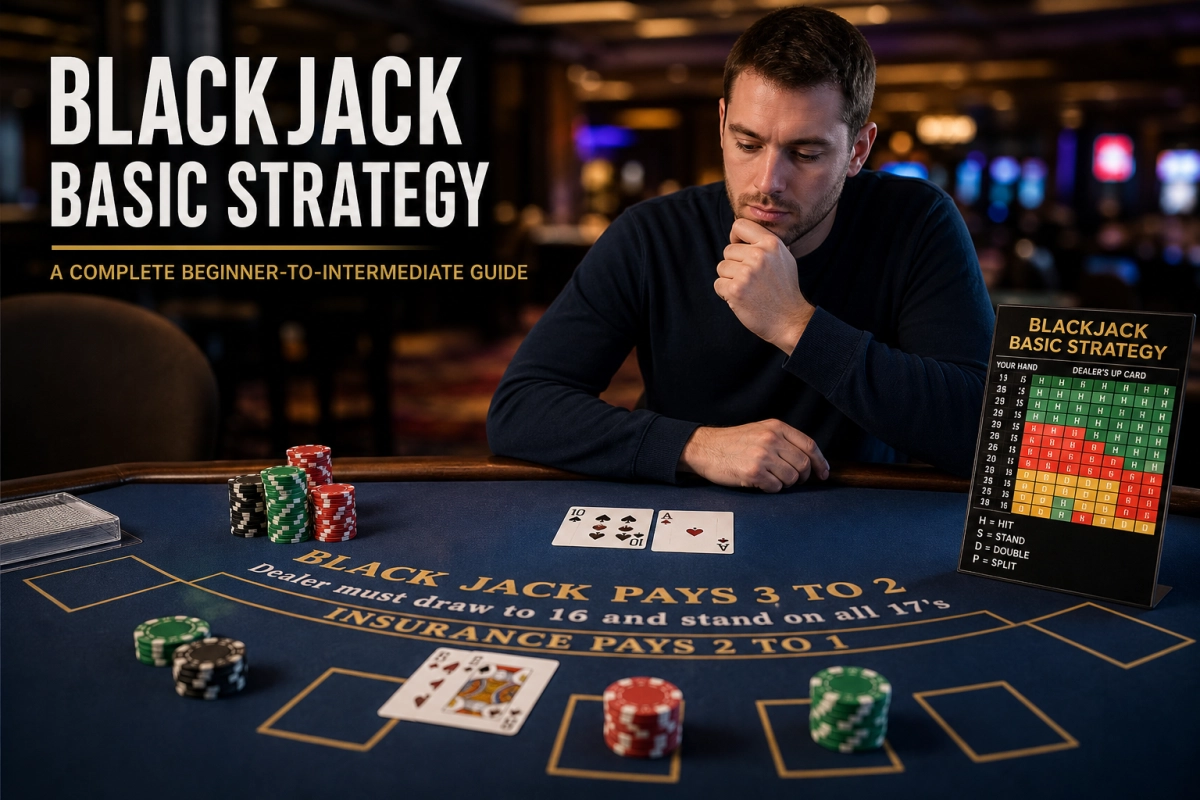
Strategy charts, widely available and permitted at most casino tables, allow players to verify decisions in real time. Using one is not an admission of inexperience — it is the practical application of a tool that exists precisely for this purpose. Over time, decisions become internalized, and the chart becomes confirmation rather than a crutch. Studying the three categories as separate systems before integrating them also helps: hard totals form the largest share of decisions, soft totals reward focused practice, and pair splitting tends to click into place once the logic of each pair becomes clear.
Playing the Percentages for the Long Game
Basic strategy does not guarantee a winning session. What it does guarantee is that every decision is the one most likely to produce the best outcome over thousands of hands. The house edge is not eliminated, but it is reduced to its lowest possible point without card counting or advanced techniques — and that difference, sustained over time, is mathematically significant.
There is also something clarifying about playing with a strategy grounded in probability rather than emotion. The temptation to stand on soft 18 against a dealer’s 10 because it feels safe, or to avoid splitting eights against an ace because the situation feels hopeless, comes from intuition that simply does not align with the numbers. Basic strategy offers a way out of those emotional traps — not by making the game easy, but by making the decisions clear.
Players who internalize these principles arrive at the table with a genuine advantage over those who play by feel: not an edge over the house, but an edge over their own worst instincts. In a game where every decision carries real mathematical weight, that is exactly where the work of improvement begins.