Why Structured Poker Strategies Separate Disciplined Players From the Rest
Poker occupies a unique space among casino card games. Unlike slots or roulette, where outcomes depend entirely on chance, poker involves a meaningful layer of decision-making that shapes long-term results. Short-term variance can be brutal regardless of skill level, but players who apply sound poker strategies consistently will tend to outperform those who rely on instinct alone.
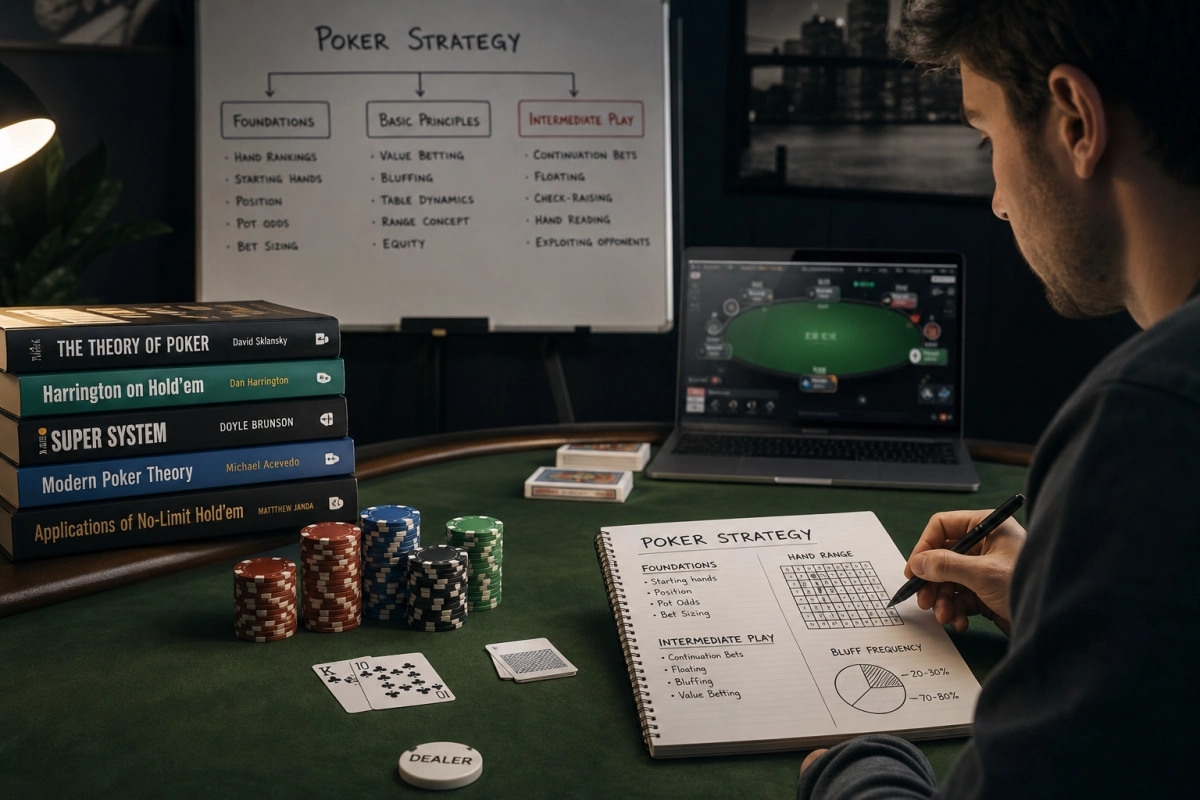
This guide covers the core principles of competent poker play: hand selection, table position, pot odds, bluffing, and bankroll management. These concepts apply across Texas Hold’em, Pot-Limit Omaha, and tournament structures. No framework eliminates variance or guarantees profit — losses are a normal part of the game. What a structured approach offers is a more disciplined foundation that reduces costly mistakes and supports better decisions under pressure.
Starting Hand Selection: The First and Most Frequently Misunderstood Decision
Every hand begins with the same choice: play or fold. Poor starting hand selection is one of the most common and expensive errors at every level. Playing too many hands forces a player into difficult post-flop situations with weak holdings, leading to avoidable losses.
In Texas Hold’em, strong starting hands fall into clear categories. Premium pairs — aces, kings, queens — and high suited connectors like ace-king suited are worth playing from almost any position. Medium pairs and suited connectors have value, but their profitability depends heavily on context, particularly position relative to the dealer button.
Understanding Hand Ranges Rather Than Fixed Rules
Experienced players think in ranges — the full set of hands they or their opponents might reasonably hold given the action. For beginners, a basic starting hand chart is a practical starting point. Over time, those fixed rules evolve into flexible decisions based on position, stack depth, and opponent tendencies.
- Early position: Play tighter, favouring premium hands. The risk of a stronger hand behind you is highest here.
- Middle position: A slightly wider range becomes viable, including suited connectors and medium pairs.
- Late position: The widest range applies. Acting last post-flop is a significant advantage that justifies entering more pots.
- Blinds: Despite the forced bet, playing out of position for the rest of the hand makes the big blind a structurally weak seat.
Folding marginal hands before the flop is not passive play — it is discipline. Applied consistently, it becomes one of the clearest markers of a developing poker player.
Position Play: Why Where You Sit Shapes Every Decision
Position is one of the most powerful concepts in poker strategy. It determines how much information a player has before acting, and information is the currency of good decision-making. Acting last means seeing how every other player responds before committing chips — an advantage that compounds into a measurable edge over hundreds of hands.
The button is the most coveted seat for a reason. On every post-flop street, the button acts last, giving the player a complete picture of opponents’ intentions. This allows more precise value betting when ahead, easier bluff identification when behind, and superior pot control unavailable to players acting earlier.
Using Position Actively, Not Just Passively
The more sophisticated application of positional theory involves using position to tell a coherent story across multiple streets. A player on the button who calls a pre-flop raise can apply pressure on the turn after the original raiser checks — a move far harder to execute from out of position. This kind of leverage requires patience and awareness of what the board communicates to an observant opponent.
- Positional awareness pre-flop: Adjust opening ranges based on how many players act after you, not hand strength alone.
- Controlling pot size: In position, calling rather than raising on certain streets keeps pots manageable with medium-strength hands.
- Information extraction: Checking back in position when the board is unclear preserves pot control while gathering information cheaply.
Pot Odds and Basic Equity: Making Decisions That Pay Off Over Time
Pot odds represent the ratio between the current pot size and the cost of a call. If the pot holds one hundred units and an opponent bets fifty, a call costs fifty to win one hundred and fifty — meaning the hand needs to win roughly one in three times to break even. If the actual winning probability exceeds that threshold, the call is mathematically justified. If it falls short, folding is correct regardless of how tempting the pot feels.
Connecting Pot Odds to Drawing Hands
The most practical application involves drawing hands — situations where a player needs a specific community card to complete a strong holding. A flush draw will complete roughly one in three times by the river across both remaining streets. Knowing this allows a player to assess whether the reward justifies continuing.
Implied odds extend this thinking. Even when immediate pot odds do not justify a call, the prospect of winning additional chips when the draw completes can shift the calculation — especially in deep-stacked cash games where future streets carry genuine earning potential.
- Outs: Count cards that would improve the hand to a likely winner, then estimate the probability of hitting across remaining streets.
- The rule of four and two: Multiply outs by four on the flop for an approximate percentage chance of hitting by the river, or by two on the turn for one remaining street.
- Reverse implied odds: Some draws, even when completed, may not win the pot or may win less than expected. Factor this risk into marginal decisions.
Bluffing With Purpose: When Deception Becomes a Legitimate Tool
A well-executed bluff is not a bold gamble on instinct — it is a calculated bet that the story told across multiple streets is more believable than an opponent’s ability to call it down. Recreational players tend to bluff too randomly, while disciplined players bluff only when the math, board texture, and opponent’s likely range align in their favour.
The most reliable bluffs carry equity — the hand has some chance of improving even if the bluff is called. A semi-bluff with a flush draw or open-ended straight draw gives two ways to win: the opponent folds, or the draw completes. Pure bluffs require a high degree of certainty that the opponent will fold, which is far harder to predict reliably.
Choosing the Right Spots and Opponents
Bluffing a player who calls everything regardless of board runout is a mathematical leak disguised as aggression. Against a calling station, the better adjustment is straightforward: value bet more, bluff less, and let their tendency pay off strong hands generously.
- Board texture: Bluffs work best on boards that connect plausibly with a pre-flop raising range — dry, unpaired boards or coordinated textures that would logically have hit the bettor’s hand.
- Opponent tendencies: Observable hesitation patterns in live play, or fold-to-continuation-bet data online, reveal who is worth targeting.
- Bet sizing: Match the size used for value bets on similar textures. Bluffs sized too small invite calls; bluffs sized too large signal weakness.
- Number of opponents: Single-opponent spots are significantly more effective. Each additional player multiplies the chances someone will call.
Bankroll Discipline: The Strategy That Protects Every Other Strategy
Every principle in this guide operates within a financial environment. Bankroll management is what keeps a player in that environment long enough for their decisions to matter. Even strong players experience extended losing periods, and without adequate reserves, those periods end the session — or the hobby — before skill has a chance to express itself.
Standard guidance for cash games is twenty to thirty buy-ins at the stake being played. Tournaments, with their winner-takes-most variance, typically require fifty or more buy-ins at the relevant entry level. These figures reflect how much downswing a player should expect to survive without deviating from sound play.
- Set clear thresholds: Decide in advance when a move up or down in stakes is triggered, and treat those thresholds as firm commitments.
- Separate poker funds from personal finances: A dedicated bankroll prevents a bad session from creating real-world stress that compromises future decisions.
- Record keeping: Tracking results by session, stake, and format reveals patterns invisible in the moment — including whether a particular format is genuinely profitable over time.
Building a Game That Holds Up Under Pressure
The skills described in this guide do not arrive simultaneously. Hand selection becomes second nature before positional leverage is fully understood, and pot odds feel mechanical before they become instinctive. That progression is normal, and recognising it prevents the frustration of expecting immediate improvement across every dimension at once.
What a structured approach builds, over time, is internal consistency. Each decision connects to a principle; each principle connects to a broader framework. That framework allows a player to review a session, identify where decisions diverged from sound reasoning, and correct those divergences before they become habit.
Poker rewards patience, precision, and the willingness to accept that short-term outcomes and long-term quality of play are entirely separate things. Losses happen to good players. Mistakes happen to experienced ones. What distinguishes disciplined play is not the absence of either, but the presence of a framework that keeps both in perspective and continues moving forward regardless.