Why Blackjack Rewards Players Who Think Carefully
Blackjack occupies a unique position on the casino floor. Unlike roulette or slots, where outcomes are entirely determined by chance, blackjack gives players genuine decisions on every hand — decisions with measurable consequences. This is precisely why blackjack strategies matter: not as a path to guaranteed profit, but as a framework for mathematically sound choices that keep the house edge as low as possible.
The house edge in blackjack typically ranges from around 0.5% to 2%, depending on table rules and how consistently a player applies sound strategy. A player who hits without thinking effectively hands the casino a larger advantage than the game’s rules require. Conversely, a player who applies basic strategy correctly and chooses a favorable table can narrow that edge considerably.
This guide covers the core principles new players need: what basic strategy is and why it works, the mathematical logic behind specific decisions, and how to manage a bankroll in a way that keeps sessions sustainable.
What Basic Strategy Actually Is — and What It Is Not
Basic strategy is a set of optimal decisions — hit, stand, double down, or split — derived from probability analysis of every possible combination of a player’s hand and the dealer’s visible card. It does not rely on intuition or guesswork. Every recommendation reflects the statistically best move available given the information on the table.
The strategy accounts for one critical asymmetry: the dealer plays by fixed rules. In most games, the dealer must hit on 16 or below and stand on 17 or above. This predictability is what makes probability-based decisions possible, allowing players to use the dealer’s exposed card as meaningful information.
How Expected Value Shapes Individual Decisions
The logic behind each basic strategy recommendation comes down to expected value — the average outcome of a decision made repeatedly over time. Consider a player holding a hard 16 against a dealer showing a 10. Standing feels safer emotionally, but the dealer is likely to complete a strong hand regardless of what the player does. Hitting carries its own bust risk, but over thousands of hands the expected loss is slightly lower than standing in this matchup.
No single hand is a guarantee either way, and short-term variance can push results in any direction. What basic strategy does is ensure each decision is the most defensible one available, based purely on probability.
The Practical Form: Reading a Strategy Chart
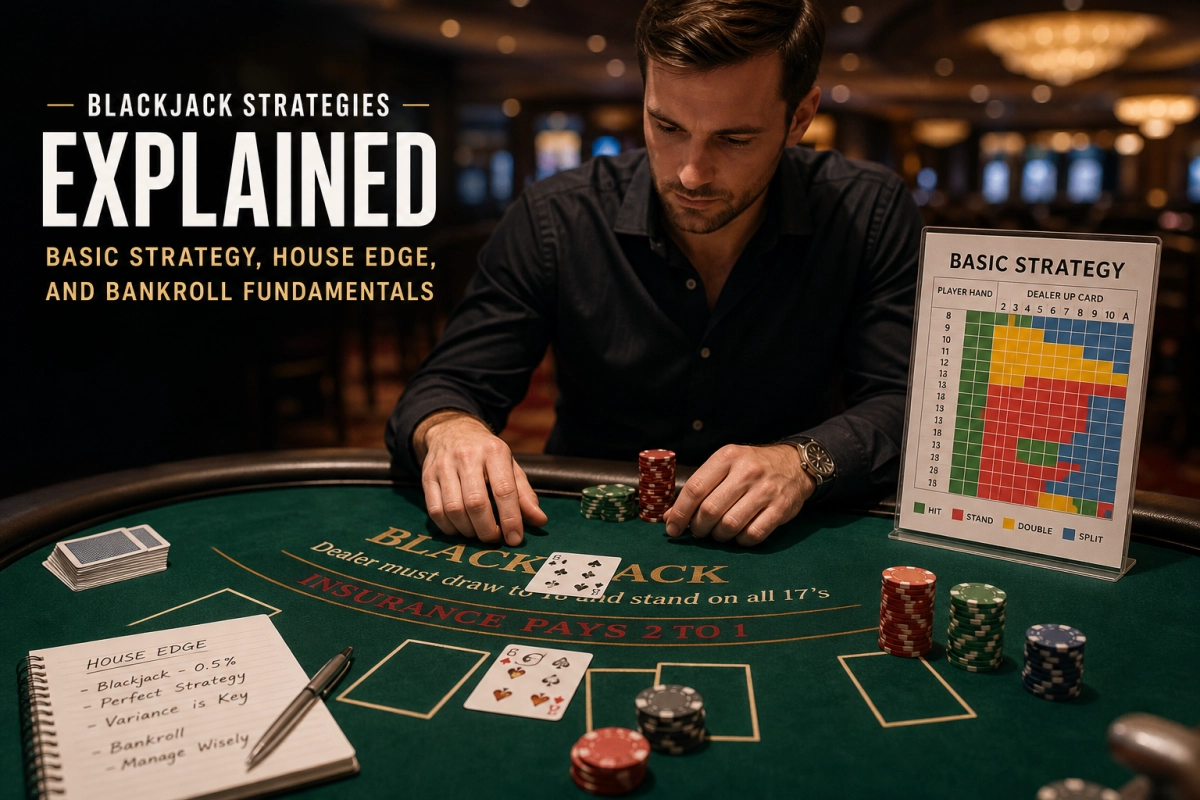
Basic strategy is typically presented as a grid — one axis shows the player’s hand total or pair type, the other shows the dealer’s upcard. Most players start by memorizing the clearest, highest-frequency scenarios:
- Always split aces and eights, regardless of the dealer’s upcard.
- Never split tens — a combined total of 20 is already a strong hand.
- Double down on 11 when the dealer shows anything lower than an ace.
- Stand on hard 17 and above in virtually all situations.
- Hit soft hands more aggressively, since the ace provides a safety buffer against busting.
Building familiarity with these core decisions first — before moving on to soft doubles or multi-deck adjustments — is far more practical than attempting to memorize an entire chart at once. Understanding why each decision is recommended separates a player who follows strategy mechanically from one who genuinely understands the game.
Common Mistakes That Cost Beginners More Than They Realize
Most new players lose more than the mathematics of the game actually demands. The gap between the theoretical house edge and what a typical beginner experiences is largely explained by a handful of recurring errors that feel reasonable in the moment but quietly compound into significant losses.
The most damaging is playing by feel rather than by strategy. Blackjack generates a powerful emotional pull. A player who has busted twice in a row will often stand on a hand they should hit, reasoning instinctively that drawing another card is the problem. This pattern-seeking is natural but counterproductive. Each hand is statistically independent — the deck has no memory of what just happened, and the correct play on a hard 14 against a dealer’s 7 is the same regardless of previous outcomes.
Misreading the Dealer’s Upcard
A subtler but equally costly mistake is failing to treat the dealer’s exposed card as the primary piece of information it is. Beginners frequently make decisions based on their own hand total in isolation — standing on 15 because it feels close to 21 — without adequately accounting for what the dealer is showing. Against a dealer’s 6, the strategic calculus shifts considerably because the dealer carries a strong probability of busting. Against a dealer’s 9 or 10, the same hand of 15 demands a different response entirely.
The dealer’s upcard is not background information. It is the central variable around which decisions are built. Beginners who internalize this will find that much of the basic strategy chart begins to make intuitive sense rather than feeling like an arbitrary list of rules.
Insurance Bets and Other Traps
Casinos offer several side options that seem appealing but carry a higher house edge than the base game. Insurance — offered when the dealer shows an ace — is the most common example. It pays 2:1 if the dealer has blackjack, which sounds reasonable until you examine the probability. The deck contains far more non-ten cards than tens, making insurance a poor choice for nearly every player not tracking cards.
Similar logic applies to even-money offers and side bets at some tables. They introduce a visual appeal — defined payouts, a sense of hedging risk — that distracts from the fact that the base game, played well, already offers the best odds available. Beginners who chase side bets while also making suboptimal main-hand decisions effectively multiply the cost of each session.
Bankroll Management as a Strategic Tool, Not an Afterthought
Bankroll management belongs in any honest introduction to blackjack strategy. Even perfect basic strategy cannot eliminate variance — losing streaks happen to every player regardless of how correctly they play. Without a sensible approach to managing funds, a temporary downswing can end a session far earlier than necessary.
The most practical starting point is the concept of session limits. Deciding before sitting down how much you are willing to lose — and treating that figure as a hard ceiling rather than a rough guideline — removes the most dangerous in-session decision from the equation. Losses trigger psychological pressure to chase and bet more aggressively. A pre-set session limit sidesteps that pressure entirely.
Sizing Bets Relative to Your Bankroll
Bet sizing is where many beginners create unnecessary fragility. A broadly sound principle is to keep individual bets in the range of one to two percent of the total session bankroll. This approach does not guarantee profit, but it ensures that variance has room to even out rather than wiping out a player before basic strategy has time to work across a sufficient sample of hands.
Blackjack is a game measured over sessions and thousands of hands, not individual rounds. Bankroll management and basic strategy work together toward the same end: keeping the player in the game long enough for the mathematics to assert themselves.
Playing with Clarity Rather Than Hope
Blackjack is not a game that rewards optimism on its own. It rewards preparation — the kind that happens before a single card is dealt. A player who arrives having internalized basic strategy, who understands why the dealer’s upcard is the axis around which every decision turns, and who has already decided how much they are willing to risk, is playing a fundamentally different game from the one most beginners experience.
That difference rarely shows up in a single hand or session. Variance will still produce frustrating runs, and no strategy eliminates the house edge entirely. What basic strategy does is ensure that every decision made under uncertainty is the most defensible one available — that losses, when they come, reflect the natural distribution of outcomes rather than avoidable errors in judgment.
The players who find genuine enjoyment in blackjack over the long run are not chasing dramatic swings or relying on instinct to override the numbers. They are the ones who have learned to find satisfaction in the discipline of the game itself — in making the right call on a difficult hand, in recognizing a favorable table setup, in understanding exactly what the mathematics are doing on their behalf with each correct decision. That foundation, once built, is what separates a player who simply participates from one who genuinely competes.