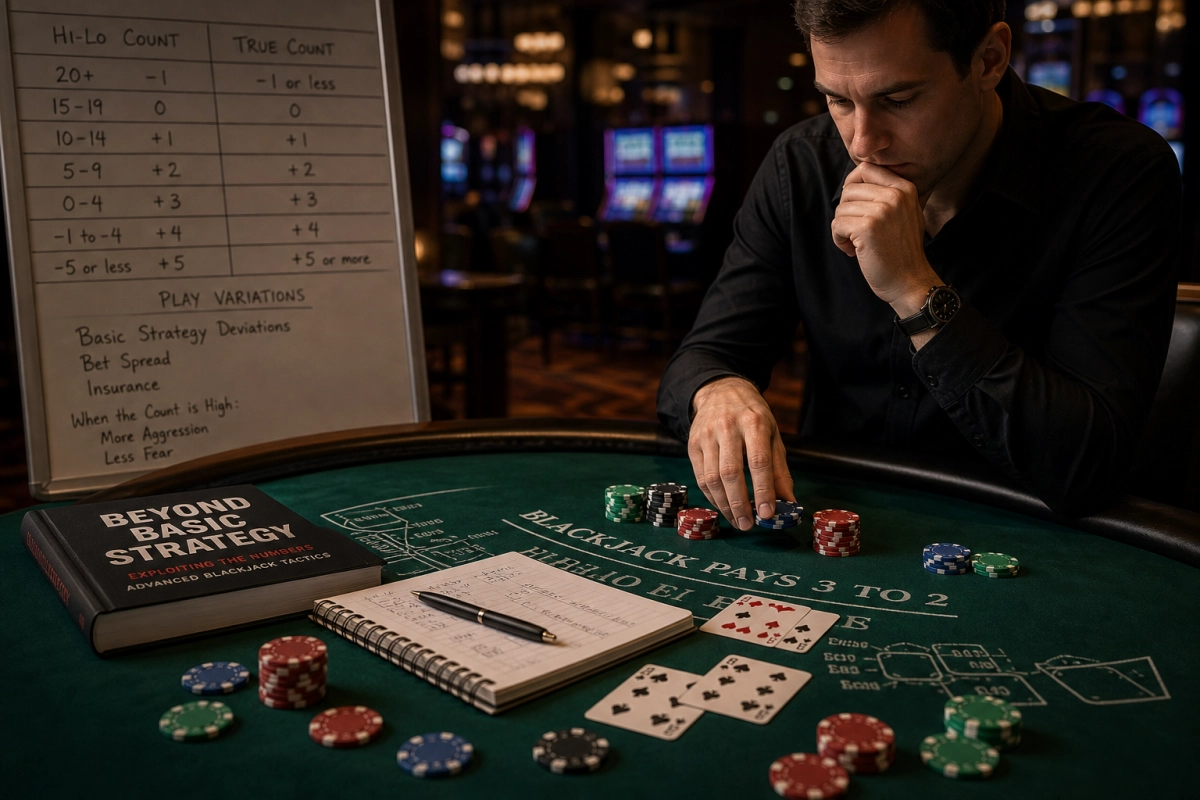
Why Basic Strategy Is Just the Starting Point
Most blackjack players reach a comfortable plateau once they have memorized basic strategy. They know when to hit a hard 16 against a dealer’s 10, when to double an 11, and when to stand on soft 18. That foundation is genuinely valuable — it reduces the house edge to well under one percent in favorable rule conditions. But basic strategy is a generalized framework, giving the statistically optimal decision averaged across every possible card combination behind a given hand total. Advanced blackjack strategies go further by accounting for information that basic strategy deliberately ignores.
A hand total of 16 against a dealer’s 10 looks the same on a basic strategy chart whether it is made up of a 10 and a 6, a 9 and a 7, or a 5, 4, and 7. The chart treats all three identically. But the actual composition of those cards changes the statistical landscape in measurable ways, particularly in single-deck and double-deck games where removing specific cards from a small shoe has a proportionally larger effect on the remaining distribution.
The adjustments involved are not dramatic, and none eliminate the house edge entirely. What they do is refine decision-making so that, over a large volume of hands, the cumulative cost of suboptimal choices is reduced.
Composition-Dependent Decisions and Their Practical Value
Composition-dependent strategy means adjusting a playing decision based on the specific cards that make up a hand, rather than relying solely on the total. Most of these adjustments are meaningful only in one- or two-deck games, because the influence of any individual card diminishes sharply as deck count increases. In a six-deck shoe game, the difference between a 10-6 and a 9-7 is statistically negligible. In a single-deck game, it is not.
The 16 vs. 10 Adjustment in Single-Deck Play
When a player holds a 10-6 against a dealer’s 10 upcard in a single-deck game, the correct composition-dependent play is to stand rather than hit, contrary to basic strategy. With one 10-value card already in the player’s hand and another on the dealer’s board, fewer busting cards remain in the deck — shifting the math just enough to make standing the lower-cost option. This adjustment does not apply in multi-deck games, and it does not turn a losing situation into a profitable one. The goal is to lose slightly less over time.
Other Hand Compositions Worth Knowing
- Hard 12 vs. dealer 4: Basic strategy says to stand, but a 12 made of two 6s in a single-deck game carries a slight preference for hitting, as removing both 6s reduces bust probability.
- Hard 15 vs. dealer 10: Surrender is standard where available, but when it is not offered, the specific composition of the 15 affects whether hitting or standing carries the lower expected loss.
- Soft totals near the hit/stand boundary: Compositions involving an ace interact differently with remaining deck distributions, which becomes relevant when evaluating borderline soft hand decisions in low-deck games.
Understanding these cases builds an important habit: treating each hand as a product of its actual cards, not just a number — a mindset that becomes even more consequential when evaluating soft hands.
Soft Hand Strategy Beyond the Basics
Soft hands generate more misplayed decisions than almost any other category. The presence of an ace creates flexibility — the hand cannot be busted by a single card — yet many players treat soft totals as though that flexibility were a liability. The result is chronic under-doubling and unnecessary standing that quietly inflates the effective house edge hand after hand.
Soft Doubling Thresholds and Dealer Upcard Sensitivity
The correct doubling range on soft hands is significantly wider than intuition suggests. Soft 13 through soft 18 all carry doubling opportunities against specific dealer upcards, with exact thresholds shifting based on deck count and whether the dealer hits or stands on soft 17. A dealer who hits soft 17 (H17) counterintuitively makes certain aggressive player actions more valuable because the dealer’s bust probability distribution changes at the margins.
Soft 18 is where experienced players most commonly leave money behind. Standing on soft 18 against a dealer’s 9, 10, or ace is a losing play in the long run. Against those upcards, the dealer’s likely finishing distribution makes 18 a losing total often enough that hitting is the mathematically superior choice — yet it feels intuitively safe because 18 reads as a strong hand.
When the Ace Changes Composition Dynamics
In low-deck games, soft hand composition interactions are worth tracking. A soft 17 made of ace-6 interacts with the remaining deck differently than a soft 17 reached through a multi-card sequence like ace-4-2. In the latter case, the removal of smaller cards shifts the remaining distribution toward higher values, affecting whether hitting or doubling carries the better expected outcome.
Pair Splitting Edge Cases That Most Players Mishandle
Splitting pairs is one of the highest-leverage decisions in blackjack, converting one hand into two at a moment when the player has structural information about the dealer’s vulnerability. Used correctly, it is a significant profit-generating tool. Used carelessly, it represents one of the clearest gaps between basic-strategy and advanced-level play.
The Counterintuitive Cases
- Nines vs. dealer 7: Standing is correct because 18 beats the dealer’s most likely outcome of 17. But nines against a dealer’s 8, 9, or ace require splitting — a distinction that trips up players who apply a blanket standing rule to all strong totals.
- Fours vs. dealer 5 or 6: In games allowing doubling after splitting, splitting fours against a dealer’s 5 or 6 is correct because each resulting hand becomes a strong doubling candidate. Without that rule, fours should not be split.
- Sixes in pitch games: Single and double-deck games extend the splitting range for sixes. Against a dealer’s 2 in single-deck play, splitting sixes is correct where it would not be in a six-deck game.
Many pair splitting refinements hinge on whether the table allows doubling after splitting, re-splitting aces, or late surrender. Mapping your decisions to the precise rule set in front of you — rather than a generic chart — is one of the clearest markers of advanced play.
Side Bet Evaluation and Why Most Are Not Worth Your Money
Most side bets carry house edges between five and fifteen percent. For a player who has reduced the main game edge to under half a percent, voluntarily placing a side bet is a meaningful step backward. The most common options — Insurance, Perfect Pairs, and 21+3 — are not all equivalent in their cost or exploitability.
Insurance is the most strategically interesting case. As a standalone side bet without counting context, it carries a house edge of approximately 7.5 percent in a single-deck game and worsens as decks increase. Basic strategy is unambiguous: never take Insurance. However, Insurance becomes mathematically correct when the count is sufficiently positive and the ratio of 10-value cards remaining crosses a specific threshold. For card counters, it is a weapon. For everyone else, it is a recurring drain.
Perfect Pairs and 21+3 offer no such redemption. No count-based adjustment renders them positive expectation plays under standard casino conditions. Every dollar wagered on a fifteen-percent edge side bet requires multiple perfectly played main-game hands to recover.
Bankroll Variance and the Mathematics of Staying in the Game
Even a player executing every advanced decision correctly will experience extended losing sessions. That is not a failure of strategy — it is the arithmetic reality of a game with inherent variance. The most sophisticated playing decisions are worthless if a player runs out of money before the long-run probabilities have time to express themselves.
Serious bankroll management centers on risk of ruin — the probability of losing an entire bankroll before reaching a profit goal. It is highly sensitive to bet sizing relative to bankroll depth. A player betting one percent of their bankroll per hand faces dramatically lower ruin risk than one betting five percent, even making identical strategic decisions. As a working rule, a flat-betting recreational player should carry at least 200 to 300 times their standard bet as a session bankroll.
Session Discipline as a Strategic Variable
A hard session stop-loss — a predetermined point at which a player leaves the table regardless of circumstances — prevents emotionally driven bet escalation from converting a manageable losing session into a damaging one. Leaving the table does not change the mathematical odds of the next hand. But humans under financial stress do not execute advanced strategy cleanly. The discipline to walk away is, in practice, a strategic asset.
Playing at the Level the Game Actually Rewards
Advanced blackjack strategy is a coherent framework built on one underlying discipline: making the decision that is correct for the specific hand, the specific rules, and the specific deck conditions in front of you. Composition-dependent adjustments, precise soft hand play, rule-sensitive pair splitting, sober side bet evaluation, and rigorous bankroll management are all expressions of that same discipline applied to different moments in the game.
None of these refinements guarantee winning sessions. What they do is compress the gap between your results and the theoretical best possible outcomes over time — and in a game measured in thousands of hands, that compression is where the real value lives.
Players who reach this level find that the game changes in character. It becomes less about chasing outcomes and more about executing decisions. The score is kept not hand by hand, but across the full arc of a serious player’s relationship with the game. That shift in perspective — from results to process — is, ultimately, what distinguishes advanced blackjack play from every other level beneath it.