Why Basic Strategy Is Only the Beginning
Most players who take blackjack seriously eventually reach the same turning point. They have memorized basic strategy, they understand why standing on 17 matters, and they no longer make the obvious mistakes that drain a bankroll early. Yet something still feels incomplete. Basic strategy reduces the house edge to roughly 0.5% under favorable rules, but it treats every hand in isolation, assuming the remaining deck is always in its original shuffled state. That assumption is never actually true.
Advanced blackjack strategies build on basic strategy by accounting for information it deliberately ignores: which cards have already been played, how the remaining shoe composition shifts probabilities, and when the mathematically correct decision changes as a result. These techniques do not eliminate the house edge or guarantee income. What they can do, when applied with precision and discipline, is narrow that edge considerably and, under specific conditions, shift it slightly in the player’s favor.
This guide is written for experienced players ready to move beyond the basics. It covers how card counting works in practice, what composition-dependent strategy means, how index deviations adjust decisions based on the count, and what effect each layer of technique has on the overall house edge.
How Card Counting Works in Practice
Card counting is frequently misrepresented as something close to photographic memory. The reality is more methodical. At its core, counting tracks the ratio of high cards to low cards remaining in the shoe. A shoe rich in tens and aces favors the player; one depleted of them favors the dealer.
The Running Count and the True Count
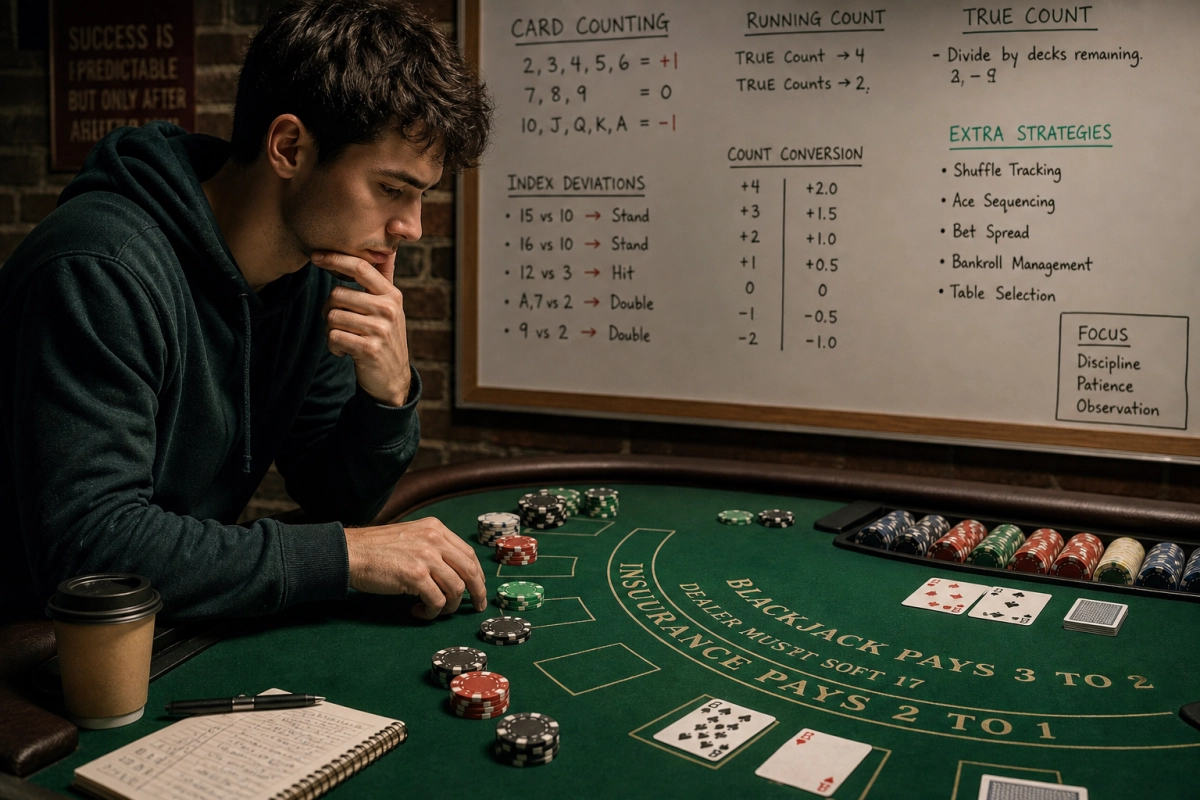
The most widely studied system is Hi-Lo, which assigns +1 to low cards (2 through 6), 0 to neutral cards (7 through 9), and -1 to high cards (10 through ace). As each card is dealt, the player adjusts a running total called the running count. A positive count indicates the remaining deck is relatively rich in high cards.
However, a running count alone is insufficient. A running count of +10 means something very different with five decks remaining than with one. To correct for this, players divide the running count by the estimated number of decks left in the shoe, producing the true count — a standardized, deck-adjusted measure of current advantage. Most betting and playing adjustments in advanced strategy are tied to this figure rather than the raw running total.
Bet Spreading and Its Practical Limitations
The most direct application of the true count is adjusting bet size. When it rises, the player increases their wager; when it falls or turns negative, they return to the table minimum. This practice, known as bet spreading, is the primary mechanism through which counters extract value over time. The mathematics are real, but outcomes in any single session are not predictable. Variance is substantial, and even a player with a genuine long-run edge can experience significant losses over hundreds of hands.
Casinos are also well aware of bet spreading patterns and train staff to identify players who systematically increase wagers as the shoe progresses — a practical challenge that goes well beyond the arithmetic itself.
Composition-Dependent Strategy and Why Hand Details Matter
Basic strategy is built on total-dependent decisions: the player’s only inputs are the hand total and the dealer’s upcard. A hard 16 against a dealer’s 10 is treated identically whether it is composed of a 10 and a 6, a 9 and a 7, or three smaller cards. For most situations this simplification costs very little. For certain critical hands, however, the specific cards composing the total shift the probabilities enough that a different decision becomes mathematically correct.
The most documented example involves a hard 16 made up of three or more cards against a dealer’s 10. Because several small cards have already been removed to construct that 16, the remaining deck is marginally richer in high cards. That shift makes standing slightly more favorable than the total-dependent chart suggests. The difference in expected value is modest, but for a player operating at the margins, small adjustments accumulate over thousands of hands.
When Composition Adjustments Apply Most Meaningfully
Not every hand benefits from this analysis. Composition-dependent decisions produce a measurable edge only in hands sitting close to the strategy boundary — where the expected values of two competing actions are nearly identical and therefore sensitive to small changes in deck composition.
- Hard 16 composed of three or more cards against a dealer 10, where standing becomes more defensible than total-dependent strategy suggests.
- Hard 12 against a dealer 4, where the specific makeup of the 12 slightly affects the standing versus hitting calculation.
- Hard 15 against a dealer 10, where multi-card totals again shift the borderline decision in a measurable direction.
Players who already count cards often absorb these adjustments as a natural extension of their existing framework. For those who do not count, memorizing these edge cases without the supporting context of a running count yields only marginal improvement and risks overcomplicating decisions at the table.
Index Deviations: Adjusting Decisions Based on the True Count
Index deviations represent the most analytically rigorous layer of advanced blackjack play. Where basic strategy assumes a neutral deck and composition-dependent strategy accounts for specific hand makeup, index deviations use the true count as a direct trigger for departing from the default decision chart. Each deviation is associated with an index number — a true count threshold at which the mathematically correct decision changes.
The most important of these is what the counting community calls the Illustrious 18. Research consistently shows that a relatively small set of high-priority departures from basic strategy accounts for the substantial majority of edge gained through index play. Learning the most impactful deviations is both manageable and efficient.
How Index Numbers Function at the Table
Consider the insurance side bet, which basic strategy instructs players to refuse under all circumstances. At a true count of roughly +3 or higher, the proportion of ten-value cards remaining makes insurance a positive expected value wager. A player following index deviations takes insurance at that threshold and declines it at every other point. The same logic extends to playing decisions: standing on hard 16 against a dealer 10 becomes correct at a sufficiently positive true count, while hitting remains correct when the count is neutral or negative.
Executing index deviations requires a player to simultaneously maintain an accurate true count, recall the relevant index number for their current hand, and make the adjusted decision without breaking rhythm. Players who attempt index play before their count is fully automatic tend to find that counting errors cost more than the deviations return. The sequencing of skill development matters as much as the content of the skills.
Quantifying the Effect on House Edge
The cumulative impact depends heavily on game conditions — number of decks, penetration depth, and ruleset. Under favorable conditions, a disciplined counter using accurate true count calculations and a solid set of index deviations can shift the long-run expectation from slightly negative to slightly positive, often in the range of 0.5% to 1% in the player’s favor. That figure represents the difference between a game that slowly drains resources and one that, given sufficient volume and bankroll, carries a genuine mathematical edge.
Putting the Techniques Together: Discipline as the Final Variable
Card counting, composition-dependent decisions, and index deviations form a coherent system. Their value compounds when practiced together consistently. A player who counts accurately but abandons index deviations under pressure, or who memorizes boundary-hand adjustments without a supporting true count, captures only a fraction of the available edge.
What separates players who genuinely benefit from these techniques from those who study them without results is almost always discipline rather than intelligence. The difficulty lies in executing correctly, hand after hand, across sessions involving both winning and losing runs that feel disconnected from the underlying probabilities. Maintaining count accuracy and decision integrity during a difficult session is where most players falter.
Bankroll management reinforces this point. An edge of 0.5% to 1% is meaningful over tens of thousands of hands but provides no protection against ruin if bet sizing is poorly calibrated. The Kelly Criterion and its fractional variants offer a mathematically grounded approach to sizing wagers in proportion to both edge and bankroll, and serious practitioners study it as carefully as they study index numbers.
Game selection also carries significant weight. Penetration depth — how far through the shoe the dealer deals before reshuffling — directly determines how often the true count reaches thresholds where deviations and bet spreading become meaningful. A six-deck shoe with 75% penetration offers considerably more opportunity than the same game cut at 50%. Rules allowing doubling after splitting, late surrender, or re-splitting aces reduce the house edge before a single card is counted, creating a more favorable base from which advanced techniques operate.
The Edge Belongs to Those Who Earn It Through Precision
Blackjack remains the casino game most susceptible to informed, skillful play. The structure — sequential decisions, exposed dealer cards, a finite and trackable deck — creates genuine room for a prepared player to narrow and occasionally overcome the house’s mathematical advantage. That room is not large and does not forgive careless execution. But it exists, which is more than can be said of almost any other game on the casino floor.
The techniques covered here represent a progression rather than a checklist. Basic strategy is the prerequisite. A reliable counting system, practiced until it requires no conscious effort, is the next step. Composition-dependent adjustments and index deviations follow once the counting foundation is solid. Each layer adds complexity, demands more in terms of focus and preparation, and returns a measurable if incremental improvement to long-run expectation.
What advanced blackjack strategy ultimately offers is not a shortcut or a guaranteed outcome. It offers something more valuable: a framework for making the best possible decision with the information available at every point in a session. For players drawn to games where preparation genuinely matters, that is precisely the appeal — and precisely why the study never quite feels finished.