Why balancing bluffs and value bets matters for your long-term results
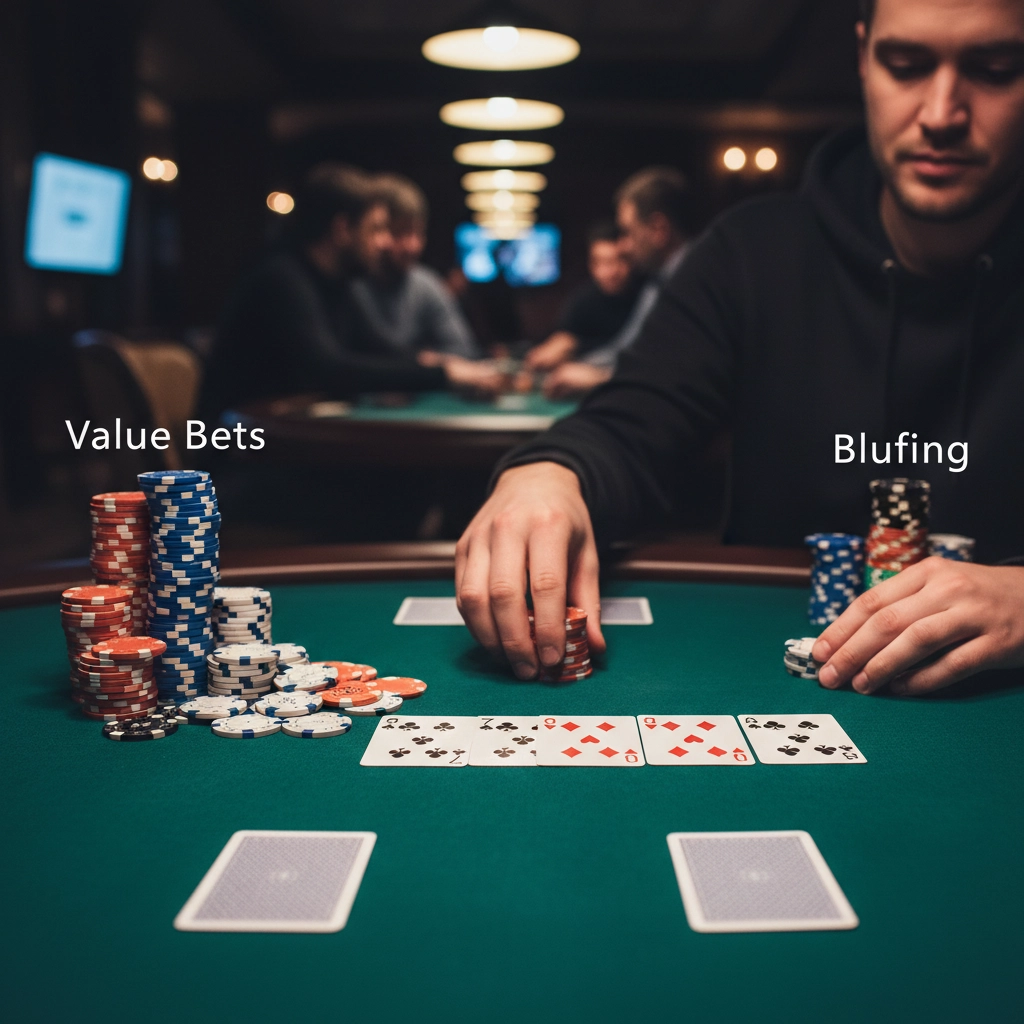
When you play poker, simply trying to win every hand by strength or bluffing indiscriminately will cost you chips. You need a balanced approach: a mix of value bets (hands you expect to be best) and bluffs (hands you expect opponents to fold). Balance keeps opponents from exploiting you — if your betting range contains both believable value and credible bluffs, they can’t profitably call or fold against you every time.
Balance is not about being random; it’s about constructing ranges that make your actions ambiguous. You want opponents to face difficult decisions — calling loses them chips when you have value, folding loses them chips to well-timed bluffs. Understanding this trade-off is the first step toward a strategy that converts correct plays into consistent profit.
Core principles: range construction, board texture, and bluff frequency
Constructing a balanced betting range rests on three interdependent principles:
- Range construction: Think in terms of hands, not individual cards. When you bet, consider which hands in your preflop and postflop range can reasonably make the same bet. That creates plausible bluffs mixed with your value bets.
- Board texture: Wet, coordinated boards (lots of straights/flushes possible) offer better bluffing cover because many hands miss and can represent strong draws. Dry boards favor value betting because there are fewer believable bluffs.
- Bluff frequency: Your bluff-to-value ratio should be informed by pot odds and opponent tendencies. A simple rule is to bluff often enough that calling is not automatically correct for your opponent, but not so often that skilled players can exploit you by calling down light.
Practical example: on a three-bet pot against a tight player on a wet turn, include more semi-bluffs (hands with equity like open-ended straight draws) than pure bluffs. On a dry board against a calling station, reduce your bluff frequency and lean on value betting.
Selecting effective bluffs and strong value bets
Choose bluffs that contain blockers to your opponent’s strong hands (e.g., holding the ace when representing an ace-high nut) and semi-bluffs with live equity so you have a backup plan if called. For value bets, pick hands that are likely ahead of your opponent’s calling range and size your bets to extract maximum value while keeping weaker hands in play.
- Prefer bluffs with blockers or backdoor equity.
- Prefer value bets when you beat the likely calling range by a meaningful margin.
- Adjust frequencies based on position, stack depth, and opponent type.
With these fundamentals clear, you’re ready to translate them into specific bluff-to-value ratios, bet sizes, and adjustments by opponent profile in the next section.
Turning pot odds into concrete bluff-to-value ratios and bet sizes
One of the most practical tools for balancing your ranges is converting pot odds into target bluff frequencies. A simple and reliable rule: when you size a bet, the fraction of bluffs in your betting range should roughly equal bet / (pot + bet). This is the same expression used to compute the minimum defense frequency (MDF) for the opponent — the proportion of the time they must call to prevent you from profitably bluffing every missed hand.
Examples make this clearer:
- Half-pot bet (B = 0.5P): B/(P+B) = 0.5 / 1.5 = ~33%. Your betting range should contain roughly one bluff for every two value bets (about 33% bluffs).
- Quarter-pot bet (B = 0.25P): 0.25 / 1.25 = 20% bluffs. Small bets should typically be more value-heavy.
- Full-pot bet (B = 1.0P): 1 / 2 = 50% bluffs. Large bets must be much more polarized — many bluffs mixed with strong value hands.
How to apply this practically:
- Decide your bet size based on the story you want to tell. If you want to appear polarized (either very strong or air), use larger sizes and include more bluffs to meet the ratio.
- If you want to appear range-merged (many hands that can be strong or medium), use smaller sizes and include fewer bluffs — these sizes help extract value from weaker calls.
- When planning a line across streets, remember the cumulative effect: a bluff on the turn that requires another bluff on the river should be considered in pair — semi-bluffs on earlier streets reduce the need for pure river bluffs.
Use these numbers as guides, not absolutes. Board texture, opponent tendencies, and available blockers will push you away from perfect arithmetic — but if you consistently ignore the math, good opponents will exploit you.
Adjusting balance by opponent type, position, and stack depth
Balanced strategy must be dynamic. Theoretical ratios assume an unexploitable opponent; real opponents force deviations. Below are practical adjustment rules:
- Against calling stations (calls wide): Reduce bluffing frequency. Lean heavily on value bets and tighten the hands you bluff with (prefer strong blockers or semi-bluffs with equity).
- Against overly tight players: Increase bluff frequency and consider larger sizes on favorable textures. These players fold too often, so polarized lines pay off.
- In position: You can polarize more often since you control the action and can use sizing on the river to apply pressure. Use a mix of small value bets and larger polarized bluffs depending on opponent responses.
- Out of position: Favor merged lines and smaller bets. Bluffing out of position is costlier; prioritize hands with equity and blockers and reduce pure river bluffs.
- Short stacks: With shallow stacks, postflop play simplifies — fewer bluff opportunities and more emphasis on shove/fold decisions. Reduce multi-street bluffs and focus on nut-value and all-in semi-bluffs.
- Deep stacks: Deep pots reward multi-street semi-bluffs with equity. You can incorporate more hands that can realize equity if called (draws, two-pairs/weak made hands).
Finally, always use history to refine adjustments. If an opponent calls your polarized river bets 75% of the time, your theoretical 50% bluff ratio on full-pot rivers needs immediate correction. Balance is a target, not a prison — learn the math, then bend it when facts at the table justify doing so.

Putting balanced bluffing into practice
Balance is best learned at the tables and in targeted practice, not only on paper. Start small: pick one bet size (say half-pot) and focus on meeting the theoretical bluff ratio for that size while tracking how often opponents call you. Use hand history review to check whether your bluffs contained useful blockers or equity and whether your value bets are extracting correctly. Over time, add more bet sizes and board textures to your practice repertoire, and use tools and solvers selectively to test specific lines rather than trying to memorize complex charts.
Set measurable goals (e.g., “I will include ~33% bluffs in my half-pot continuation bets on wet boards”) and review sessions weekly. When you spot consistent leaks—bluffing too much vs. calling stations or too little vs. tight opponents—adjust immediately. For drills and deeper study, consult reliable training resources and range-analysis tools to accelerate learning; for example, see Upswing Poker for structured lessons and practice exercises.
Frequently Asked Questions
How often should I bluff with a given bet size?
Use the simple formula bluff frequency = bet / (pot + bet) as a starting point. For a half-pot bet that works out to roughly 33% bluffs; for a quarter-pot bet ~20%; for a full-pot bet ~50%. Then adjust based on board texture, blockers, and opponent tendencies.
What makes a good bluff hand versus a pure value hand?
Good bluffs typically contain one or more blockers to opponents’ strong hands (like an ace when representing top pair) or have backup equity (draws or backdoor outs). Value hands are those that beat the opponent’s likely calling range and can be sized to extract maximum value while keeping worse hands in to call.
How should I change my bluffing strategy against different opponent types?
Against calling stations, reduce bluff frequency and favor value bets and bluffs with strong blockers or equity. Versus very tight players, increase bluff frequency and consider larger, polarized sizes. In position you can polarize more; out of position, favor merged lines and semi-bluffs with equity. Always adapt quickly if an opponent’s actual behavior deviates from your read.