How Blackjack Gives the Casino a Mathematical Advantage
When you sit down at a blackjack table, you’re playing a game that looks simple—beat the dealer’s hand without busting. Underneath that simplicity, the casino has built-in advantages that produce a predictable, long-term profit called the house edge. The house edge is the percentage of each bet the casino expects to keep on average over many hands. For example, a 0.5% house edge means you will lose about $0.50 for every $100 wagered in the long run.
Understanding the house edge helps you set realistic expectations: short-term results can swing widely, but over time the edge determines who comes out ahead. In blackjack, unlike many casino games, your decisions—hit, stand, double, split, or surrender—affect your own expected return, which is why strategy matters. Before you try to reduce the edge, you need to know what creates it.
Core Factors That Determine the Blackjack House Edge
The house edge in blackjack isn’t a single mysterious number; it’s the sum of several rule and decision-driven components. Knowing these components lets you compare tables and spot opportunities to lower the casino advantage.
Dealer rules and when the dealer acts
- The dealer’s fixed behavior (e.g., standing on all 17s vs hitting soft 17) removes choice from the casino side and shapes the mathematics of the game. A dealer who hits soft 17 generally increases the house edge compared to one who stands.
- Whether the dealer checks for blackjack when showing an ace or ten-value card affects you when you double or split—delayed resolution of bets can change expected losses slightly.
Payout structure and deck composition
- Blackjack payout: A natural blackjack normally pays 3:2. Some casinos pay 6:5 or worse; reduced payouts significantly raise the house edge. The change from 3:2 to 6:5 typically increases the casino’s edge by a sizable margin (often around one percentage point or more, depending on decks).
- Number of decks: More decks generally increase the house edge a bit. Single-deck games can be more favorable to players, but casinos often offset that with other rule changes.
Player options and rule variations
- Doubling: Allowing doubles on any two cards is more favorable to you than restricting doubles (e.g., only on 10–11).
- Splitting: Rules about resplitting aces, and whether you can double after split, affect expected return.
- Surrender: Early or late surrender reduces your losses on certain hands and lowers the house edge if offered.
All of these elements combine mathematically: the probability of each outcome (win, lose, push, blackjack) multiplied by its payout or loss gives the expected value per bet. Using that expected value you convert to a percentage—the house edge—that represents the casino’s advantage.
Next, you’ll see concrete examples and step-by-step calculations showing how to compute the house edge for common rule sets, and which practical strategy and rule choices will reduce it at the table.
Calculating the House Edge: a Step‑by‑Step Example
To make the abstract idea of a house edge concrete, here’s a simple, realistic calculation you can follow. First, you need probabilities for the possible outcomes on a typical hand played with basic strategy under a common rule set (six decks, dealer stands on soft 17, blackjack pays 3:2, doubling allowed on any two cards, no surrender). Reasonable approximations for those outcomes are:
– Natural blackjack: 4.8% (0.048)
– Player wins (non‑blackjack): 42.0% (0.420)
– Player loses: 49.7% (0.497)
– Pushes: 3.5% (0.035)
Expected value (EV) per unit wager is the sum of each outcome’s probability times its payoff. For most wins you receive +1 unit, a loss is −1, a push is 0, and a blackjack pays +1.5 units. So:
EV = (blackjack_prob × 1.5) + (win_prob × 1) − (lose_prob × 1)
Plugging in the numbers:
EV = (0.048 × 1.5) + (0.420 × 1) − (0.497 × 1) = 0.072 + 0.420 − 0.497 = −0.005
An EV of −0.005 means you lose on average 0.5% of each bet — the house edge.
This method is how analysts convert the game’s outcome probabilities into a single percentage that represents the casino’s advantage. If you change any rule or strategy that alters those probabilities or payoffs, you change the EV and thus the house edge.
Small rule changes have predictable, additive effects. For example, swapping a 3:2 blackjack payout for 6:5 reduces the blackjack payoff from 1.5 to 1.2 units. The effect on EV is roughly blackjack_prob × (1.2 − 1.5) = 0.048 × (−0.3) ≈ −0.0144, i.e., the house edge increases by about 1.44 percentage points. That single rule change can turn a player‑favorable tweak into a heavy loss over time.
How Basic Strategy and Table Rules Reduce the Edge
Knowing how the math works points you to practical ways to reduce the edge at the table. These fall into two categories: player decisions (strategy) and table/rule selection.
– Use basic strategy precisely: Basic strategy is the mathematically optimal decision chart for hitting, standing, doubling, and splitting. Using it consistently converts a casual player’s large mistakes into the small, predictable house edge shown above (often around 0.5% on good tables). Deviations from basic strategy increase the edge quickly.
– Choose favorable rule sets: Look for S17 (dealer stands on all 17s), 3:2 blackjack, double after split allowed, resplit aces, and late or early surrender where available. Typical impacts: H17 vs S17 adds roughly 0.1–0.2% to the edge; removing double‑after‑split or restricting doubling adds another ~0.1–0.4%; 6:5 blackjack instead of 3:2 commonly increases the house edge by about 1.3–1.5%.
– Avoid side bets: Side bets carry a much larger house edge than the main game and will erode any short‑term gains from favorable main‑game play.
– Consider game speed and penetration: For advantage play (e.g., card counting), deeper shoe penetration (more cards dealt before reshuffle) and slower tables improve the technique’s effectiveness. For casual players, choose tables where you can play deliberately without pressure.
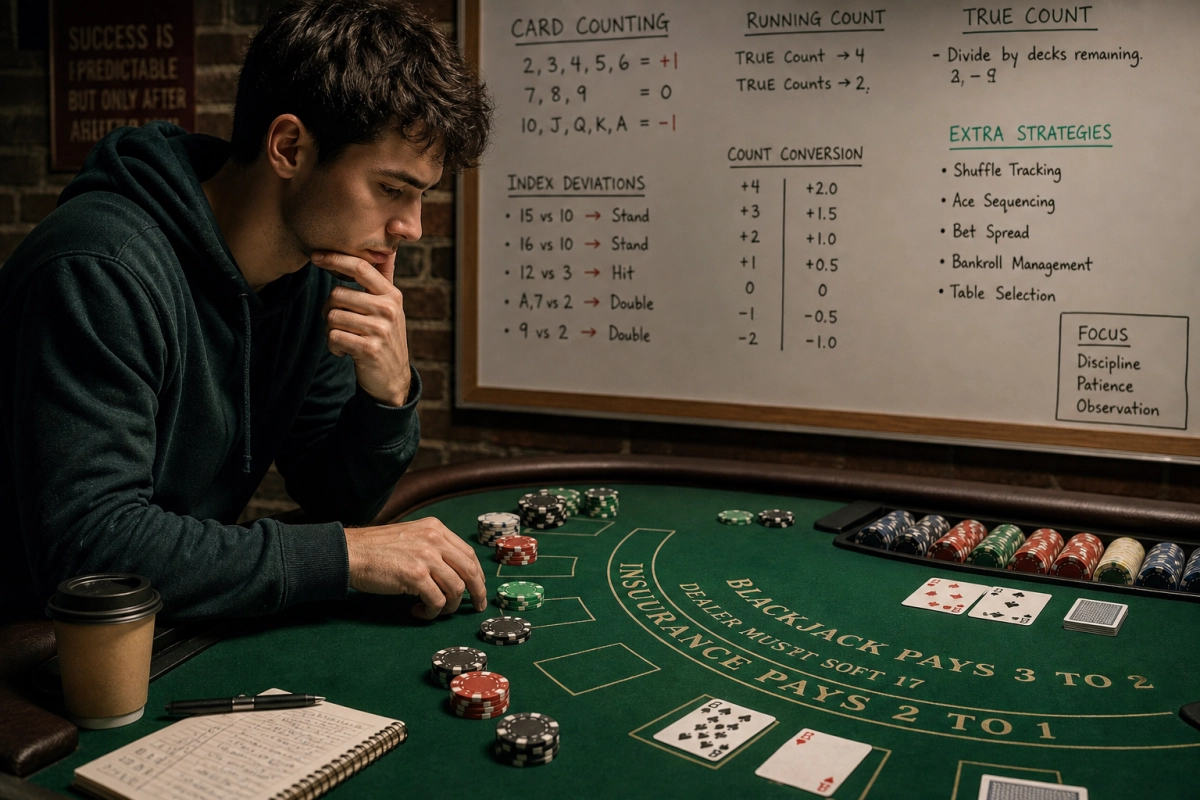
Advanced techniques such as card counting can swing the long‑term advantage back toward the player when executed correctly, but they require skill, bankroll management, and the ability to avoid casino countermeasures. For most players, disciplined basic strategy plus careful rule selection is the most practical path to minimizing the house edge.
Putting the Math Into Practice
Knowing how the house edge is calculated is only useful if you apply that knowledge at the table and in your preparation. Focus on improving decisions, choosing the right tables, and managing your play environment so the small advantages you can create actually matter over time.
Practical next steps
- Memorize and use a basic strategy chart for the exact rule set you’re playing; small strategy errors compound.
- Prefer tables with favorable rules (S17, 3:2 blackjack, DAS, resplitting) and avoid 6:5 blackjack or restrictive doubling rules.
- Skip side bets and sucker promotions—their house edges are usually far larger than the main game.
- Practice bankroll and session management: set loss limits, choose bet sizes that withstand variance, and walk away when you reach your limits.
- Use simulators or apps to see how rule changes affect long‑term results before risking real money. For in‑depth rule comparisons and strategy tools, a reliable resource is Wizard of Odds — Blackjack.
Final guidance
Blackjack rewards disciplined, informed play rather than luck alone. Whether you aim to minimize the house edge for recreational play or to explore advantage techniques, keep learning, practice deliberately, and respect casino rules and responsible‑gaming limits. Small, consistent improvements in strategy and table selection are the most dependable way to tilt outcomes in your favor.