Why basic strategy is the first tool you need at the blackjack table
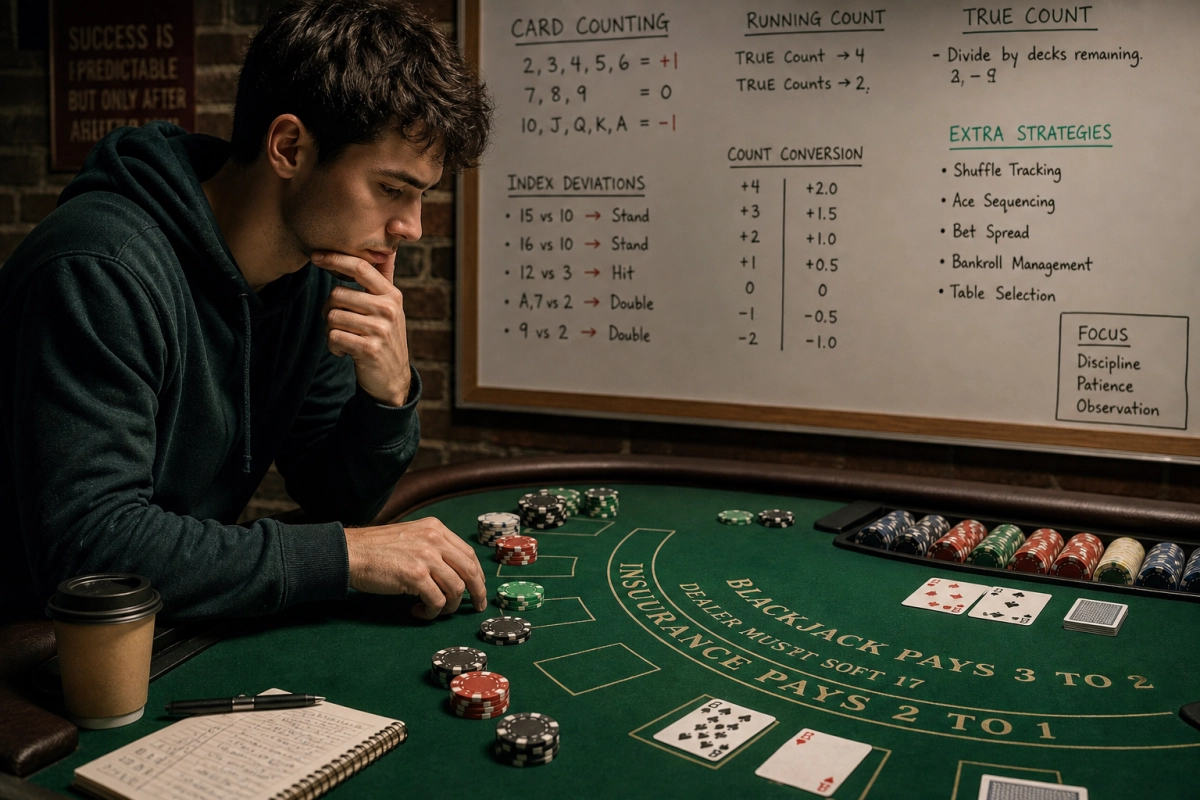
You already know blackjack mixes skill and luck. Basic strategy is where skill begins: a mathematically derived set of plays that minimizes the house edge when you have no additional information (like card counting). Using the chart doesn’t guarantee you’ll win every hand, but it does give you the best long-term decisions for every two-card or multi-card total vs. the dealer’s upcard.
When you follow the chart consistently, you:
- Reduce the house edge from roughly 2%–5% (for casual play) to under 1% in many rule sets.
- Take emotion and guesswork out of decisions—no more “gut” hits on a 16 just because you feel unlucky.
- Learn which hands are profitable to double or split, not just when to hit or stand.
How to read the basic strategy chart: rows, columns and hand types
The strategy chart is a simple grid. Rows usually list your hand totals (hard hands, soft hands, and pairs) and columns list the dealer’s visible upcard (2 through Ace). The intersecting cell tells you the optimal play: hit, stand, double, split, or surrender.
Hard hands, soft hands, and pairs — know the difference
Recognizing which row to use is essential:
- Hard hands — totals without an ace counted as 11 (e.g., 10, 16).
- Soft hands — totals including an ace counted as 11 (e.g., A-6 = soft 17).
- Pairs — two cards of the same rank where you may be able to split (e.g., 8-8).
Charts also use abbreviations: H (Hit), S (Stand), D or Ds (Double if allowed, otherwise Hit or Stand depending on the chart), P (Split), SU (Surrender). If a rule like surrender or doubling after split isn’t available at your table, you must adapt the chart accordingly.
Practical early-play examples and what the chart actually changes
Instead of memorizing dozens of isolated rules, learn small groups that cover most situations. For example:
- If you have a hard 12–16 and the dealer shows 7–Ace, the chart often tells you to hit (or surrender 16 vs. 9–Ace if that option exists).
- With soft hands like A-7, you’ll sometimes double vs. dealer 3–6 and stand vs. 2, 7, or 8; the ace shifts the decision dramatically from a hard 18.
- Always split 8-8 and A-A; never split 10-10. These splits are consistent across nearly all strategy charts.
Using the chart during play takes discipline. Many newcomers default to intuition under pressure—this is where practice matters most. Next, you’ll get a step‑by‑step walkthrough showing how to consult the chart during live play, plus drills to build automatic, error-free decisions at the table.
Step‑by‑step: consulting the chart during live play
When the action is fast and the table is noisy, a calm, repeatable routine keeps you from slipping back into instinctive mistakes. Use this six‑step checklist every time you get dealt cards:
- Lock in the hand type. Is it a hard total, a soft total (contains an ace counted as 11), or a pair? This tells you which row to read on the chart.
- Note the dealer’s upcard. Look at the dealer before you make any decision—this is the chart’s column.
- Find the intersecting cell. Read the recommended play (H, S, D, P, SU). If the chart shows a conditional play (Ds), interpret according to the table’s doubling rules (double if allowed, otherwise hit or stand as indicated).
- Adjust for table rules. Quickly remind yourself whether the table allows surrender, doubling after split (DAS), and whether the dealer hits or stands on soft 17 (H17 vs S17). These rules can change a handful of plays; if you’re unsure, err on the conservative chart variant you memorized for that table type.
- Act decisively. Make the play—double, split, stand, or hit—without hesitation. Confidence avoids drawing attention and keeps your rhythm.
- Mentally note the outcome for practice. After the hand, whether you win or lose, briefly register if the chart play felt right. Over time those mental checkpoints build automaticity.
Keeping this routine consistent makes the chart a reflex rather than a crutch. Don’t try to tweak plays mid‑hand for “reads” on the dealer; basic strategy assumes no additional information, and deviations usually raise the house edge.
Quick rules for common table variations
Not every casino table uses the same rules. You don’t need a new chart for every nuance—just a handful of quick adjustments to your routine:
- Surrender available? If the table offers late surrender, you should surrender 16 vs. dealer 9–Ace and sometimes 15 vs. 10 (check the chart for your deck count). If surrender isn’t offered, play the hit/stand rule for that total.
- Doubling after split (DAS). DAS usually makes splitting small pairs more favorable (2s, 3s, 6s). If DAS is not allowed, be more conservative on certain splits—consult the chart variant you learned for “no DAS” tables.
- Dealer hits soft 17 (H17) vs stands (S17). H17 slightly increases the house edge and nudges some double/stand decisions; when in doubt, follow the H17 variant of the chart if the dealer hits soft 17.
- Number of decks. Single‑deck vs multi‑deck charts differ in a few spots (notably surrender and some doubles). Most players can use the multi‑deck chart as a default, but choose the single‑deck variant at single‑deck tables for optimal play.
Practice drills to make basic strategy automatic
Memorizing the whole chart at once is overwhelming. Use targeted drills to build groups of plays until they’re instinctive.
- Flashcard groups. Create decks for hard totals (12–16), soft hands (A-2 to A-9), and pairs. Drill one group daily until you hit speed goals (for example, answer correctly within 3 seconds for 90% of cards).
- Speed trainer apps. Use blackjack trainer apps that time your responses and simulate random hands. Start with unlimited practice, then add a timer to reduce your response window.
- Dealer simulation. Deal 50 hands to yourself from a deck, making chart decisions aloud. Include splitting and doubling so you practice multi‑action hands under mild pressure.
- Live table practice. Play low‑stakes or free online tables with the chart open until you can play 100 consecutive hands without consulting it more than twice.
Practice 15–30 minutes daily and focus on one group at a time. Within a few weeks you’ll make basic strategy plays automatically — and when you do, the chart becomes a confidence tool rather than a checklist.
Your next steps at the table
Keep practicing the small groups and the six‑step routine until basic strategy becomes second nature. When you’re at the casino, focus on matching the chart variant to the table rules, protecting your bankroll, and making every decision calmly and decisively. Avoid emotional or speculative deviations—unless you have a verified advantage technique like card counting, the chart is your best tool for minimizing the house edge.
Final checklist
- Confirm the table rules (surrender, DAS, dealer hits/stands on soft 17) before you sit down.
- Use the chart variant that matches those rules and drill the relevant hand groups until you respond in under three seconds.
- Practice with apps or flashcards for 15–30 minutes daily; add timed sessions to build speed.
- Start at low stakes or play free tables until you can play confidently without consulting the chart more than twice in 100 hands.
- Manage your bankroll and stick to preset session limits to avoid tilt-driven mistakes.
- If you want more reference material or printable charts, consult expert resources like Wizard of Odds — Blackjack Strategy.
Stay disciplined, keep your routine, and let the chart guide your decisions—over time that consistency is what turns correct plays into better results at the blackjack table.