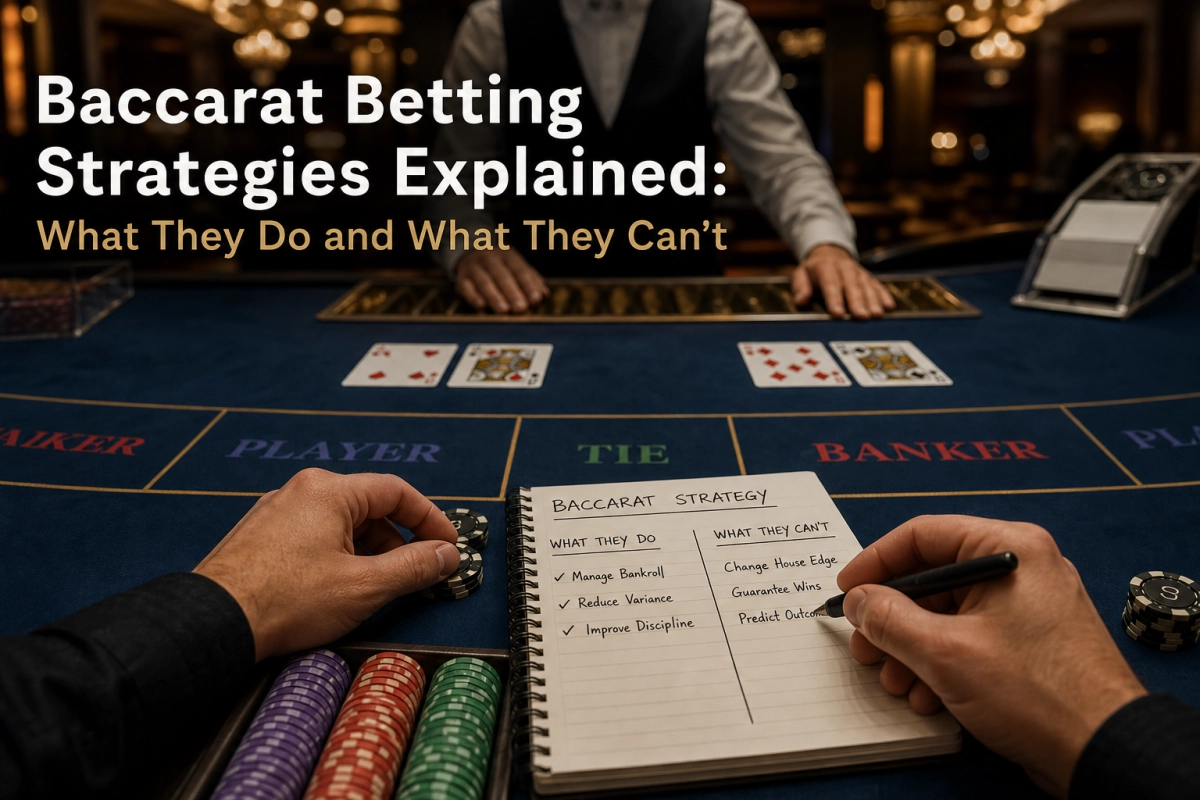
Why Players Turn to Betting Systems in Baccarat
Baccarat has always attracted players who prefer structure over instinct. The game is straightforward by design — three possible bets, fixed drawing rules, and outcomes decided in seconds. Yet that simplicity is precisely what draws players toward betting systems. When there are no complex decisions to make at the table, the betting pattern itself becomes the focus.
Unlike blackjack, where correct play decisions measurably reduce the house edge, baccarat offers no equivalent tactical layer. What players control is how much they bet, when they bet it, and on which outcome. Betting systems attempt to impose a logical framework around those decisions — but none of them alter the underlying odds. The Banker bet carries a house edge of approximately 1.06 percent, the Player bet around 1.24 percent, and the Tie bet holds a significantly higher edge that makes it unattractive for most informed players. These numbers stay fixed regardless of the betting pattern used.
The Fixed Odds Framework Every Strategy Operates Within
Baccarat is a negative expectation game. The house maintains a statistical advantage on every bet, and over enough hands, it always retains that edge. Betting strategies do not eliminate this reality. What they do is redistribute risk across a session — some protecting bankrolls through gradual increases, others chasing quick recovery through escalating stakes.
Key variables every player should understand before choosing a system include:
- Bankroll size — how much is available to withstand a losing run before the session ends or the table limit is reached
- Table limits — minimum and maximum bets, which directly constrain how far any progressive system can extend
- Session length — the number of hands played and the exposure that accumulates over time
- Risk tolerance — whether the goal is steady bankroll protection or a larger short-term gain at greater risk
No combination of these factors produces a guaranteed result. The most honest way to evaluate any baccarat strategy is to examine what it actually does to bet sizing and session dynamics — not what it promises.
Negative Progression Systems: Chasing Losses with Calculated Intent
Negative progression strategies respond to losses by increasing the next bet, operating on the premise that a win will eventually arrive and offset preceding losses. The logic is intuitive. The structural risk, however, is real.
The Martingale System
The Martingale is the most well-known negative progression system. The mechanic is simple: double the bet after every loss, and reset to the original stake after a win. In theory, a single win recovers all prior losses and produces a profit equal to the starting amount.
In practice, the system collides with two hard limits. Table maximums cap how far the progression can extend — six or seven consecutive losses push the required bet beyond what most tables will accept. Bankroll is the second constraint. A player starting at ten units faces a required bet of 640 units after just six losses. The Martingale offers a high probability of small wins in exchange for a low probability of catastrophic loss. Players who understand that trade-off and set strict loss limits can use it within a defined session framework. Those who expect guaranteed recovery are treating it as something it was never designed to be.
The Fibonacci System
A slower form of negative progression, the Fibonacci system follows the famous mathematical sequence to determine bet sizing after losses. Rather than doubling after every loss, the player moves one step forward along the sequence. After a win, they step back two positions. This moderates the rate at which stakes escalate, making extended losing runs more survivable than the Martingale allows.
The drawback is that recovery takes longer. A single win does not wipe the slate clean, and players may need several consecutive wins to return to profit — extending the time spent at elevated stakes. The system suits players more concerned with pacing their exposure than with rapid recovery, and it works best when sessions are kept short and the starting unit is small relative to total bankroll.
Positive Progression Systems: Building on Momentum
Positive progression systems respond to wins rather than losses. Instead of chasing losses, these strategies attempt to capitalize on winning streaks while limiting exposure during losing runs. The appeal is psychological as much as mathematical — the player increases bets with winnings rather than their own reserves, which many find considerably more comfortable.
The Paroli System
The Paroli is the most commonly used positive progression approach at the baccarat table. After a win, the player doubles their bet. After three consecutive wins, the bet resets to the original amount. Losses always return the stake to the starting unit, keeping downside exposure flat while the system targets a three-win sequence.
This structure creates a natural ceiling on ambition. The cost of a losing hand is always one unit. The reward for a completed sequence is seven units of profit from a single-unit starting stake. That asymmetry makes the Paroli genuinely attractive for players who want controlled risk rather than aggressive recovery. The limitation is one the game itself imposes: three consecutive wins are not rare, but they cannot be predicted or manufactured. The system performs well when variance runs in the player’s favor and underperforms during choppy sessions where wins and losses alternate without pattern.
The 1-3-2-6 System
A more structured positive progression variant, the 1-3-2-6 system prescribes specific bet sizes across a four-hand sequence. The player bets one unit on the first hand, three on the second, two on the third, and six on the fourth. If all four win, the cycle resets with a profit of twelve units. A loss at any point restarts the sequence from the beginning.
What distinguishes this system is the deliberate reduction in stake at the third position, which protects accumulated winnings if the sequence breaks late. A player who wins the first two hands and loses the third exits the cycle having lost only two units total. That built-in protection makes the 1-3-2-6 more conservative than straight positive doubling, and its clearly defined structure removes in-session decision-making entirely.
Flat Betting: The Strategy That Refuses to Be a Strategy
Flat betting — placing the same amount on every hand regardless of what came before — is often dismissed as passive. In practice, it deserves more credit. Because it never escalates stakes in response to losses, it cannot produce the compounding exposure that makes negative progression dangerous during extended cold runs. The player’s cost per session is entirely predictable, with no catastrophic sequences and no pressure to continue beyond a comfortable point.
Against the Banker bet, flat betting keeps the house edge at its lowest possible figure across every hand played. No system can improve on that figure. What progressions offer is a different shape to the variance — not a better average outcome. For players whose primary concern is longevity at the table rather than amplified wins, flat betting on the Banker is a legitimate and coherent approach.
Choosing a System That Fits the Game You Actually Play
The most useful question a baccarat player can ask is not which system wins the most, but which system matches how they actually want to experience the game. The mathematical outcome across many sessions will trend toward the house edge regardless of the pattern used. What changes between systems is the distribution of that outcome — how wins and losses cluster, how quickly stakes rise, and how a session feels when variance moves against the player.
A player with a modest bankroll and no appetite for dramatic swings is poorly served by the Martingale, regardless of how appealing its recovery logic sounds. A player comfortable absorbing short-term losses for the chance at a concentrated winning sequence may find the Paroli more engaging. The 1-3-2-6 suits those who want positive progression with built-in discipline. The Fibonacci suits those who want negative progression without the exponential stakes of straight doubling. None is objectively superior — each represents a different answer to the same question: how should risk be distributed across time?
Setting a firm loss limit before a session begins remains the most practical discipline any player can apply, regardless of system. Once that limit is reached, the session ends. This single rule does more to protect a bankroll than any betting sequence ever devised, because it prevents the one outcome every system is ultimately vulnerable to: the extended losing run that erases everything accumulated before it.
What Baccarat Betting Systems Actually Deliver
Baccarat betting systems are not methods for beating the game. What they genuinely offer is something more modest and, in many ways, more valuable: structure. They transform a game of pure chance into an experience with rhythm, decision points, and a defined framework for managing money across a session.
The house edge in baccarat is among the lowest in any casino, and it requires no system to access — simply betting the Banker and avoiding the Tie captures the most favorable position available. Any progression layer added on top changes the session’s texture without changing its mathematical trajectory. Understanding that distinction separates a player who uses a betting system intelligently from one who expects it to deliver something the game’s fixed odds cannot provide.
Used with clear expectations, a defined bankroll, and genuine respect for variance, any of the systems examined here can make for a more deliberate and enjoyable session at the table. That is an honest return on what they promise — and for most players, it is enough.