Why Baccarat Side Bets Deserve a Closer Look
Baccarat is built around three core wagers — Player, Banker, and Tie. The main bets are simple, the house edge on the Banker bet sits at roughly 1.06%, and the pace of play is fast. Yet at most tables today, a row of additional betting options sits alongside the standard layout, each offering higher payouts and considerably higher risk.
These are baccarat side bets, and they occupy a complicated space in the broader conversation around baccarat strategies. For some players, they add variety to a game that can feel repetitive over a long session. For others focused on bankroll management, they represent unnecessary exposure to a house advantage several times larger than the main bets beside them. Understanding the mechanics — payouts, probabilities, and house edge — is essential before placing a single chip.
This breakdown covers the most common baccarat side bets found across physical and online tables: the Pair bet, the Perfect Pair, and the Dragon Bonus. Each has its own payout structure and house edge that deserves clear examination, not promotional language.
The Main Game as a Baseline for Comparison
Before examining any side bet, it helps to establish the main game as a reference point. The Banker bet carries a house edge of approximately 1.06% after the standard 5% commission. The Player bet sits at around 1.24%. Both figures are notably low by casino standards, which is why experienced players tend to stick to these two wagers as the core of their approach.
The Tie bet, by contrast, carries a house edge ranging from 14% to over 14.4% depending on whether it pays 8:1 or 9:1. It serves as a cautionary example of how a single wager on the same table can carry dramatically different risk. The side bets explored here follow a similar pattern — they sit on the same felt as a sub-2% house edge game, yet most carry house edges that begin where the Tie bet leaves off.
That contrast is not a reason to avoid side bets entirely. It is simply the context needed to evaluate them honestly. A bet with a 10% house edge is not inherently wrong to place if the player understands the risk and has budgeted accordingly. The problem arises when players treat these wagers as extensions of the main game’s favorable odds — which they are not.
The Pair Bet: Familiar, Accessible, and Often Misunderstood
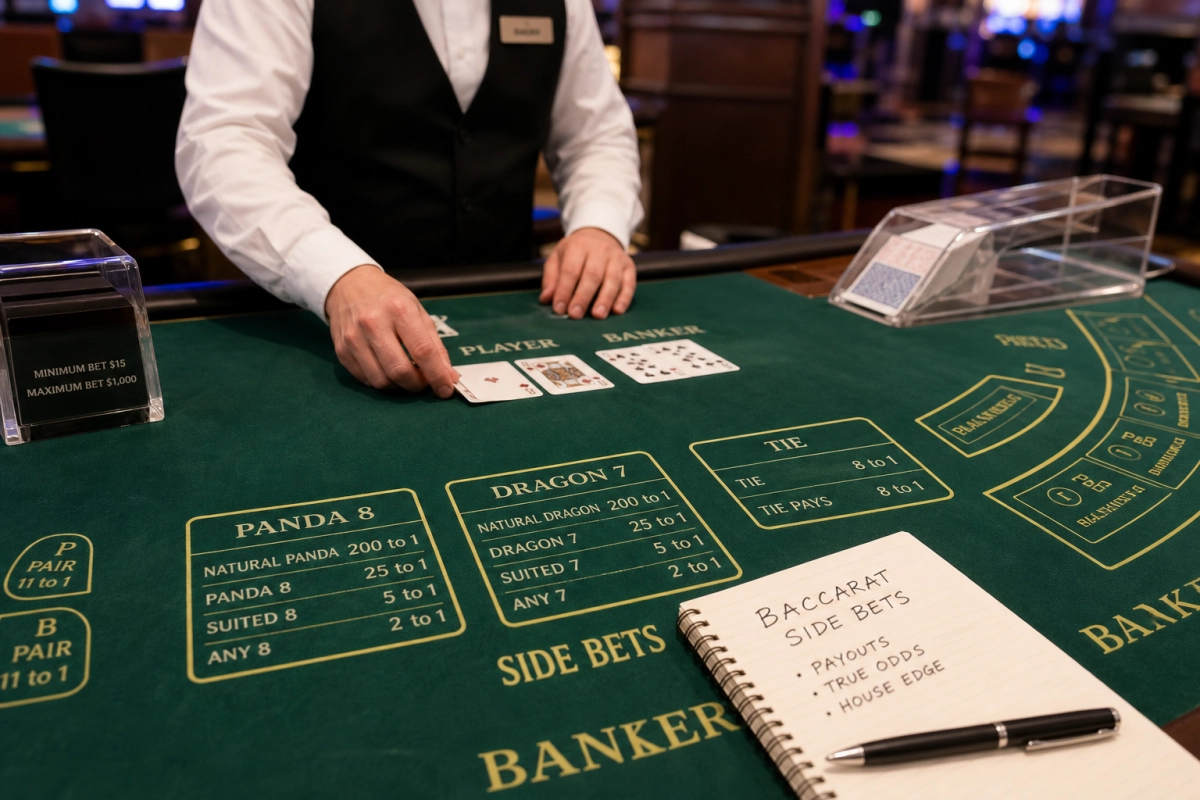
The Pair bet appears on virtually every baccarat layout. Its premise is uncomplicated: you are wagering that the first two cards dealt to either the Player or the Banker will form a pair — two cards of identical rank. A winning Pair bet typically pays 11:1, a figure that looks generous at first glance and is precisely what makes the bet so widely placed without deeper scrutiny.
In a standard eight-deck shoe, the probability of the first two cards forming a matching pair works out to approximately 7.47%, translating to true odds of roughly 12.35:1. When the table pays 11:1 on a winner, the gap between what the casino pays and what the outcome is actually worth produces a house edge of approximately 10.36% — nearly ten times the exposure of the Banker bet sitting beside it.
The number of decks in play directly affects this calculation. Fewer decks slightly reduce the probability of a pair occurring, which marginally shifts the house edge. The practical difference is not dramatic, but deck count and pay tables should always be confirmed before assuming any specific figure applies to the table in front of you.
The Pair bet also exists in two distinct variations. A Player Pair wager applies only to the cards dealt to the Player hand, while a Banker Pair applies only to the Banker hand. Some tables offer both as separate betting options. The probability and payout structure are identical for both, and placing both simultaneously simply doubles your exposure on two correlated but independent events within the same hand.
The Perfect Pair: A Steeper Climb for a Larger Reward
The Perfect Pair narrows the winning condition considerably. Where a standard Pair requires only that two cards share the same rank, a Perfect Pair requires both rank and suit to match — two sevens of spades, two queens of diamonds, and so on. The payout is substantially higher, commonly set at 25:1, though some tables offer up to 30:1 depending on the operator.
The probability of two consecutive cards forming a true perfect pair sits at roughly 3.34% in an eight-deck game. At a 25:1 payout, the house edge typically falls between 13% and 17% depending on the specific payout offered and the number of decks in use.
The wide variance in payouts across tables makes the Perfect Pair especially important to verify. The difference between 25:1 and 30:1 may seem modest in absolute terms, but it produces a meaningful shift in the house edge. Players who switch between properties or live dealer platforms without checking the pay table are accepting a house edge they have not confirmed.
How Perfect Pair Payouts Vary Across Tables
Because the Perfect Pair is not universally standardized, operators retain flexibility in setting the pay table. Some tables distinguish between a mixed pair — same rank, different suits — a colored pair — same rank, same color but different suits — and a true identical pair, creating a tiered payout ladder. This structure can make the bet appear more nuanced than a flat offer, while the blended house edge across all three outcomes often remains within a similar range. Reading the specific pay table on the felt or in the game’s information panel is the only reliable way to know exactly what structure is in play.
The Dragon Bonus: Betting on Margin, Not Just Outcome
The Dragon Bonus operates on a fundamentally different logic. Rather than focusing on card composition, it rewards the margin of victory — the number of points by which the winning side beats the other. A Dragon Bonus bet can be placed on either side and wins under one of two conditions: the chosen side wins by a natural (a two-card total of 8 or 9), or the chosen side wins by a margin of four points or more. The standard payout structure is as follows:
- Natural win (any margin): pays 1:1
- Win by 9 points: pays 30:1
- Win by 8 points: pays 10:1
- Win by 7 points: pays 6:1
- Win by 6 points: pays 4:1
- Win by 5 points: pays 2:1
- Win by 4 points: pays 1:1
Wins by fewer than four points that are not naturals result in a loss, and ties push the bet in most versions of the rules. This means a player backing the Dragon Bonus needs their chosen side not just to win, but to win convincingly — a narrow one- or two-point victory produces no return, so the bet can lose even on hands where the underlying Player or Banker wager wins.
The house edge varies significantly depending on which side the bet is placed on. The Player Dragon Bonus carries a house edge of around 2.65% — notably lower than either Pair bet and genuinely competitive relative to the main game. The Banker Dragon Bonus, by contrast, carries a house edge often cited around 9.37%, largely because the Banker side wins more frequently but at smaller margins, reducing the frequency of larger payout tiers. The same favorable logic does not carry over when the bet is placed on the Banker side.
Putting the Numbers in Their Proper Place
Across these three side bets, a clear pattern emerges. The standard Pair bet carries a house edge of roughly 10.36%. The Perfect Pair pushes that figure to between 13% and 17%. The Dragon Bonus occupies more complicated ground: genuinely competitive at around 2.65% on the Player side, but rising to roughly 9.37% on the Banker — a distinction that matters enormously and is not always communicated clearly at the table.
None of this makes side bets irrational in every context. A player with a modest entertainment budget who wants variety has a reasonable case for placing the occasional Pair bet, provided they understand that the 11:1 payout reflects true odds closer to 12.35:1. The issue has never been that these bets exist — it is that the gap between their apparent value and their mathematical reality is rarely made explicit.
The Dragon Bonus on the Player side stands apart in that its house edge warrants genuine consideration rather than simply serving as a cautionary contrast. For players comfortable with how margin-of-victory outcomes work across a shoe, it represents the closest thing to a structurally defensible side wager at most baccarat tables.
Sizing Your Side Bet Exposure Against the Main Game
One practical implication that follows from everything above is the question of proportion. A player consistently wagering equal amounts on the Banker and a Pair bet is not playing a sub-2% house edge game with a small side element — they are playing a blended game where the effective house edge across their total action is materially higher than either wager in isolation would suggest. Keeping side bet stakes as a fraction of the main wager, rather than treating them as equivalent bets, is the most straightforward way to preserve the mathematical advantage the core game offers.
Understanding that relationship — between the size of the side bet, the house edge it carries, and the effect on overall bankroll exposure — is ultimately more valuable than memorizing any specific payout figure. The numbers attached to each bet will vary across tables and platforms. The underlying logic connecting payout structure to true probability to house edge remains constant, and it is that logic, rather than any individual figure, that allows a player to evaluate any baccarat side bet with clarity and without relying on the casino’s framing to do it for them.