Why Baccarat Strategy Starts With Understanding the Game Itself
Baccarat has a reputation that cuts two ways. In land-based casinos, it carries an air of exclusivity. Online, it attracts players who appreciate its simplicity and low house edge. Yet despite its straightforward structure, plenty of myths surround baccarat strategies — some useful, many overstated, and a few that can quietly damage a bankroll if followed without question.
Unlike blackjack, where decisions such as hitting, standing, or doubling down genuinely affect outcomes, baccarat gives players almost no influence over the cards once a bet is placed. The dealer manages the draw according to fixed rules. The player’s only meaningful decision happens before the round begins: which outcome to back.
Baccarat strategies cannot change the mathematical structure of the game. What they can do is shape how a player manages their money, paces their session, and responds to winning or losing runs. Understanding that boundary honestly is the foundation of any sensible approach.
The Three Core Bets and What the Numbers Actually Say
Every round of baccarat offers three betting positions: the Player hand, the Banker hand, and the Tie. Each carries a distinct house edge, and those differences are meaningful over time.
- Banker bet: The statistically strongest choice. The Banker hand wins slightly more often due to the drawing rules, and most casinos charge a 5% commission on winning Banker bets. Even so, the house edge sits at around 1.06%.
- Player bet: Slightly less favourable, with a house edge of approximately 1.24%. It pays even money with no commission, which feels cleaner — but the numbers favour the Banker over long play.
- Tie bet: Pays 8:1 or 9:1 depending on the casino, but carries a house edge often above 14%. Most experienced players treat it as an occasional side wager rather than a primary strategy.
A player who consistently backs the Tie because of its attractive payout is working against themselves at a rate far higher than necessary. Most practical baccarat strategies begin with a simple rule: focus on the Banker or Player bet, and treat the Tie as a rare option at best.
These figures assume standard commission rules and a typical eight-deck shoe. Variations exist — including reduced or no-commission baccarat — and those rule changes shift the edges slightly, making it worth checking table conditions before playing.
Flat Betting: The Underrated Foundation of Sensible Play
Flat betting means wagering the same amount on every round regardless of what happened before. Wins and losses do not trigger any change in stake size. It is frequently dismissed as unsophisticated compared to progression systems — and that dismissal is largely unfair.
Flat betting gives a player the clearest possible picture of how they are performing relative to the house edge. There are no amplified losses from doubling into a losing run, and no false sense of security when wins coincide with inflated stakes. The relationship between outcomes and bankroll movement stays transparent throughout.
Over a defined number of rounds, flat betting on the Banker produces the most mathematically predictable results available in baccarat. That predictability does not guarantee profit — the house edge remains — but it does mean a player with a modest bankroll can estimate reasonably accurately how long their session might last and how much variance they are likely to face.
Flat betting also removes the emotional dimension that progression systems introduce. There is no pressure to chase after a losing streak, no temptation to inflate stakes after a win. The bet is simply the bet, every time — a psychological simplicity that rewards disciplined players.
Negative Progression Systems: How They Work and Where They Fall Short
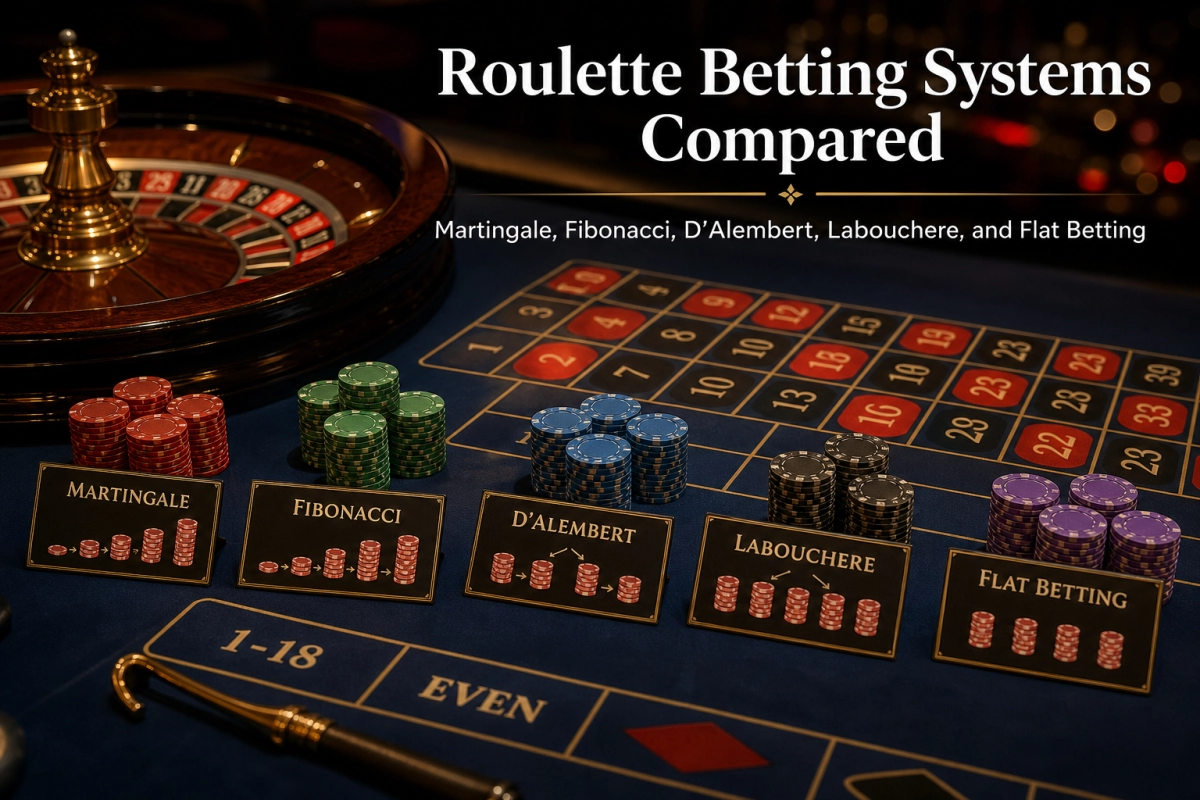
Negative progression systems increase bet size after losses and reduce it after wins, with the expectation that an eventual winner will recover previous losses and produce a net gain. The Martingale is the most widely known example.
Under the Martingale, a losing player doubles their next bet. The sequence continues until a win occurs, at which point the player returns to their original stake. In theory, a single win always recovers all preceding losses plus one unit of profit. The logic is clean and seductive.
In practice, several serious problems emerge:
- Losing streaks are longer and more frequent than intuition suggests. Even on a near-even bet like the Banker position, runs of five, six, or seven consecutive losses are not exceptional. A starting bet of ten units becomes 320 units by the sixth consecutive loss.
- Table limits create a hard ceiling. Once the Martingale sequence approaches the maximum bet, the system collapses entirely. A player who cannot double their stake faces their largest bet of the session at the worst possible moment.
- Bankroll requirements scale uncomfortably. To survive eight consecutive losses with a ten-unit starting stake requires over 2,500 units in reserve — a disproportionate commitment for a one-unit profit.
Other systems such as the Fibonacci or Labouchère escalate less aggressively, but share the same structural flaw: no staking pattern alters the house edge. Progression systems concentrate risk in a specific pattern rather than distributing it evenly, and that concentration tends to be punishing at exactly the moments a player can least absorb it.
Bankroll Management as the Real Strategic Layer
The area where a player genuinely exercises meaningful control is bankroll management. It rarely features in dramatic discussions of betting systems, yet it represents the difference between a sustainable approach and one that ends sessions earlier — and more expensively — than necessary.
The starting point is a session budget entirely separable from everyday finances — money a player is genuinely comfortable losing, because the house edge makes loss a realistic outcome regardless of how well a session begins. Treating that budget as the cost of an evening’s entertainment rather than working capital changes the psychological relationship with variance considerably.
Dividing the budget into individual bet units creates a practical framework. A common approach is sizing bets at no more than two to three percent of the total session bankroll. A player with 500 units might therefore bet ten to fifteen units per round — enough runway to absorb variance without a short losing streak ending the session prematurely.
Win limits deserve equal attention alongside loss limits. Setting a point at which a player walks away from a profitable session — say, once winnings reach fifty percent of the starting bankroll — protects gains that variance might otherwise erode. Baccarat’s near-even odds mean positive runs regress toward the house edge over time, which gives a self-imposed win limit a purpose beyond mere caution.
Time-based limits work alongside financial ones. Fatigue erodes the discipline that keeps flat betting flat and prevents impulsive increases after losing hands. Deciding in advance how long a session will last, and keeping to that, is a straightforward safeguard experienced players consistently endorse.
What Strategy Can Honestly Deliver — and What It Cannot
Baccarat is, at its mathematical heart, a game of near-fixed outcomes. The house edge persists across every bet regardless of how creatively a staking system is constructed. Any honest assessment of baccarat strategy has to begin and end with that reality.
What strategy genuinely can deliver is a framework for working with the game’s structure rather than against it. Consistently backing the Banker bet keeps a player on the lowest available house edge. Flat betting preserves transparency and removes compounding risk. Sound bankroll management extends sessions, controls losses, and occasionally locks in a winning result before variance reclaims it. None of these approaches are exciting in the way that a doubling system feels exciting — but excitement and effectiveness are rarely the same thing in gambling.
What strategy cannot deliver is a reliable path to profit. No staking sequence converts a house edge into a player edge. The Martingale does not overcome table limits or extended losing runs. Tracking outcomes and looking for patterns provides no predictive value in a game where each round is independent of the last. Baccarat has no memory, and systems built on the assumption that it does are built on an illusion.
The players who enjoy baccarat most sustainably approach it with clear expectations. They understand that the Banker bet is the sensible default. They set budgets and stick to them. They choose staking systems that protect their bankroll rather than ones that promise to defeat the house. And they treat a session that ends close to even, or modestly ahead, as the genuine success it actually is — because against a house edge, walking away intact is an outcome worth respecting.
Baccarat rewards composure more than cleverness. The game’s simplicity is not a limitation to be outsmarted; it is the condition under which every decision about money management, bet selection, and session discipline plays out. Work with that structure rather than against it, and baccarat becomes exactly what it is best suited to be: an elegant, low-complexity game that offers reasonable odds and a genuinely engaging experience, provided no one expects the cards to be fairer than they are.