How blackjack plays out and what your main goal is
Blackjack is a fast, low-friction casino card game where your primary objective is simple: make a hand value closer to 21 than the dealer’s without going over. You’ll compete only against the dealer, not other players, which keeps decisions focused and strategic. Whether you’re at a live table or a digital game, understanding the basic flow will help you avoid costly mistakes.
Round flow: the sequence you’ll encounter
- Place your bet: You start by betting in your chip area before cards are dealt.
- Cards are dealt: Typically each player receives two cards face up; the dealer gets one up and one down (the “hole” card) in most American games.
- Player decisions: You choose actions on your turn—hit, stand, double, split, or surrender—based on your hand and the dealer’s upcard.
- Dealer plays: Once players finish, the dealer reveals the hole card and follows fixed rules to draw or stand.
- Resolve bets: Hands are compared; winners are paid, ties push (you keep your bet), and losses are collected.
Fundamental rules and how card values work
Knowing how cards count is essential because it determines every decision you make. Cards 2 through 10 are worth their face value. Face cards—Jack, Queen, King—are worth 10. Aces are special: they count as 1 or 11 depending on which value benefits your hand more. A hand that contains an Ace that can be counted as 11 without busting is called a “soft” hand; otherwise it’s “hard.”
What constitutes a blackjack and other key terms
- Blackjack (natural): An Ace plus a 10-value card on the initial two-card deal. Typically pays 3:2 (though some casinos pay 6:5—avoid those if you can).
- Bust: Any hand total over 21—automatic loss.
- Push: A tie with the dealer results in your original bet being returned.
- Soft vs. hard totals: Soft totals include an Ace that can be 11 (e.g., A-6 = soft 17). Hard totals have either no Ace or an Ace counted as 1.
Common player options and when they matter
You’ll encounter several decision options that change both risk and potential reward. “Hit” asks for another card; “Stand” ends your turn. “Double down” doubles your bet and gives exactly one more card—best used on favorable totals like 10 or 11. “Split” separates pairs into two hands (you must place an equal bet) and can be powerful when splitting Aces or 8s. Some casinos offer “surrender,” letting you forfeit half your bet to fold a weak hand early.
These basics set up everything else: how the house edge forms, what moves reduce it, and which strategies give you the best chance. In the next section you’ll learn the true odds behind common hands and the simple strategy rules that improve your winning chances.
The true odds: how the dealer upcard and rules shape your chances
Understanding basic probabilities helps you interpret why certain plays are right or wrong. The single most important visible piece of information is the dealer’s upcard — it polarizes the deck into “dealer likely to bust” (2–6) and “dealer likely to make a strong hand” (7–Ace). That simple split underlies nearly every correct decision.
A few rule changes also shift the odds noticeably:
– Blackjack payout: 3:2 pays much better for players; 6:5 dramatically increases the house edge and should be avoided.
– Dealer hitting soft 17 (H17) vs standing on soft 17 (S17): H17 gives the house a small edge increase (~0.1–0.2%).
– Number of decks: more decks slightly increase house edge; single- and double-deck games are usually friendlier than six- or eight-deck shoes.
– Doubling/splitting/surrender rules: allowing double after split, surrender, and re-splitting aces lowers the house edge for the player.
When both player and dealer follow fixed rules, “basic strategy” converges to a predictable expected return. With good table rules, basic strategy reduces the house edge to roughly 0.5% or lower; with poor rules (6:5 blackjack, H17, no surrender, six+ decks) the house edge can be 1% or higher. Those percentages explain why small strategic changes matter over thousands of hands.
Basic strategy simplified: clear rules for common hands
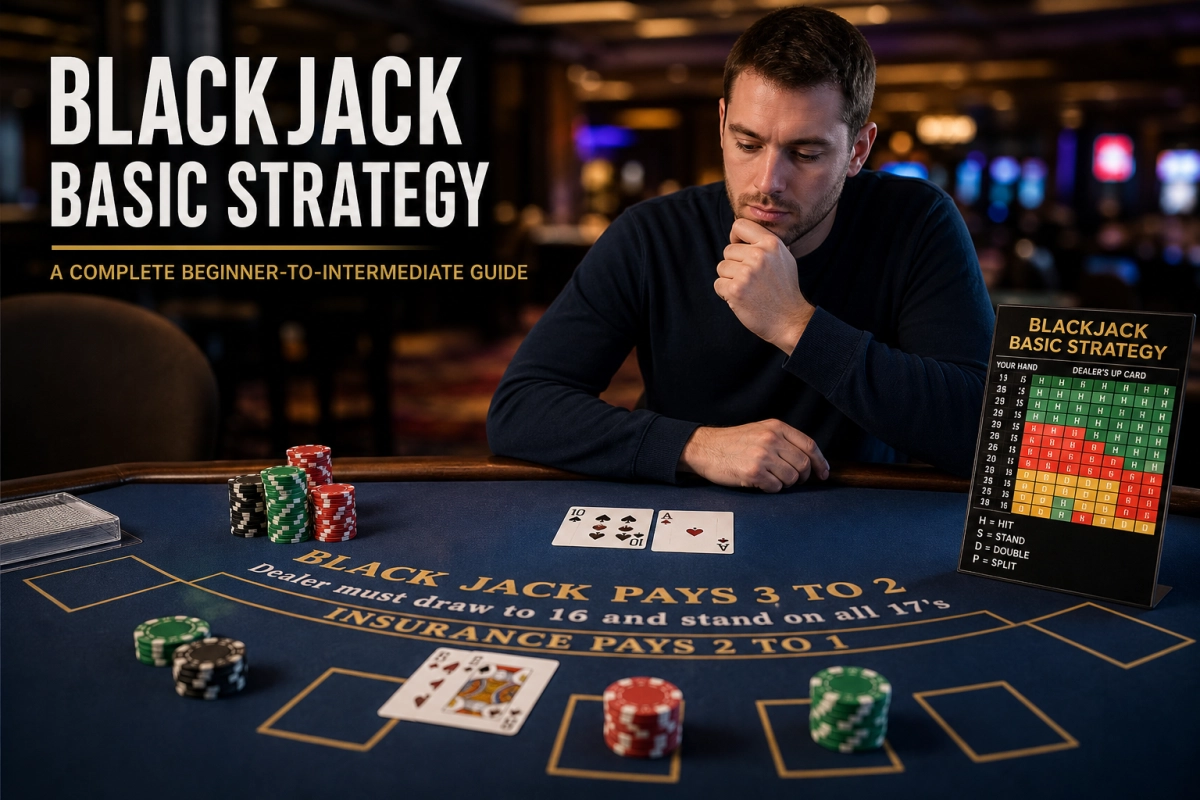
You don’t need to memorize a complex chart immediately—learn a handful of clear, high-value rules that cover 80–90% of hands. Below are concise, practical moves based on your total and the dealer’s upcard.
Hard totals (no usable Ace)
– 8 or less: always hit.
– 9: double vs dealer 3–6; otherwise hit.
– 10: double vs dealer 2–9; otherwise hit.
– 11: double vs dealer 2–10; hit vs Ace.
– 12: stand vs dealer 4–6; otherwise hit.
– 13–16: stand vs dealer 2–6; hit vs 7–Ace.
– 17+ : always stand.
Soft totals (Ace counted as 11 when beneficial)
– A2–A3: double vs dealer 5–6; otherwise hit.
– A4–A5: double vs dealer 4–6; otherwise hit.
– A6: double vs dealer 3–6; otherwise hit.
– A7: stand vs dealer 2,7,8; double vs 3–6 if allowed; hit vs 9–Ace.
– A8–A9: always stand.
Pair splitting
– Always split Aces and 8s.
– Never split 5s or 10s. Treat 5s like a hard 10 (double when appropriate).
– Split 2s and 3s vs dealer 2–7.
– Split 6s vs dealer 2–6.
– Split 7s vs dealer 2–7.
– Split 9s vs dealer 2–6 and 8–9; stand vs 7, 10, Ace.
Surrender (if available)
– Surrender hard 16 vs dealer 9–Ace (some charts specify 10–Ace for 15).
– Surrender hard 15 vs dealer 10 when allowed.
These guidelines won’t guarantee a win every hand, but they minimize the house edge and keep your variance predictable. Learn a complete basic-strategy chart for specific table rules and practice on free apps — it becomes second nature quickly and is the single best non-counting way to improve your results at the table.
Bankroll, practice, and table etiquette
- Manage your bankroll: set session limits, bet sizes you can sustain, and walk away when you reach them.
- Practice before you play for real: free online trainers and low-stakes tables help make basic strategy automatic.
- Choose the right table: look for favorable rules (3:2 blackjack, S17, double after split) and reasonable deck counts.
- Mind the etiquette: act promptly, be respectful to dealers and other players, and avoid discussing strategy at the table.
Putting strategy into practice
Blackjack rewards steady preparation more than flashy plays. Keep learning, practice the core rules until decisions feel automatic, and prioritize good table rules and responsible bankroll management. When you’re ready to deepen your understanding, reputable resources such as Wizard of Odds Blackjack offer detailed charts and simulations to refine your approach. Enjoy the game, play within your limits, and let disciplined strategy guide your sessions rather than emotion or streaks.