Start winning more consistently by using basic blackjack strategy
You learn blackjack quickly by memorizing a few decision rules that tell you when to hit, stand, double, split, or surrender. Basic strategy is a mathematically derived set of plays that minimizes the house edge when the dealer follows standard rules. As a beginner, you don’t need to count cards or master complex systems—just apply the right actions for common hands, and you’ll make better choices than most recreational players.
Why following basic strategy matters for every hand
When you sit at a blackjack table, every decision affects your expected return. Casinos build a small house edge into the rules, but that edge can be much larger if you play poorly. Basic strategy reduces the house advantage to the lowest possible level for the rules in play. That means:
- You lose less money over the long run.
- You make more of the statistically correct decisions in every situation.
- You avoid common beginner mistakes, like splitting 10s or taking insurance.
Basic strategy depends on a few variables—number of decks, whether the dealer hits or stands on soft 17, and available options like surrender. Still, many core rules are the same across variants, so learning them gives you a reliable foundation before you worry about table-specific charts.
Core decision rules every beginner should memorize
Start by learning simple rules that cover most hands. Memorize these baseline plays and use them at the table until they become automatic.
- Always split Aces and 8s: Two Aces give you a chance at two strong hands; two 8s total 16, which is a poor hand—splitting improves your outcome.
- Never split 10s: A hand of 20 is powerful—breaking it up reduces your expected value.
- Stand on hard 17 and higher: If your hand has no Ace counted as 11 and totals 17+, don’t risk hitting.
- Hit on 8 or less: You can’t bust with 8 or less, so always hit to improve your hand.
- Double down on 11 (and 10 if dealer shows 9 or less): With an 11 you have high chances to make 21; doubling increases your expected return when the dealer is weak.
- Soft hands require special care: With an Ace counted as 11 (soft totals), you can hit more aggressively—soft 17 is a hand you often hit or double, depending on the dealer card.
- Never take insurance: Insurance is a side bet that usually favors the house and increases your losses over time.
These guidelines will cover the majority of decisions you face. Practice them in low-stakes games or online free play so your responses become automatic. In the next section you’ll see exactly how to apply these rules to specific dealer up-cards and how to use a basic strategy chart at the table.
How to play against common dealer up-cards
One of the simplest ways to apply basic strategy at the table is to think in terms of the dealer’s up-card. Certain dealer cards make the dealer more likely to bust (2–6), while others make the dealer more likely to end with a strong hand (7–Ace). Use that knowledge to be more aggressive when the dealer is weak and more conservative when the dealer is strong.
- Dealer shows 2–6 (weak): These are the dealer’s “bust” cards. With hard totals of 12–16 you should generally stand—you’re hoping the dealer will bust. With 9–11 you should double when allowed (9 doubles vs 3–6; 10 doubles vs 2–9; 11 doubles vs 2–10). With soft hands, be willing to double in the appropriate soft ranges (for example, double A6 vs 3–6).
- Dealer shows 7–Ace (strong): Treat these as dangerous up-cards. Hit more aggressively on hands that are vulnerable—stand only on stronger totals. For instance, hit on a hard 12–16 against a 7 or higher; always stand on hard 17+. With a soft 17 (A6), hit or double depending on the up-card (you’ll usually hit against 7+).
- Specific, high-frequency plays to memorize: Stand on 12 vs dealer 4–6; stand on 13–16 vs dealer 2–6; double 11 vs dealer 2–10 (hit vs Ace); double 10 vs dealer 2–9; double 9 vs dealer 3–6; always split Aces and 8s; never split 10s or 5s.
These situational rules cover most hands you’ll see and make decision-making fast and effective. Practice verbalizing a simple rule like “Dealer weak (2–6): stand on 12–16, double 9–11 when allowed”—it keeps you from pausing too long at the table.
How to use a basic strategy chart at the table
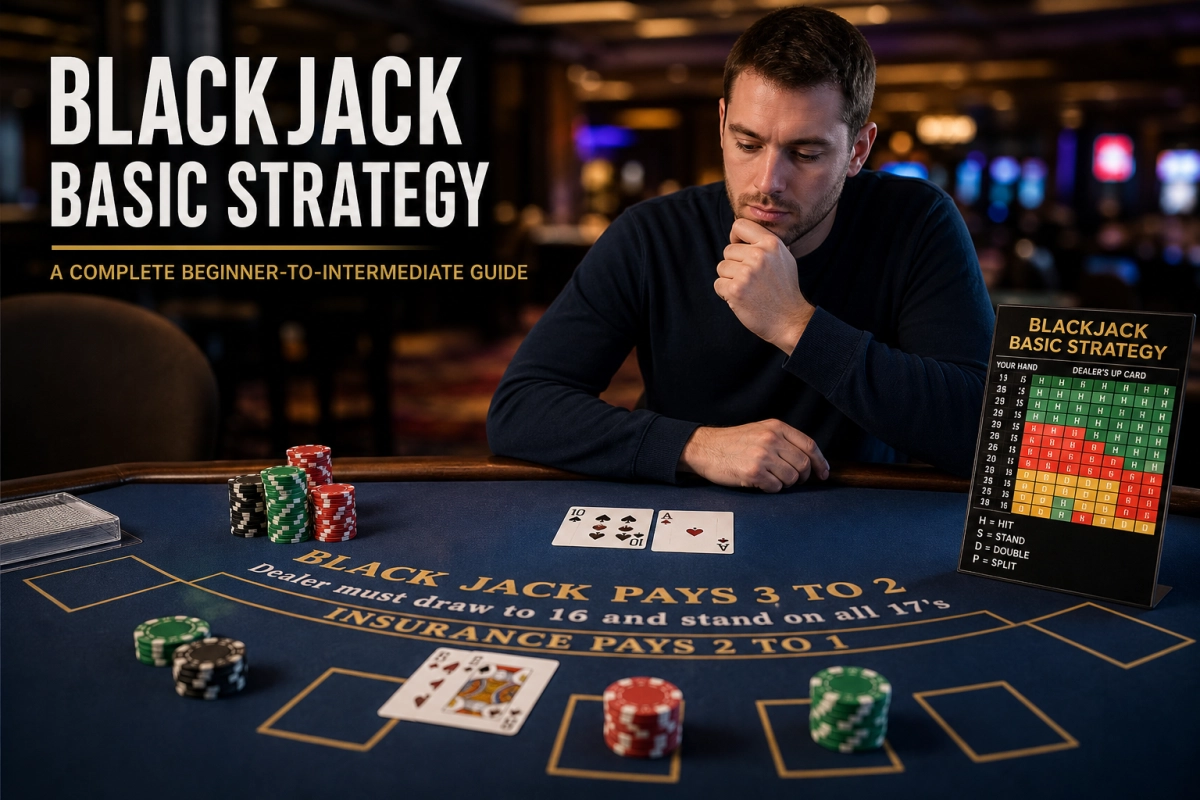
A basic strategy chart translates the rules above into a quick reference grid. Charts show your total (hard, soft, and pairs) on one axis and the dealer up-card on the other, with the recommended play in each cell. For beginners, a chart is an excellent training aid until the rules become automatic.
- Reading the chart: Find whether your hand is a hard total, a soft total (contains an Ace counted as 11), or a pair. Then follow the column for the dealer’s up-card. The chart will tell you H (hit), S (stand), D (double if allowed, otherwise hit), or P (split).
- At the table: Carry a small laminated strategy card or use a basic strategy app while learning—many casinos allow printed charts but forbid electronic devices at the table, so check house rules. Use the chart until you can quickly follow the most common plays without referencing it.
- Training tips: Drill the high-frequency scenarios: decisions versus dealer 2–6 and 7–Ace, how to play soft totals and pairs, and the doubling spots (9–11 and soft doubles). Online trainers and flashcard apps can speed memorization by simulating hands under timed conditions.
Adjust your play for common rule variations
Basic strategy is slightly different depending on rules such as number of decks, whether the dealer hits or stands on soft 17 (H17 vs S17), and whether late surrender or double-after-split (DAS) is allowed. These differences change the exact chart but not the overall approach: learn the variant-specific chart for the table you’re playing.
- Dealer hits on soft 17 (H17): This increases the house edge slightly. Some doubling and standing decisions shift marginally—if you often play at H17 tables, use a chart specifically for H17.
- Number of decks: Single-deck strategy has tiny differences versus multi-deck, mainly in doubling and splitting frequencies. Most casinos use multiple decks, so beginners should start with a multi-deck chart unless you sit at a single-deck table.
- Surrender and DAS: If late surrender is offered, there are extra profitable options (e.g., surrender hard 16 vs dealer 9–Ace). If double-after-split is allowed, it’s more profitable to split some pairs (like 2s/3s and 6s) more often.
Before you sit down, glance at the table rules and use the matching basic-strategy chart. That small step ensures you’re making the right statistical plays for the conditions in front of you.
Parting tips for playing smarter
Mastering basic strategy is as much about mindset as it is about memorizing moves. Stay disciplined with your bankroll, avoid tempting side bets, and don’t let short-term results change your approach. Use low‑stakes tables or online practice to build confidence, and pause to check the table rules and the correct strategy chart whenever you sit down to play.
Next steps
If you want a reliable source of printable charts and drill tools, visit Wizard of Odds — Blackjack. Practice regularly, keep sessions short and focused, and your decisions will become faster and more profitable over time.