Why basic strategy should be your foundation at the blackjack table
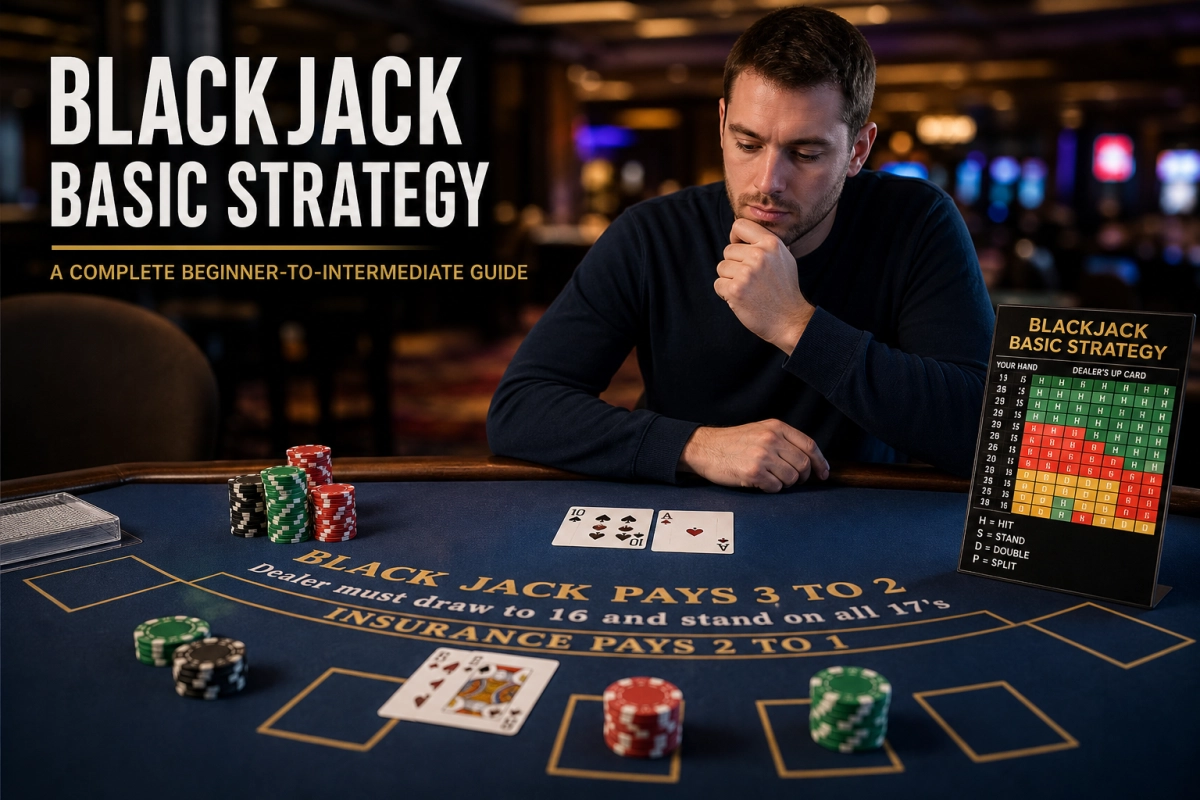
You’ll play far better when you start with basic strategy. Basic strategy is a mathematically derived set of rules that tells you the optimal play (hit, stand, split, double) for every two-card hand versus the dealer’s upcard, assuming no card-counting information. When you follow it, you reduce the house edge to the lowest level possible for casual play—typically around 0.5% depending on the rules.
Basic strategy is designed to be easy to learn and apply under pressure. You don’t need to track cards or perform calculations; you memorize a grid or use a small strategy card where permitted. Because of that simplicity, basic strategy is the baseline everyone should use before considering more advanced options.
- Effectiveness: Cuts house edge dramatically compared to intuitive play.
- Accessibility: Learnable in a few hours with drills and practice apps.
- Casino friendliness: Completely legal and tolerated; many casinos even allow strategy cards.
- Bankroll impact: Reduces long-term losses but doesn’t guarantee short-term wins.
Situations where basic strategy is the right choice for you
If you value low effort and predictable results, basic strategy fits. You should rely on it when you’re playing for entertainment, have a limited bankroll, or are uncomfortable with techniques that draw attention. It also suits players who prefer minimal variance and want to maximize enjoyment without extra stress or practice time.
How advanced blackjack strategy changes the game and what it requires
Advanced strategies build on basic strategy by adding information or techniques that tilt expected value further in the player’s favor. The most well-known advanced method is card counting, which estimates the ratio of high to low cards remaining to adjust your bets and some plays. Other advanced approaches include shuffle tracking, hole-carding exploitation, composition-dependent deviations, and team play.
Adopting advanced play can lower the house edge to zero or produce a positive expected value if executed perfectly, but that potential comes with significant costs.
- Skill and study: You’ll need substantial practice to count accurately under casino conditions and to make correct index plays.
- Bankroll and risk: Variance increases with bet sizing strategies; you must have a larger bankroll and tolerance for swings.
- Casino countermeasures: Casinos watch for bettors who vary bets dramatically or behave unusually; you risk being backlisted or ejected.
- Ethical and legal considerations: Counting using only your mind is legal in most jurisdictions, but covert tactics (devices or collusion) can be illegal.
Understanding these trade-offs—skill investment, bankroll requirements, and casino practicality—will help you decide whether to stop at basic strategy or pursue advanced methods. In the next section, you’ll see a side-by-side comparison of expected return, required practice time, and real-world feasibility to help you choose what’s best for your goals and play style.
Side-by-side comparison: expected return, practice time, and real-world feasibility
Here’s a practical comparison that puts numbers and realities next to each other so you can weigh costs and benefits.
-
Expected return
Basic strategy: typically reduces the house edge to roughly 0.4–0.7% (varies with rules).
Advanced play (card counting, shuffle tracking, index plays): can swing that edge into positive territory in favorable conditions. Realistic ranges for a competent single-player counter are roughly +0.25% to +1.5% expected value (EV) against typical casino rules and penetration; elite team play or extreme penetration can push higher in rare cases. Exact numbers depend on rules, number of decks, and how deep the dealer cuts the shoe.
-
Practice and study time
Basic strategy: a few hours to memorize and several sessions to internalize under pressure.
Advanced methods: expect months to years. Learning a count (e.g., Hi-Lo), converting running to true counts, mastering index deviations, and building camouflage habits require deliberate, repeated practice—plus time playing live to handle distractions and heat from casinos.
-
Bankroll and variance
Basic strategy: lower variance; standard recreational bankrolls suffice.
Advanced play: substantially higher variance because you size bets by count. Conservative guidance: prepare to invest many times your minimum bet as your working bankroll—commonly 100–200 units for casual counters; more conservative players and team operators often plan for 250–500+ units to weather downswings.
-
Feasibility and casino response
Basic strategy: fully legal and widely tolerated.
Advanced play: card counting with only your mind is legal in most places, but casinos actively counter it—bet spread scrutiny, shuffling early, flat betting requests, or denial of service. Team play or device use often crosses legal/ethical lines and attracts severe consequences.
Practical step-by-step plan if you decide to learn advanced play
If you’re leaning toward advanced strategy, follow a staged approach to minimize wasted effort, bankroll loss, and heat from casinos.
- Master basic strategy first. You must make basic plays automatically so counting and index deviations don’t break your game under pressure.
- Choose a simple count system. Hi‑Lo is the standard for its balance of accuracy and ease. Begin with running-count drills until you’re flawless at 60–90 cards per minute.
- Learn true count conversion and betting ramps. Practice turning running count into true count under time pressure. Design a conservative bet spread (e.g., 1–8 units) you can use without standing out.
- Drill index plays and composition-dependent decisions. Memorize a small set of the highest-utility deviations (e.g., insurance and some doubles/splits) before adding more.
- Simulate and track results. Use software to model expected EV for your specific rules and penetration, and keep a disciplined log of sessions to measure variance.
- Practice camouflage and bankroll discipline. Never let bet jumps be your only giveaway—vary timing, take breaks, and keep table talk normal. If casinos respond negatively, stop and reassess; don’t escalate.
Common misconceptions that trip up aspiring advanced players
- “Card counting is illegal.” Not when done mentally. Illegal is using devices, collusion, or deception involving third parties.
- “You need a photographic memory or math genius.” Most successful counters rely on a small set of practiced skills and discipline—not extraordinary innate ability.
- “A small edge means easy money.” Small percentage edges still produce significant variance; without proper bankroll and tilt control you can lose long before the edge pays off.
- “Team play is required.” It helps in certain contexts but raises complexity and risk. Many single players profit modestly with clean technique and restraint.
Choosing the right strategy for you
Deciding whether to stop at basic strategy or invest in advanced techniques is ultimately a personal choice. Think about what you want from blackjack—casual entertainment, steady low-variance play, or the challenge of pursuing an edge—and be honest about the time, bankroll, and emotional bandwidth you can commit. Whatever path you choose, keep it legal, keep it disciplined, and accept that results will reflect the effort and risk you put in.
Next steps
- Clarify your goal: fun, skill-building, or profit-seeking.
- Set a bankroll and hard limits you won’t exceed under pressure.
- Practice deliberately: drill basics until automatic, then add advanced drills incrementally.
- Track sessions and adjust your plan based on real results and comfort with variance.
- Use reputable resources for learning and simulation—see Wizard of Odds for calculators, charts, and drills.
Good decisions at the table start before you sit down: choose a strategy that fits your life and temperament, prepare deliberately, and play within the boundaries you set. That approach will keep the game fun and sustainable, whichever strategy you follow.