How blackjack odds affect every decision you make at the table
When you sit down at a blackjack table, every choice — hit, stand, split, or double — is a bet against probability. Understanding those probabilities helps you make decisions that minimize the house edge and maximize your expected value over time. You don’t need to be a mathematician; you need an intuitive grasp of what the cards in the deck mean for your likely outcomes and how dealer rules shift the math in the house’s favor.
Blackjack is fundamentally a comparison of two things: the probabilities of your final hand beating the dealer’s final hand, and the risk of busting when you take another card. The game’s built-in advantage comes partly from the rules that force the dealer to act in fixed ways (usually hitting on 16 and standing on 17), and partly from payouts and rule variants (blackjack paying 3:2 vs 6:5, ability to surrender, number of decks). You can reduce the house edge by tailoring your decisions to these probabilities.
Basic components that determine your odds
- Deck composition: More decks slightly favor the house because the relative frequency of high cards changes. Single-deck games give you better odds than eight-deck games, all else equal.
- Dealer rules: Whether the dealer hits or stands on soft 17, and whether late surrender is allowed, directly changes expected returns.
- Payout structure: Blackjack’s payout (3:2 vs 6:5) dramatically affects your long-term return — 6:5 increases the house edge noticeably.
- Player options: Doubling, splitting pairs, and surrender add strategic choices that interact with probabilities; using them correctly improves your chances.
Key probabilities you should know right away
Once you understand the components above, focus on a handful of probabilities that drive decisions at the moment you act.
Probability of busting if you hit
- If your total is 12, hitting busts you roughly 31% of the time.
- At 13, about 39% chance to bust; 14 ≈ 56%; 15 ≈ 58%; 16 ≈ 62% — risk rises quickly.
- Hands of 11 or less cannot bust on one hit, making doubles attractive when dealer shows a weak card.
Dealer upcard influence
The dealer’s upcard strongly changes your odds. When the dealer shows a 2–6, they’re more likely to bust because their required drawing rules often force additional cards. Against a dealer 7–Ace, the dealer’s chance of reaching a strong total is higher, so you should be more conservative.
These early probabilities — your bust odds by total and the dealer’s likelihood of breaking or making a strong hand — form the foundation of basic strategy. They explain why you often stand on 12 vs a 6 but hit 12 vs a 7, or why doubling 11 against a dealer 6 is statistically favorable.
With these fundamentals in place, you’re ready to see how basic strategy tables use those exact probabilities to recommend the mathematically optimal play on every possible two-card situation. In the next section, you’ll learn how to read and apply a basic strategy and how much it reduces the house edge.
How to read and apply basic strategy: a practical guide
Basic strategy tables condense the probabilities you just learned into a single, easy-to-use decision map. Each square in a table tells you the statistically best action (hit, stand, double, split, or surrender) for a specific combination of your two-card hand and the dealer’s upcard. Learning the logic behind a few common cells makes the whole table less intimidating.
Practical pointers for using a table at the table:
– Know the three hand types: hard totals (no ace counted as 11), soft totals (an ace can be 11), and pairs (two identical cards). Each has different ideal plays because the risk of busting or the flexibility of the ace changes the math.
– Memorize a handful of high-frequency rules that apply to most situations: never split tens or face cards (20 is already excellent); always split aces and 8s; double 11 vs any dealer upcard 2–10 (or at least 2–9 depending on rules); stand on hard 12 vs dealer 4–6 but hit 12 vs 7–Ace.
– When you see “double if allowed, otherwise hit,” the logic is that the extra bet is justified by a positive expected value when the dealer has a weak upcard. If doubling isn’t allowed, hitting is the next-best choice.
Examples to build intuition:
– Soft 18 (A-7) vs dealer 9: Basic strategy usually recommends hitting or sometimes hitting/doubling depending on deck count and rules. The ace gives you flexibility, so you can attack borderline situations more aggressively than with a hard 18.
– Pair of 8s vs dealer 10: Split — two hands of 8 have a better chance to beat the dealer than keeping a hard 16, which is one of the worst single totals.
– Hard 16 vs dealer 10: If late surrender is available, surrender is usually correct; otherwise, hit. The probability of losing a hard 16 against a 10 is high enough that mitigating losses via surrender can be optimal.
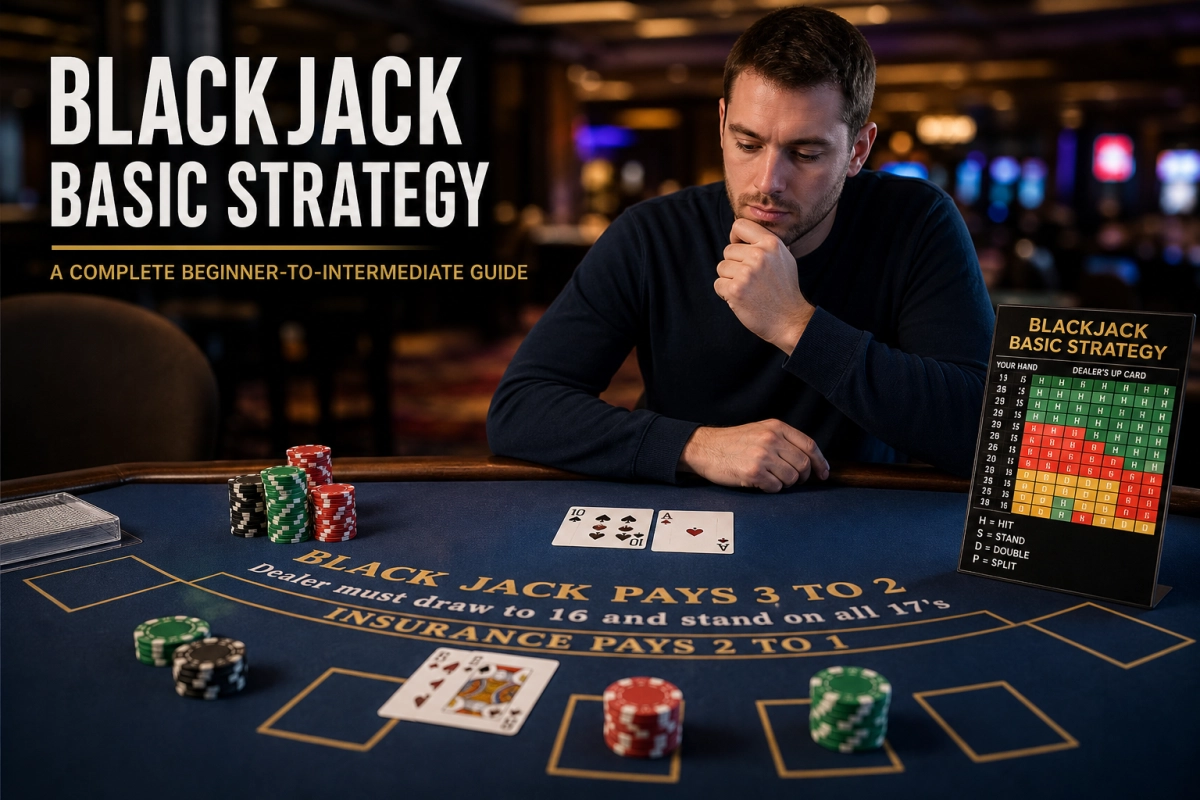
Most casinos allow you to keep a small strategy card at the table; use it until the basic plays become instinctive. Over time the table starts to read like common sense because every recommendation reflects the underlying bust and dealer-probability math you already learned.
How much basic strategy reduces the house edge — and when to adjust for rules
Using perfect basic strategy is the single biggest non-counting step you can take to improve returns. Against a typical six-deck shoe with dealer standing on soft 17 and a 3:2 blackjack payout, perfect basic strategy brings the house edge down to roughly 0.5% (often between 0.4% and 0.6% depending on precise rules). Without strategy, that edge can be 2% or more, so learning basic strategy dramatically changes long-term outcomes.
However, rule variations shift the numbers:
– Blackjack payout: Moving from 3:2 to 6:5 adds roughly 1.4% to the house edge — a huge penalty you should avoid if possible.
– Dealer hits soft 17: This typically increases the house edge by about 0.2–0.3% compared with standing on soft 17.
– Number of decks: Single- or double-deck games slightly favor the player more than six- or eight-deck games, but casinos often offset that with other rule changes.
– Surrender, doubling after split, re-splitting aces: Each favorable option can shave off tenths of a percent.
When rules vary, the basic strategy table itself can change in small ways (e.g., different doubling or surrender recommendations). If you play a game with unusual rules, look up or carry the correct basic strategy for those conditions. For everything else — insurance, side bets, and nonstandard payouts — treat them skeptically: without specific countermeasures like card counting, they usually increase the house edge rather than reduce it.
Practice tools and further learning
If you want to turn these concepts into reliable instincts, practice deliberately. Use basic-strategy trainers, mobile apps, and computer simulators to drill common decisions until they feel automatic. Play low-stakes or free online games to build confidence with rule variations and table pace. For deeper study — including exact strategy charts for specific rule sets — reliable resources such as Wizard of Odds offer detailed explanations and calculators.
Parting advice for the table
Blackjack rewards preparation more than bravado. Before you sit down, set a clear bankroll and session limit and stick to them — short-term variance can be large even when you play correctly. Use a correct basic-strategy card for the game rules you’re facing, avoid tempting side bets and insurance unless you understand their true expected value, and treat doubling, splitting, and surrender as tools to manage expected value rather than instincts to chase wins.
Keep improving incrementally: practice, review hands you aren’t sure about, and adapt only when you understand how rule changes affect strategy. If you ever consider advanced techniques like card counting, study the legal and practical implications carefully; counting changes how you must approach bankroll, bet spread, and table selection.
Finally, remember why you play: to enjoy the game. Make mathematically sound choices, manage your money, and step away when the session no longer aligns with your limits or enjoyment. That combination — skill, discipline, and perspective — is the best way to give the odds their proper role at your table.