[Start HTML content here]
How blackjack odds shape the choices you make at the table
When you sit down to play blackjack, every decision you make—from whether to hit or stand to how you split and double—relies on underlying probabilities. Understanding those odds helps you make choices that minimize the house edge and maximize your expected return. You’re not predicting one-off outcomes; you’re managing risk across many hands so that small advantages or disadvantages compound over time.
Why probability matters more than luck over the long run
Each hand is random, but the law of large numbers means that over hundreds or thousands of hands, expected percentages reveal themselves. For example, a natural blackjack occurs roughly 4.8% of the time; when it pays 3:2 instead of 6:5, that payout difference significantly affects your long-term returns. Playing basic strategy reduces the house edge to a fraction of a percent in many rule sets, while deviating from correct plays can quickly add several percentage points to the house advantage.
Which rule changes and actions determine the house edge you’ll face
Not all blackjack games are created equal. The casino’s rule set and the deck composition directly influence the mathematical edge against you. Small rule differences—whether the dealer hits a soft 17, how many decks are used, and whether blackjack pays 3:2—translate into measurable shifts in the house edge. Knowing which elements matter lets you choose better tables and adapt your decisions.
Key factors that move the percentages
- Number of decks: Generally, more decks increase the house edge. Single-deck games can be slightly friendlier (when rules are standard), while 6–8 deck shoes tend to raise the edge by tenths of a percent depending on other rules.
- Blackjack payout: A 3:2 payout for a natural is standard and favorable to you. If a table pays 6:5, the house edge jumps noticeably—avoid those games when possible.
- Dealer rules on soft 17: If the dealer hits soft 17, the house gains a small additional edge compared with a game where the dealer stands on soft 17.
- Doubling and splitting rules: Allowing double after split (DAS), re-splitting aces, and late surrender options all lower the house edge in your favor.
- Player skill and strategy: Using basic strategy typically reduces the house edge into the neighborhood of a few tenths of a percent for many casinos. Playing poorly—ignoring basic strategy—can raise the edge to 2% or higher.
- Card counting and deck penetration: While not practical or legal in all venues, skilled counting combined with deep shoe penetration can swing expected value in your favor over time in some rule sets.
By recognizing how each rule and decision affects the math, you can make table choices that materially change your expected losses or gains. In the next section, you’ll see specific examples and learn how basic strategy and simple counting techniques alter those probabilities and the house edge.
How basic strategy changes your expected value — concrete examples
Basic strategy isn’t a vague “play better” suggestion — it’s a precise set of plays derived from probability that measurably reduces the house edge. Depending on the rule set, switching from casual play to perfect basic strategy typically cuts the house edge from around 1.5–2.0% down to roughly 0.5% (many common 6-deck, 3:2, dealer-stands-on-soft-17 games). Those percentages translate directly into money: on a $100 average bet, sloppy play might cost you $1.50–$2.00 per round in expectation, while basic strategy lowers that to about $0.50.
Here are a few concrete examples of how specific correct plays affect expected value (EV). Numbers are approximate and depend on deck count and rules, but they illustrate scale:
- Hard 16 vs dealer 10: Basic strategy recommends hitting (or surrendering where available). Standing instead of hitting can worsen EV by several tenths of a percent — meaning tens of cents per $100 bet repeatedly over time.
- Splitting 8s vs dealer 10: Splitting converts a highly negative single-hand EV into a less-negative pair of hands and is typically a correct play; failing to split can increase your expected loss by a noticeable fraction of a percent.
- Doubling on 11 vs dealer 6: Doubling down is often the right play and captures extra EV; failing to double here surrenders a profitable opportunity and can cost you roughly 0.2–0.5% in overall edge across many hands.
Small EV differences per decision add up because you will make thousands of decisions in a session. Learning a basic strategy chart for your specific rule set is the most efficient way to convert those small per-hand gains into meaningful reductions in expected loss.
Simple card counting, bet sizing, and what advantage you can realistically expect
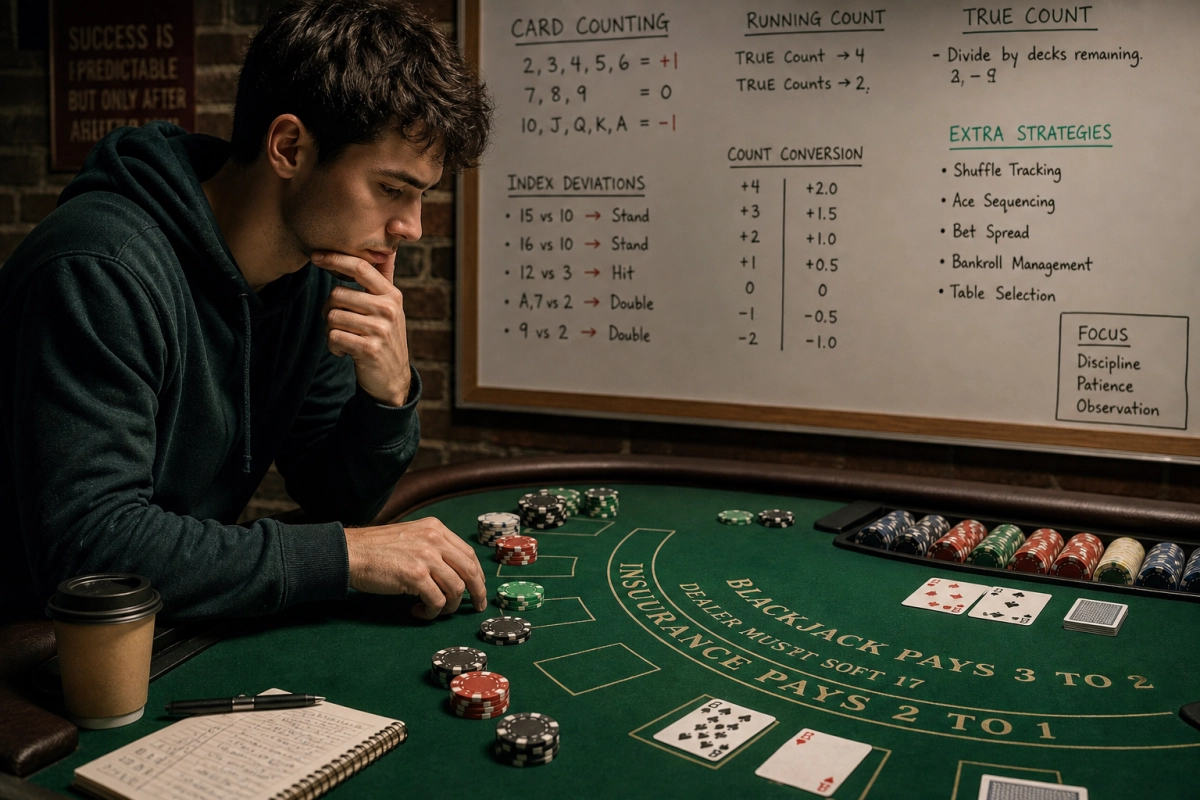
Card counting is the next logical step once you master basic strategy. A simple, widely used method is the Hi‑Lo system: assign +1 to cards 2–6, 0 to 7–9, and −1 to 10–A. Maintain a running count, convert it to a true count by dividing by remaining decks, and increase your bet when the true count is positive (high count = more tens and aces remaining = player advantage).
Realistic expectations are important. With competent counting, favorable shoe penetration, and standard casino rules, an experienced counter might swing the EV by roughly +0.5% to +1.5% over the house — sometimes more in exceptionally favorable situations. That sounds small, but on large bet spreads and many hands it becomes meaningful. However, achieving that requires disciplined bet spreads, accurate counting, and the ability to absorb variance.
Practical bankroll guidance: because advantage percentages are small and variance is high, you’ll need a sufficiently large bankroll to withstand losing streaks. Many counters use conservative Kelly‑based or fraction‑Kelly approaches and keep bet spreads modest to avoid attention. And remember the non-mathematical costs: casinos monitor play and may shuffle earlier, restrict bet spreads, or ask suspected counters to stop. Counting gives a measurable edge in theory; in practice you must manage bankroll, camouflage, and casino countermeasures to realize it.
Where to practice and learn more
Practical improvement comes from repetition and feedback. Use free online simulators and basic strategy trainers to ingrain correct plays, try low‑stakes live tables to practice bankroll and bet management, and study reputable calculators or breakdowns that show how specific rules change EV. For reliable explanations and strategy tools, see Wizard of Odds blackjack resources.
Parting advice for steady, sensible play
Blackjack rewards patience, preparation, and discipline more than boldness. Keep learning one decision at a time, manage your bets and bankroll sensibly, and treat counting or advanced techniques as skills that require practice and discretion. Above all, play within limits you can afford and focus on making each hand—the thousands of small choices—your best possible ones.