
[Start HTML content here]
Why knowing poker hand rankings changes how you play
When you sit down at a poker table, every decision — fold, call, or raise — depends on one basic skill: understanding which hands beat which. If you can instantly judge the relative strength of your cards and potential community combinations, you make smarter bets, avoid costly mistakes, and exploit opponents who misread hands. This isn’t just memorizing a list; it’s about applying rankings to real situations so you can assess risk and extract value.
How hand-reading improves decisions and bankroll
Reading hands helps you in three practical ways:
- Pre-flop clarity: Knowing which starting hands are playable reduces random calls and preserves your chips.
- Post-flop evaluation: You’ll quickly judge whether the flop improved your hand or whether to fold facing aggression.
- Opponent profiling: Identifying likely holdings from board texture and bet sizing lets you exploit mistakes.
Practicing this skill increases your win-rate across cash games and tournaments. Instead of guessing, you base choices on which hands outrank others and how community cards change probabilities.
Core building blocks: ranks, suits, and hand formation
Before you memorize a ranking list, understand the basic anatomy of poker hands. Every hand is constructed from card ranks (2–Ace) and suits (clubs, diamonds, hearts, spades). How these combine determines the category your hand falls into — from a high card up to a royal flush.
What you should check first when you see your cards
- Pair potential: Do you already hold a pair or two cards of the same rank? Pairs are the simplest made hands and often determine early action.
- Suited connectors: Are your cards consecutive and of the same suit? These increase chances for straights and flushes.
- High-card strength: If you have an Ace or King without other help, you’re relying on high-card value — often competitive pre-flop but vulnerable post-flop.
- Board compatibility: Think about how the community cards could pair, flush, or straight the board — and how that affects your relative strength.
Common misreads to avoid
- Overvaluing suits: a single suited ace is good pre-flop but rarely wins alone on coordinated boards.
- Miscounting outs: don’t assume every unseen card that helps you is an “out” if it also improves an opponent’s likely hand.
- Underestimating two-pair vs. straights/flushes: two pair can be strong but still beaten by a single completed straight or flush.
With these foundations — why rankings matter and how cards form hands — you’re ready to learn the ranking list itself and specific recognition cues for each category. In the next section, you’ll walk through every poker hand from highest to lowest, see visual examples, and learn quick checks to spot them during play.

Hand rankings, from top to bottom
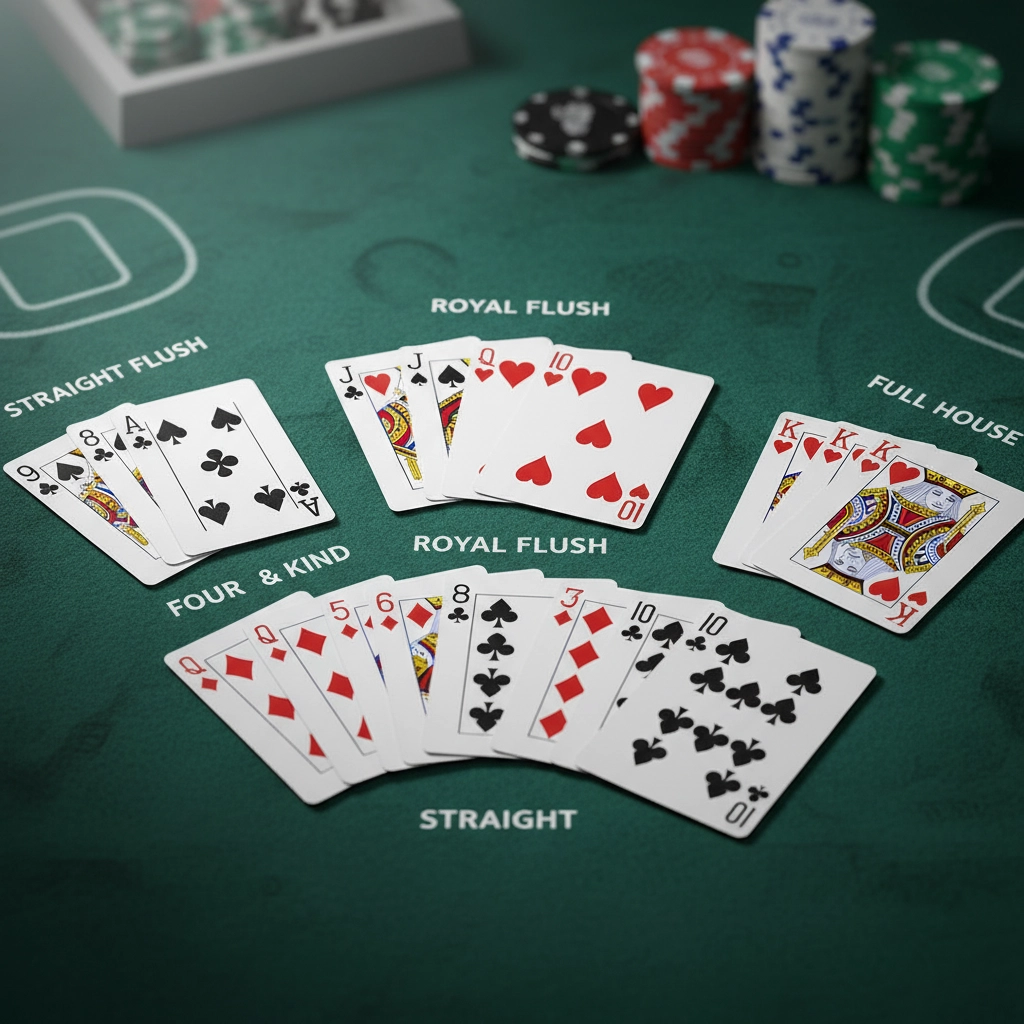
Here’s a practical rundown of every hand you’ll see, ordered highest to lowest, with a quick example and what to watch for at the table.
- Royal flush — A♦ K♦ Q♦ J♦ 10♦. The top straight flush (Ten through Ace). Extremely rare; if the board presents four suited high cards or an Ace-high monotone board, beware a possible royal.
- Straight flush — 9♣ 8♣ 7♣ 6♣ 5♣. Five consecutive cards of the same suit. Look for coordinated, single-suit boards; if you or an opponent is holding connected suited cards, the danger is real.
- Four of a kind (quads) — K♠ K♦ K♣ K♥ 7♣. Four cards of the same rank. Rare but usually a value hand — watch for small, suspicious bets if the board pairs in ways that complete full houses.
- Full house — Q♣ Q♥ Q♦ 8♠ 8♣. Three of a kind plus a pair. Strong on most boards; if the board is paired and someone starts betting big, consider full house possibilities even with seemingly “safe” trips.
- Flush — A♥ 10♥ 6♥ 4♥ 2♥. Five cards of the same suit. Suited boards and multiple players holding hearts/spades increase flush possibilities; always count how many cards of a suit are visible.
- Straight — 7♦ 6♣ 5♠ 4♥ 3♣. Five consecutive ranks, mixed suits. Connected boards (e.g., 5-6-7) are red flags — straights can sneak up on two-pair/trips holdings.
- Three of a kind (set/trips) — 9♣ 9♦ 9♠ K♦ 2♥. Three cards of the same rank. A set (pocket pair plus board pair) is disguised and strong; trips made on board are more transparent and vulnerable.
- Two pair — J♠ J♦ 4♣ 4♥ A♣. Two distinct pairs. Good but often beaten by straights/flushes/full houses on coordinated boards; protect it with sensible sizing.
- One pair — A♣ A♥ 8♦ 7♠ 3♣. A single pair is common; kicker values matter. Top pair with a weak kicker is often marginal against aggressive opponents.
- High card — A♦ K♣ 9♠ 6♥ 2♦. No pair — best card wins. Rarely a strong showdown hand; use it mainly for bluffing or when pot odds justify a call.
Fast table cues: spotting threats and sizing up hands quickly
Beyond knowing the order, you need fast heuristics to evaluate how dangerous your situation is. Use these checks when the action heats up:
- Board texture scan: Ask: is it monotone (flush possible), connected (straight possible), or paired (full house/quads possible)? The more “coordinated” the board, the more hands your opponent can legitimately have.
- Betting story: Pre-flop raiser who continues to bet the flop often has a made hand or strong draw. Check-raises usually show strength or a powerful draw.
- Count realistic outs: Only count cards that improve you without helping opponents to a better hand. Remove blockers and duplicate outs from your math.
- Watch kickers and blockers: Holding the Ace of a suit or a high rank reduces opponents’ combinations and can justify more aggressive play.
- Adjust by stack and position: Short stacks change the value of draws and two-pair hands; in position you can extract more value or fold marginal holdings safely.
These quick checks let you translate raw hand rankings into immediate decisions — fold before a trap, or extract maximum value when you’re ahead. In the next part, we’ll cover reading opponents and turning this knowledge into concrete betting lines.
Before you dive into opponent reads and bet construction, make a habit of scanning the board, counting visible suits and ranks, and asking the three quick questions: could a flush, straight, or full house exist here? That simple routine turns theoretical knowledge into fast, profitable instincts at the table.
Putting rankings to work
Mastering hand rankings is a foundation, not a finish line. Use them as a lens for every decision: evaluate threat levels, size bets to protect vulnerable holdings, and look for blockers that change opponents’ ranges. Practice with hand-history reviews, play low-stakes sessions to test instincts, and study opponents’ betting stories rather than relying solely on raw rank knowledge. When you want a concise reference on combinations and probabilities, check a trusted source like List of poker hands.
Frequently Asked Questions
What is the rarest poker hand and how should that influence my play?
The rarest standard hand is the royal flush — essentially a specific high straight flush. Because it’s so unlikely, you shouldn’t count on seeing one; instead, use the possibility of straights and flushes (which are much more common) to guide cautious play on coordinated boards rather than factoring in royals.
How do kickers change hand strength and betting decisions?
Kickers serve as tie-breakers when pairs are equal. A strong kicker (like an Ace with a lower pair) can turn a marginal pair into a hand worth betting for value or for protection. Conversely, weak kickers make your pair vulnerable — consider pot control or folding to heavy action against aggressive opponents.
How do I count outs without overcounting or helping opponents?
Only count cards that complete your best possible hand without giving opponents a better one. Remove duplicate outs (cards that complete both your straight and flush) and discount outs that create full houses or higher for opponents on paired boards. When in doubt, run the common “double-check” — subtract cards that appear in opponents’ likely ranges (blockers) before committing.