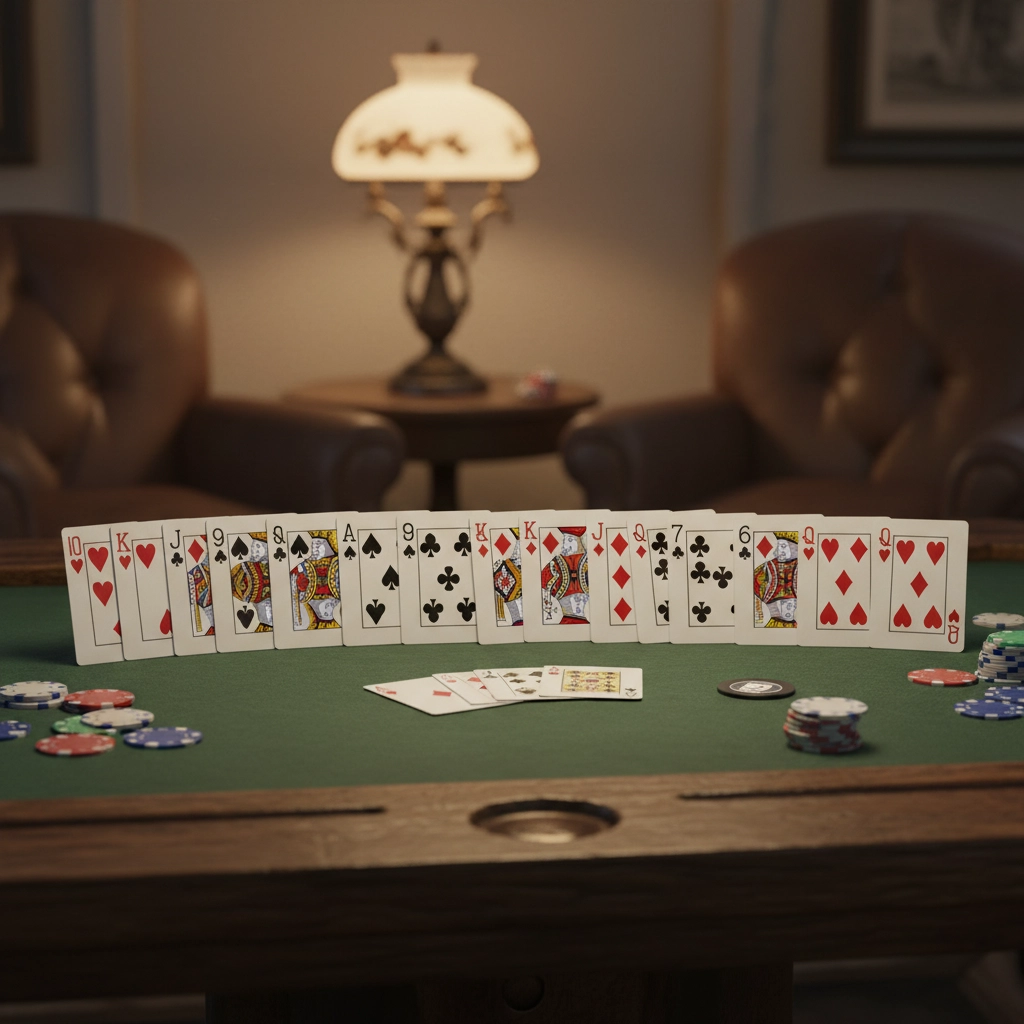
Why mastering poker hand rankings matters for every decision you make
You win in poker by making better choices than your opponents. Knowing the official hand rankings is one of the most basic — and most important — skills you need. When you can quickly identify the strength of a hand, you make smarter bets, avoid costly mistakes, and extract value when you’re ahead. This guide gives you the foundational concepts that let you read hands, compare combinations, and begin thinking strategically about how to play them.
How the ranking order determines which hand wins
At its core, poker uses a fixed hierarchy of hands: some combinations outrank others. If two players both show hands at showdown, the rank determines the winner — higher-ranked hand wins. You should be comfortable with the relative order (from strongest to weakest) so you can evaluate your chances at a glance and choose appropriate actions: fold, call, raise, or bluff.
- High-level hierarchy: hands built from the same five-card poker rules are compared by pre-established rank; a stronger category always beats a weaker category.
- Common categories you should be familiar with include flushes, straights, full houses, pairs, and high card. Each category has internal tie-breaking rules.
- Game variants (Texas Hold’em, Omaha, 7-card stud) use the same ranking system, but the way you form your best five cards can differ — be sure to know your variant’s rules for combining hole and community cards.
Key details: tie-breakers, kickers, and community cards
Understanding tie-breakers and kickers is crucial because many showdowns end with similar categories. A kickers is an extra card that decides ties between otherwise equal hands. You also need to know how community-card games (like Hold’em and Omaha) affect who can make which combinations.
- Tie-breakers: For identical categories (for example, two players with one pair), you compare the highest relevant cards in order. For pairs, compare pair value first, then kickers top to bottom.
- Kickers: Extra unrelated cards that break ties. A pair of aces with a king kicker beats a pair of aces with a queen kicker.
- Community cards impact: When the board contains a strong five-card combination, all players may share that hand; the winner is then determined by any better side cards (kickers) each player holds.
- Suit equality: Suits do not rank against each other in most poker variants — flush vs. flush is decided by the highest card sequence, not by spades over hearts, for example.
With these basics — the hierarchy, how ties are resolved, and how community cards and kickers work — you can start recognizing which hands are playable and how much equity they might have in different scenarios. Next, you’ll get a detailed, step-by-step breakdown of every standard poker hand from Royal Flush down to High Card, with examples and play recommendations for each.

Top-tier combinations: Royal Flush, Straight Flush, Four of a Kind
These are the absolute monsters of poker — almost always winners and the hands you want when you can get them. A Royal Flush is simply the highest possible straight flush: A‑K‑Q‑J‑10 of the same suit. A Straight Flush is any five sequential cards of the same suit (for example 9‑8‑7‑6‑5 of hearts). Four of a Kind (quads) is four cards of the same rank plus one side card (kicker), e.g., K♠ K♥ K♦ K♣ + 3♣.
- Tie-breakers: For straight flushes, the highest top card wins (a royal flush beats all). For quads, higher quad rank wins; if two players can use the same four on a board, the odd kicker decides the winner.
- Play recommendations: Bet for value aggressively. With quads and straight/royal flushes your goal is to extract as many chips as possible; use checking or slow‑playing only sparingly and situationally (for example when a draw-heavy board invites calls). Be mindful of the board: if a straight flush is possible on the board everyone may already share the best five cards, so kickers or better side hands decide the pot.
Powerful hands that still require judgment: Full House, Flush, Straight
These hands win frequently but can be vulnerable depending on the board texture and player actions. A Full House combines three of a kind and a pair (e.g., 9‑9‑9‑K‑K). A Flush is five cards of the same suit (A♥ J♥ 9♥ 6♥ 4♥). A Straight is five sequential cards of mixed suits (10‑9‑8‑7‑6).
- Tie-breakers: Full houses compare the three‑of‑a‑kind first, then the pair. Flushes are compared by highest card, then next highest, etc. Straights are compared by the top card (a 10‑9‑8‑7‑6 loses to J‑10‑9‑8‑7).
- Play recommendations: These hands are almost always worth raising. With a full house you should push for maximum value but watch for higher full houses or quads when the board is paired or shows boiz-heavy possibilities. With a flush, be aware of higher flushes and straight flush potential if the board is suited. With straights, consider whether a higher straight or flush could beat you; on coordinated boards you may prefer pot control rather than bloating the pot.
Common made and marginal hands: Three of a Kind, Two Pair, One Pair, High Card
These hands are the workhorses of regular play. Three of a Kind (trips or a set) can be formed with pocket pair hitting the board (set) or pairing one hole card (trips). Two Pair and One Pair are frequent and require kickers to break ties. High Card hands are losers unless everyone misses.
- Tie-breakers and kickers: For sets/trips compare the three cards’ rank. For two pair compare the top pair, then the second pair, then the kicker. For single pairs compare the pair rank then the remaining kickers in descending order. High‑card hands compare highest down to lowest card.
- Play recommendations: Be selective: set mining with small pocket pairs can be profitable when implied odds are high. Two pair is usually strong on dry boards but vulnerable to straights and flushes. One pair (especially top pair) is often worth value betting, but avoid getting overly attached if the board develops. High‑card hands should be used for bluffing or folding rather than showdown value.
Putting the rankings to work
Knowing the hand hierarchy is only the first step — winning consistently means combining that knowledge with position, bet sizing, reading opponents, and bankroll discipline. Use these quick-practice steps to make the rankings actionable:
- Memorize relative strength, then practice recognizing board textures that change that strength (paired, suited, connected).
- Adjust aggression by position: raise more from late position, defend more cautiously from early position.
- Use pot control on medium-strength hands (flushes/straights on coordinated boards) and value-bet strongly with top made hands.
- Set-mine selectively: enter pots with small pocket pairs only when implied odds justify the call.
- Track outcomes and review hands: learning when a hand should have folded or gotten more value is how you improve.
Final thoughts on improving your edge
Mastering poker hand rankings gives you a stable foundation, but progress comes from disciplined application: practice, review, and gradual adjustments to how you play different hands in different situations. Seek out quality study material, play deliberately (not just volume), and keep your mindset focused on long-term decisions rather than short-term results. For structured lessons and drills, see Poker strategy resources to expand specific skills like bet sizing and hand reading.
Frequently Asked Questions
How do kickers decide a tie between similar hands?
When two players hold the same primary combination (for example both have a pair or the same three of a kind), the remaining highest card(s) — kickers — are compared in descending order until a difference is found. If all compared cards are identical (common on a paired board), the pot may be split.
When is slow-playing a strong hand appropriate?
Slow-playing can be useful when the board is dry (few draws), opponents are passive, and you can reasonably expect later betting rounds to extract value. Avoid slow-playing on draw-heavy boards or against aggressive players who may bet you off your hand.
How should I approach set mining and implied odds?
Set mining (calling preflop with a small pocket pair to hit a set on the flop) makes sense when the pot odds plus implied odds justify the call. Look for deep stacks, passive opponents likely to pay off big hands, and situations where a flop set will often be the best hand. Fold set-mining attempts when opponents are short-stacked or the table is very aggressive.