Beyond Basic Strategy: What Separates Advanced Blackjack Play
Most blackjack players learn the standard basic strategy chart and treat it as the final word on correct play. For casual sessions, that approach is entirely reasonable. But experienced players know that basic strategy, while mathematically sound, is built on specific assumptions that do not always reflect the precise situation unfolding in front of them. Advanced blackjack strategies begin exactly where basic strategy reaches its limits.
This article examines three areas where knowledgeable players go further: the theoretical mechanics of card counting, how hand composition can justify decisions that differ from the standard chart, and the conditions under which deviating from basic strategy is mathematically supported rather than reckless. None of these concepts eliminate the house edge entirely. What they do is narrow the gap between player and house more precisely than a simplified chart alone can achieve.
How Card Counting Works in Theory
Card counting is frequently misrepresented — portrayed either as illegal or as a guaranteed profit system. Neither is accurate. At its core, card counting is a legal method of tracking the relative proportion of high and low cards remaining in a shoe. It exploits a straightforward mathematical reality: a shoe rich in tens and aces favors the player, while one heavy with low cards favors the dealer.
This asymmetry exists because blackjack rules apply differently to players and dealers. A player dealt a natural blackjack typically receives a 3:2 payout; the dealer receives no such bonus. High cards also increase the likelihood of the dealer busting on stiff hands, since the dealer must follow fixed rules with no discretion. Players, by contrast, can stand on any total they choose.
The Hi-Lo Count System
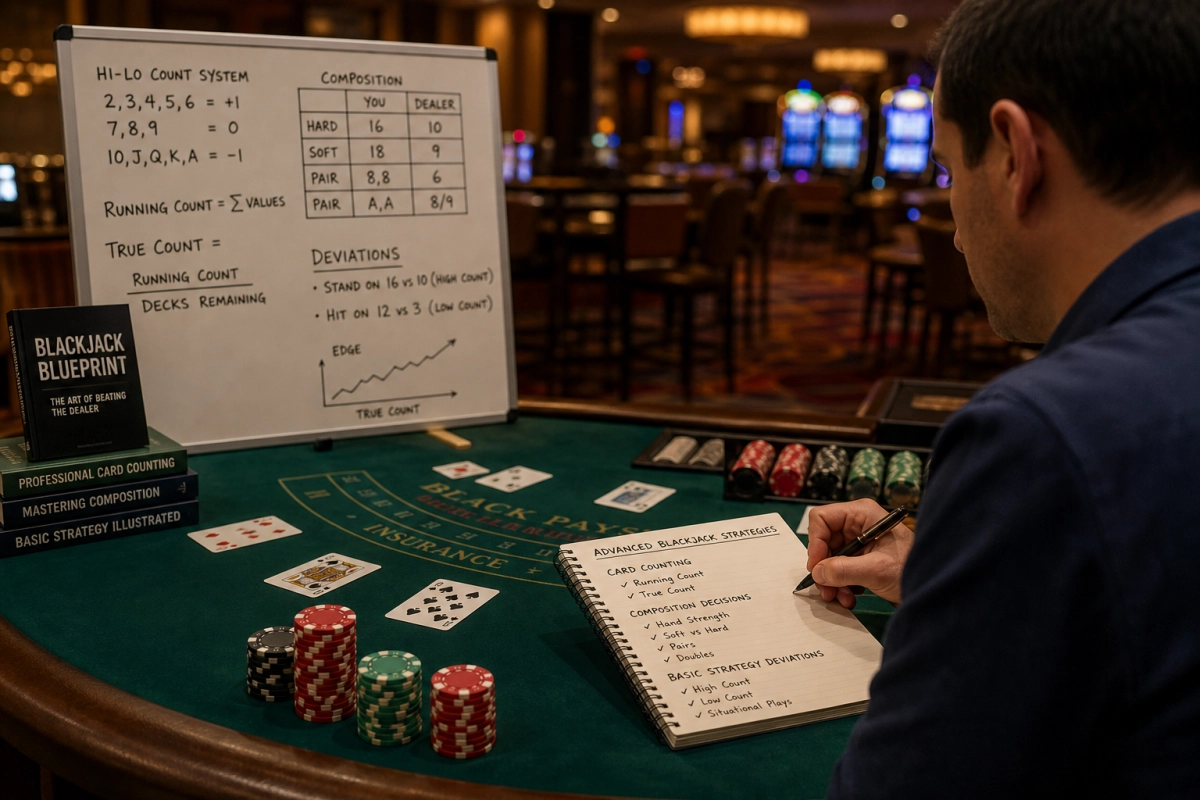
The most widely studied counting system is the Hi-Lo, which assigns a point value to every card as it is played. Cards two through six count as +1, cards seven through nine are neutral at 0, and tens, face cards, and aces each count as -1. A high positive running count signals that the remaining shoe contains a disproportionate number of high-value cards, shifting the mathematical edge toward the player.
To make this meaningful across shoes of different sizes, players convert the running count into a true count by dividing by the estimated number of decks remaining. A true count of +2 suggests a meaningful player advantage in most rule sets, at which point a card counter raises their bet — not out of intuition, but because the probability distribution of future cards has genuinely shifted. That same true count also forms the foundation for evaluating strategy deviations, which is where the next layer of advanced play becomes relevant.
Composition-Dependent Strategy: When the Cards in Your Hand Change the Math
Basic strategy evaluates each decision based on two inputs: the player’s total and the dealer’s upcard. That simplification works well across millions of hands, but it smooths over a distinction that matters in individual situations. Two hands producing the same total can carry meaningfully different probabilities, and experienced players recognize when that difference is large enough to warrant a different action.
This concept is called composition-dependent strategy, and it applies most visibly in single-deck games. The clearest example involves a hard 16 against a dealer’s 10. A hand of 10-6 and a hand of 9-7 are treated identically under basic strategy. A hand of 8-5-3, however, involves three cards — and because those three low cards have already been removed from the available pool, the probability of drawing a bust card is slightly reduced. In a single-deck game, that shift is measurable enough to influence the correct play.
The 16 vs. 10 Decision in Practice
When a player holds a multi-card hand totaling 16, the deck has been proportionally depleted of the very cards most likely to cause an immediate bust. The probability of drawing a card that keeps the player alive without pushing past 21 is fractionally higher than the simplified chart assumes, making standing slightly more attractive than the standard advice suggests.
In multi-deck games, this effect shrinks substantially — removing three low cards from a shoe containing hundreds of remaining cards barely moves the probability needle. Composition-dependent adjustments therefore carry the most practical value at single-deck tables. Even there, the impact is measured in fractions of a percentage point. For players focused on optimizing every decision, however, those fractions compound meaningfully over time.
When Deviating from Basic Strategy Is Mathematically Justified
Strategy deviations are perhaps the most misunderstood element of advanced blackjack play. Casual observers sometimes view any departure from the chart as a mistake, assuming it represents a universal truth. In reality, the chart was derived under the assumption of a neutral, unexamined shoe. Once a player has reliable information about deck composition, certain departures from the chart are not errors but corrections.
These deviations fall into two broad categories. Betting deviations involve adjusting wager size based on the true count — the more financially significant category for a card counter. Playing deviations involve changing an in-hand decision based on that same count information, and this is where advanced strategy becomes genuinely granular.
The Illustrious 18 and Their Logic
Among the playing deviations studied by blackjack researchers, a subset known informally as the Illustrious 18 represents situations where count-based departures from basic strategy carry the most mathematical weight. Each corresponds to a specific true count threshold at which the probabilities surrounding a decision cross a breakeven point and tip in a different direction.
Some of the most consequential examples include:
- Taking insurance at a true count of +3 or higher, where the concentration of tens makes the side bet statistically favorable rather than disadvantageous
- Standing on 16 versus a dealer’s 10 once the true count reaches a positive threshold, rather than hitting as basic strategy dictates in a neutral shoe
- Standing on 15 versus a dealer’s 10 when the count is sufficiently positive, for the same underlying reason
- Doubling down on 10 against a dealer’s 10 or ace when the true count is strongly positive, shifting what is normally an inadvisable double into profitable territory
- Standing on 12 against a dealer’s 3 or 4 at lower positive counts than most players would intuitively expect
What unifies these deviations is the logic that drives card counting itself. The true count does not change the structure of the game — it changes the probability landscape within which each decision is made. Standing on 16 versus 10 at a true count of +5 reflects a shoe where high card density makes the dealer’s completion of a strong hand more likely and the player’s bust risk more relevant. The math has shifted, and the correct decision shifts with it.
Playing with Precision, Not Just Knowledge
There is a meaningful difference between knowing advanced blackjack strategies and applying them correctly under casino conditions. Card counting, composition-dependent adjustments, and count-based deviations are each coherent in isolation. Combining them at the table — maintaining an accurate running count, converting to a true count, sizing bets appropriately, and still executing the right decision on a multi-card 16 — demands practiced fluency that cannot be acquired by reading alone.
This is partly why these strategies remain effective in environments where they are theoretically known. The gap between understanding a concept and executing it accurately, consistently, and without visible tells is wide enough that most players never fully close it. For the serious player, the appropriate response is calibration: composition-dependent decisions offer the greatest value at single-deck tables with deep penetration, while count-based deviations matter most in games where the true count swings significantly.
What all three areas share is a common foundation — they treat blackjack not as a guessing game governed by intuition, but as a probability problem that responds to information. The house edge is not a fixed wall; it is a dynamic quantity that shifts with deck composition, rule variations, and decision quality. Advanced players do not expect to eliminate that edge entirely. They expect to understand exactly where it comes from, how it moves, and how to place themselves on the right side of it as often as the math will allow.
That orientation — rigorous, patient, and grounded in probability rather than superstition — is ultimately what distinguishes an experienced blackjack player from one who has simply spent more time at the table.