Why play blackjack online and what to expect at a virtual table
When you play blackjack online, you get the classic casino game in a format that fits your schedule and budget. You’ll find two main formats: live dealer games, which stream a real table and human dealer, and RNG (random number generator) tables, where software deals digitally. Both let you place bets, make the same strategic decisions, and aim to beat the dealer by getting closer to 21 without going over.
Before you join a table, you should check a few details so you know what to expect: number of decks, dealer rules (does the dealer hit or stand on soft 17?), payout for a natural blackjack (usually 3:2, but some tables pay 6:5), and available side bets. These variables influence how much the game favors the house and which strategic choices will work best for you.
How hands are valued and the objective you play toward
The basic goal and card values
Your primary objective is simple: form a hand value closer to 21 than the dealer’s without exceeding 21 (busting). Card values are straightforward:
- Number cards (2–10) are worth their face value.
- Face cards (Jack, Queen, King) are each worth 10.
- Ace can count as 1 or 11 — the value that helps your hand most without causing a bust.
A two-card Ace plus a 10-value card is “blackjack” or a “natural” and usually pays better than a regular win.
Common player actions and what they mean
When it’s your turn, you’ll use one of several actions. Online tables provide buttons to make these moves quickly:
- Hit: Take another card to increase your hand total. Use this when your total is low and the risk of busting is acceptable.
- Stand: Keep your current total and end your turn. This is the safe choice when you’re satisfied with your hand.
- Double down: Double your original bet and receive exactly one more card. Best used when the odds favor improving a strong two-card total (commonly 9–11).
- Split: If you have two cards of the same rank, split them into two hands and place an equal bet on the new hand. Splitting aces and eights is usually correct; avoid splitting tens.
- Surrender (if offered): Forfeit half your bet and end the hand early — useful when your chances are poor against the dealer’s upcard.
- Insurance: A side bet offered when the dealer shows an Ace. It pays if the dealer has blackjack but is generally considered a weak long-term bet.
Dealer play follows a set house rule: the dealer reveals their hole card and must hit or stand according to the table’s rule (commonly hit until 17 or higher). Because the dealer acts after you, your decisions determine most of the outcome and where you can apply strategy.
With these basics in place — formats, card values, and the standard actions you can take — you’re ready to learn the strategic rules and bankroll tips that reduce the house edge and improve your results at online blackjack tables.
Basic strategy: decisions that minimize the house edge
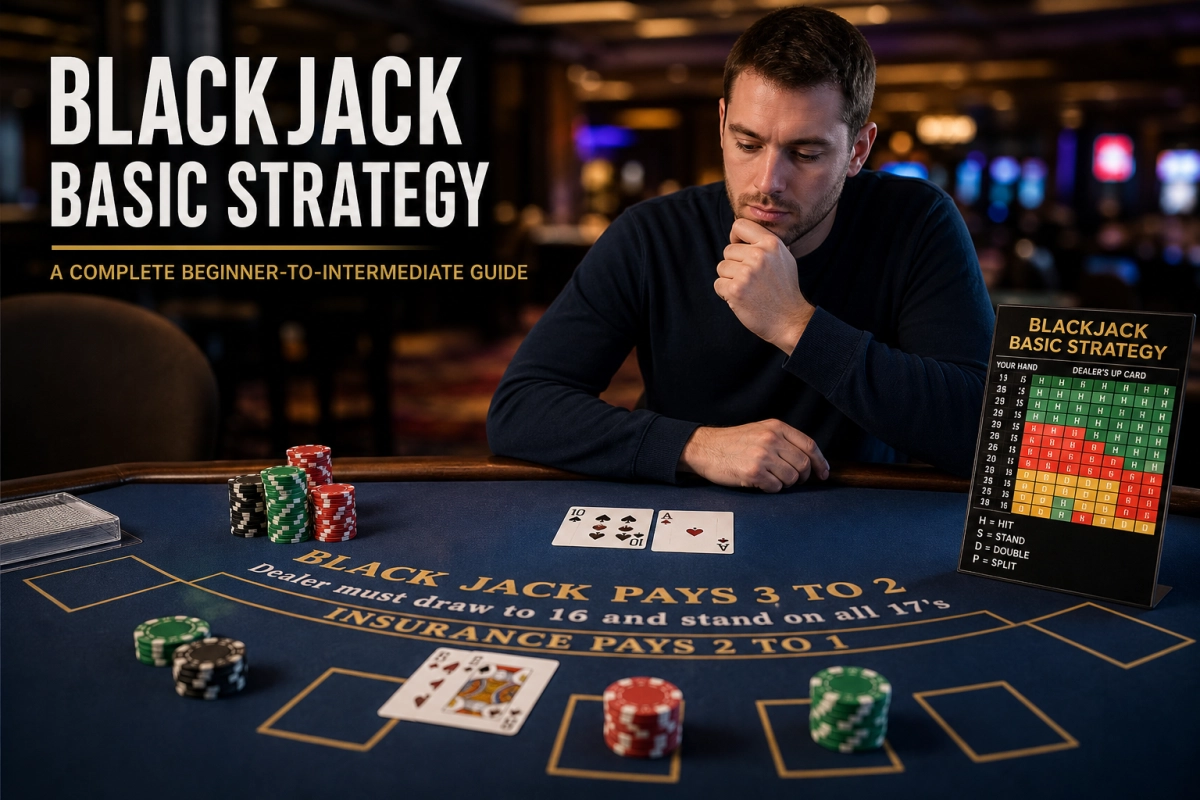
Basic strategy is a mathematically derived set of plays that tells you the statistically best action (hit/stand/double/split/surrender) for every combination of your hand and the dealer’s upcard. Using it consistently reduces the house edge to the smallest possible amount for the rules in play. You don’t need to memorize a full chart right away, but know these common, high-impact rules of thumb:
- Hard totals (no usable ace): Stand on 17 or higher; hit on 8 or less. For 12–16 (a “stiff” hand) generally stand if the dealer shows 2–6 and hit if the dealer shows 7–A.
- Soft totals (with an ace counted as 11): Be more aggressive—double when you can. For example, with soft 13–18 (A+2 through A+7) double versus dealer 4–6 (and sometimes 3–6 depending on rules); otherwise hit or stand per chart.
- Doubling down: Usually double on hard 9 versus dealer 3–6, on hard 10 versus dealer 2–9, and on hard 11 versus dealer 2–10.
- Splitting pairs: Always split aces and eights. Never split tens or face cards. Split twos and threes vs dealer 2–7, split sixes vs 2–6, sevens vs 2–7, and nines vs 2–6 and 8–9 (but not vs 7 or 10/ace).
- Surrender and insurance: Surrender when you have a hard 16 vs dealer 9–A (and sometimes 15 vs A) if surrender is allowed. Avoid insurance—it’s a separate bet with negative expected value in most games.
These rules change slightly depending on deck count and dealer behavior (hit or stand on soft 17), so consult a basic strategy chart customized to the table before you play and practice with free RNG tables until the decisions feel automatic.
Bankroll management and bet sizing for longer play
Skill can reduce the house edge, but variance still exists. Bankroll management is the practical tool that keeps one bad run from ruining your session. Follow these guidelines:
- Set a session bankroll: Decide how much you can comfortably lose before you sit down. Never chase losses by increasing the bankroll.
- Use a fixed betting unit: A common rule is 1–2% of your session bankroll per hand for consistent, low-variance play. This keeps swings manageable and lets you play more hands.
- Establish stop-loss and win-goal limits: Decide a threshhold to walk away—both for losses and modest profits. Stopping while ahead preserves gains.
- Avoid aggressive progression bets unless you understand the risk: Martingale-style doubling can wipe out a bankroll quickly during normal losing streaks.
In live dealer games where counting or table-hopping is possible, players sometimes vary bets (a “bet spread”). If you try a spread, keep it proportional to your bankroll and be aware casinos may limit or refuse players who change bet sizes markedly.
Advanced options: card counting, side bets, and live-dealer quirks
Some advanced techniques and table features deserve a brief note:
- Card counting: Effective in shoe games with finite decks and predictable shuffle intervals (live dealer). It’s virtually impossible in RNG tables and often thwarted by automatic shufflers or frequent reshuffles. Counting requires practice, bankroll depth, and discretion—casinos watch for it and can restrict play.
- Side bets: Most side bets (perfect pairs, 21+3, etc.) carry a much larger house edge than the main game. They’re fine for occasional entertainment but poor value for regular play.
- Live-dealer specifics: Pay attention to shoe penetration (how many cards are dealt before a shuffle), dealer speed, and table limits. Streaming tables mimic real play rhythm—use them if you prefer human interaction and predictable dealer behavior.
Stick to basic strategy, manage your bankroll, and choose games with favorable rules (fewer decks, dealer stands on soft 17, 3:2 payouts) to get the best long-term results at online blackjack tables.
Putting strategy into practice
Now that you know how hands are valued, the core actions, basic strategy, and bankroll principles, the most important step is to put those ideas into low-risk practice. Start at free RNG tables to build muscle memory for the charted plays, then move to small-stakes tables once your decisions feel automatic. Track sessions so you can learn from patterns without letting short-term variance shape your choices.
Quick pre-play checklist
- Confirm table rules: decks, dealer stands/hits on soft 17, and blackjack payout (3:2 vs 6:5).
- Set your session bankroll, betting unit (1–2% recommended), and stop-loss/win-goal before you sit down.
- Have a basic strategy chart handy (digital or printed) until the plays are memorized.
- Avoid routine use of insurance and most side bets; treat them as entertainment rather than value plays.
- Practice doubling and splitting decisions in free play so you won’t hesitate at the real table.
Resources and practice
For clear strategy charts, rule comparisons, and calculators that show how rule variations affect house edge, check a trusted reference like Wizard of Odds Blackjack Guide. Use that kind of resource alongside free-play tables to refine your approach before playing with real money.
Responsible play
Blackjack can be skillful and engaging, but it still carries risk. Play within your means, keep sessions time-limited, and never chase losses. If gambling ever becomes a problem, seek support from local resources or national helplines. With disciplined bankroll management, consistent basic strategy, and thoughtful game selection, you’ll make smarter decisions and enjoy a better online blackjack experience.