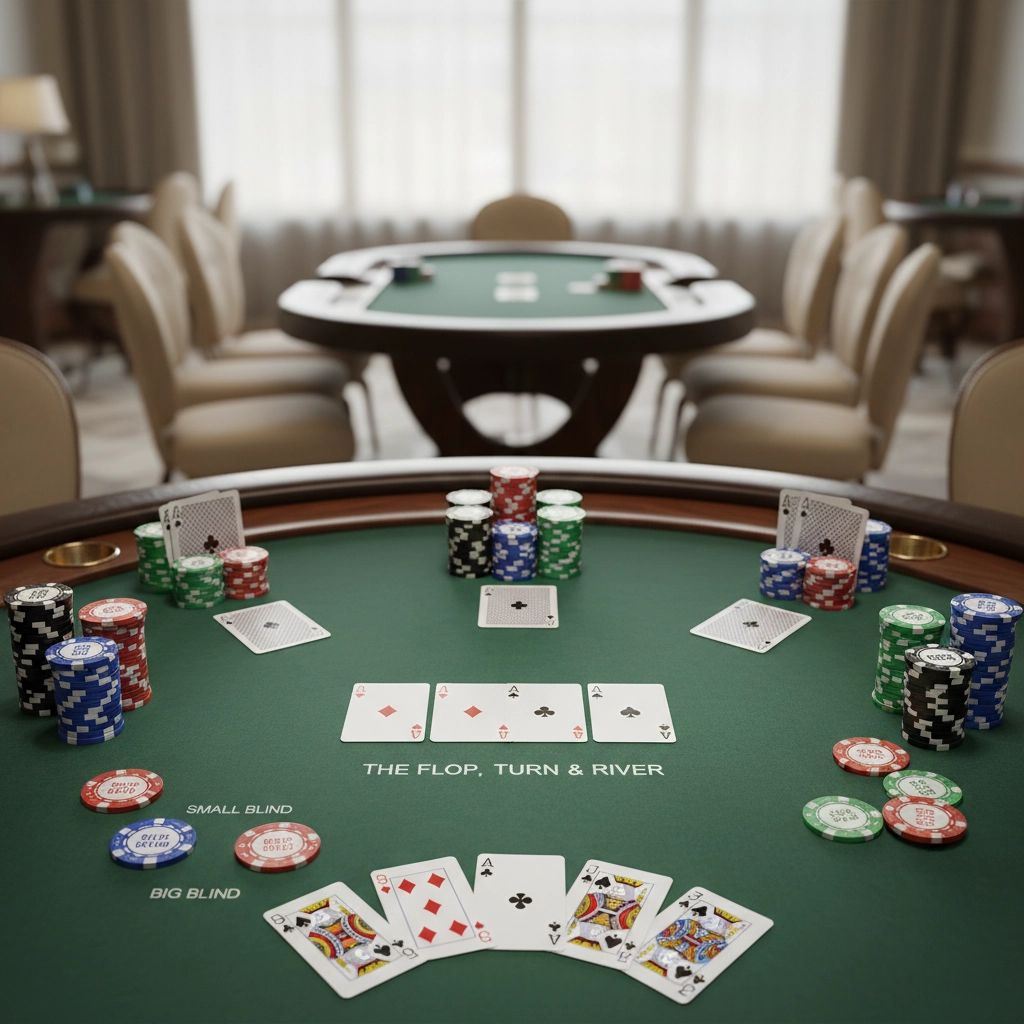
Why knowing blinds, betting rounds, and hand rankings matters for your game
If you want to play Texas Hold’em well, you need to understand three core elements that control every hand: the blinds that create the pot, the sequence of betting rounds that determine action, and the hand rankings that decide who wins. These rules aren’t just formalities — they shape strategy, bankroll decisions, and how you read opponents. As you read, you’ll see how position, forced bets, and the order of play all interact to create the game’s tension and reward.
What you need to have at the table before the cards are dealt
- Deck and players: Texas Hold’em uses a standard 52-card deck and is usually played with 2–10 players. You and your opponents get two private cards (hole cards) and share up to five community cards.
- Dealer button and position: A dealer button marks the nominal dealer position for that hand. After every hand the button moves one seat clockwise, which changes players’ positions relative to the blinds and affects who acts first in each betting round.
- Blinds: Two forced bets — the small blind and the big blind — are posted by the two players to the left of the dealer. Blinds seed the pot and encourage action; without them, players could fold indefinitely with no cost.
How the game starts: posting blinds and dealing the hole cards
Before any cards are dealt, the players to the dealer’s immediate left post the small blind and big blind. The small blind is typically half the size of the big blind, and the big blind is usually equal to the table’s minimum bet. Once blinds are posted, each player receives two face-down hole cards — these are private and only for your use.
Forced bets, preflop decisions, and options you have
- Preflop action: After you get your hole cards, betting begins with the player to the left of the big blind. You can fold (give up), call (match the current bet), or raise (increase the bet).
- Raising and caps: In most cash games there is no limit to the number of raises per round beyond the table stakes; in limit games, raises are capped according to the betting structure. Tournament rules may also limit raises.
- When you act as the blinds: If you’re in the small or big blind, you have the option to check (if no raise has been made and you’re in the big blind) or complete the blind to call a raise, or fold if the raise is large.
Betting rounds: the sequence that determines the pot
There are four betting rounds in Hold’em — preflop, flop, turn, and river — and each one gives you choices based on your cards, position, and pot size. Understanding the order and what each round reveals is essential to developing hand-reading skills and choosing profitable actions.
Next, you’ll get a step-by-step walkthrough of each betting round, full hand-ranking order from high to low, and practical examples so you can apply these rules confidently at the table.

Step-by-step: what happens in each betting round
Each hand moves through four distinct streets where new information and betting opportunities appear. Think of each street as a decision node — your choice changes as community cards are revealed, stacks shift, and opponents’ patterns emerge.
- Preflop: After the blinds are posted and you receive your hole cards, action begins with the player left of the big blind. Decisions here are largely about starting-hand selection, position, and stack sizes: fold the weakest hands, open-raise with strong holdings or suited connectors in late position, and defend your blind when odds and opponent tendencies justify it.
- Flop: Three community cards are dealt face-up. The player left of the dealer who is still in the hand acts first. On the flop you evaluate made hands (pairs, two pair, sets), draws (flush and straight draws), and how your position affects bluffing or protection. Bet sizing tends to be a larger percentage of the pot when you have a value hand or are trying to charge draws; check or pot-control with medium-strength hands.
- Turn: A single fourth community card is added. Because fewer cards remain to come, the turn often commits more chips — a turn card can complete draws or strengthen/narrow ranges. Many players increase bet sizes on the turn; be mindful of pot odds and implied odds when calling. If you were semi-bluffing on the flop and pick up outs on the turn, you may continue aggression.
- River: The fifth community card completes the board and sets final hand values. With no more cards to come, bets on the river are about extracting value or folding to strong betting. Showdowns occur after the river betting round if multiple players remain; only the best five-card combination wins.
Throughout all streets, remember betting order rotates with the dealer button and that raises/cap rules depend on game format (no-limit, pot-limit, or fixed-limit). Position — acting after opponents — gives you information that often outweighs having slightly stronger cards in early position.
Hand rankings (best five-card hand wins) with practical examples
In Hold’em every player’s best five-card combination from their two hole cards plus the five community cards determines the winner. From highest to lowest:
- Royal flush: Ten-to-Ace of the same suit. Example: you hold A♠ K♠ and the board shows Q♠ J♠ 10♠ — unbeatable.
- Straight flush: Five consecutive cards of the same suit (not royal). Example: 6♥ 7♥ 8♥ 9♥ 10♥.
- Four of a kind (quads): Four cards of the same rank. Example: you hold K♦ K♣ and the board has K♠ K♥ 3♦ — quads.
- Full house: Three of a kind plus a pair. Example: board 9♣ 9♦ 5♠ and you hold 5♥ 9♠ — full house (nines full of fives).
- Flush: Five cards of the same suit. Example: you hold A♥ 7♥ and board shows Q♥ 6♥ 2♥ — ace-high flush.
- Straight: Five consecutive ranks, mixed suits. Example: 4♦ 5♣ 6♠ 7♥ 8♦.
- Three of a kind (set/trips): Three cards of the same rank. Example: you hold 8♠ 8♦ and the board pairs an 8.
- Two pair: Two different pairs. Example: you hold A♣ Q♣ and the board is A♦ Q♦ 7♠.
- One pair: Two cards of the same rank. Example: you hold J♠ J♥.
- High card: No pair — highest single card counts. Example: A♣ Q♦ 8♠ 5♥ 2♦ = ace-high.
When hands tie, the highest five-card combination wins; if identical, the pot is split. Kickers (your unused hole card) break ties between otherwise similar hands. Practically, always evaluate your best five and how the board might create stronger hands for opponents before committing chips.

Next steps for improving your Hold’em play
Rules and hand rankings are only the starting point. To turn knowledge into consistent results, focus on deliberate practice: review hand histories, track your position-based results, and experiment with bet sizing in low-stakes games. Balance aggression with discipline, protect your bankroll, and study opponents’ tendencies rather than trying to outplay perfect strategy every hand. Use tools like hand-range charts and equity calculators to speed learning, and consider joining a study group or coach for targeted feedback.
For official rules, nuanced examples, and further strategy articles, see Texas Hold’em rules and guides.
Frequently Asked Questions
What is the difference between the small blind and the big blind?
The small blind is a forced bet placed by the player immediately left of the dealer; the big blind is typically twice the small blind and posted by the next player. Blinds seed the pot, determine initial action order preflop, and rotate with the dealer button each hand.
How do the four betting rounds affect strategy?
Each street changes the information and the odds: preflop focuses on starting hands and position, the flop reveals major draws and made hands, the turn often increases bet sizes as ranges narrow, and the river is about extracting value or folding with no more cards to come. Adjust aggression, bet sizing, and calls based on the cards left, pot size, and opponents’ ranges.
When do kickers decide the winner?
Kickers are the highest unused cards that complete a five-card hand when players share pair(s) or other identical combinations. If two players have the same pair, the player with the higher kicker wins; if both have identical five-card hands, the pot is split.