

Why poker hand rankings control every decision you make
Every time you sit at a poker table you’re making decisions based on the same core system: hand rankings. Knowing which hands beat others and why they do is the foundation for sound betting, folding, and bluffing. In most common variants such as Texas Hold’em and Omaha, a strict hierarchy determines outcomes when two or more players reach a showdown. If you internalize that hierarchy, you’ll evaluate risk more accurately and avoid costly mistakes.
As you read, think about both absolute strength (how likely a hand is to win at a showdown) and relative strength (how that hand behaves against typical ranges of opponents). You’ll also want to understand tie-breakers — what happens when two players have the “same” type of hand. This part of the article focuses on the lower end of the ranking ladder: the hands you’ll most often see and how they compare to one another.
The basic rule: stronger made hands beat weaker made hands
At a high level the ranking follows simple logic: rarer hands beat more common hands. A Royal Flush is astronomically unlikely, so it beats everything else; a High Card is common, so it loses to any made pair or better. But rarity alone doesn’t give you the full toolkit. You should also learn specific tie-breaking rules, how kickers work, and practical implications for betting patterns. Below are the early entries in the ranking order, explained so you can recognize them and act accordingly.
Low-ranked hands you’ll fold, call, or sometimes bluff with
Start by mastering the bottom tiers. These hands are the ones you’ll see most frequently and will often be part of marginal decisions.
-
High Card
High Card describes a hand in which no two cards share rank and you don’t have a straight or flush. The value is determined by your highest card, then the next highest, and so on. For example, A–J–9–6–2 beats K–Q–10–8–3 because the ace outranks the king. High Card hands rarely win at showdown unless the board is very dry and opponents have missed draws.
-
One Pair
One Pair forms when two of your five cards share the same rank (e.g., two 7s). Pair hands are common and usually beat High Card. When comparing two pairs, the pair of higher rank wins; if pairs tie, kickers decide the outcome. For instance, pocket 9s will beat pocket 8s, but 9s with an ace kicker can beat 9s with a queen kicker.
-
Two Pair
Two Pair means you hold two different pairs plus a fifth card (the kicker). Two Pair is a solid made hand and frequently strong enough to bet for value, but it can be vulnerable to sets, straights, and flushes on coordinated boards. When comparing Two Pair hands, the higher pair wins; if those tie, the lower pair breaks the tie; if both pairs match, the kicker decides.
Understanding these three foundations — High Card, One Pair, and Two Pair — gives you immediate insight into showdown likelihoods and how aggressively to play. In the next section you’ll learn how Three of a Kind and the stronger made hands change the dynamics at the table, including straights, flushes, full houses, and beyond.

When trips change the game: Three of a Kind (Trips and Sets)
Three of a Kind — commonly called trips or a set — is the next step up the ladder and often the first hand that compels confident betting. Technically, any hand containing three cards of the same rank qualifies. The distinction between “set” (you hold a pocket pair and one matching card appears on the board) and “trips” (you hold one matching card and two are on the board) is important: sets are hidden and typically play more profitably because opponents are less likely to suspect you.
When comparing two Three of a Kind hands, the rank of the trips determines the winner (e.g., three jacks beat three nines). If the trips are the same rank — possible only on board trips — the highest remaining cards (kickers) decide the outcome. Trips are strong but vulnerable: straights and flushes can overtake them on coordinated boards, and a paired board can turn trips into a full house for someone holding the right card.
Practical play tip: bet for value and protection when you have concealed sets, especially on single-suited or connected flops where draws exist. With visible trips on the board, proceed cautiously — the best you can often do is extract value from one or two hands while avoiding overcommitting if the turn or river completes straights/flushes.
The high-stakes middle: Straights, Flushes, and Full Houses
These are the hands where tables shift from cautious to aggressive. Each has its own tie-breaking rules and strategic implications.
- Straight: five consecutive ranks. The highest card in the straight determines its rank (a 10-high straight beats a 9-high). Straights are powerful but susceptible to flushes when the board contains three suited cards.
- Flush: five cards of the same suit. Compare flushes by the highest card, then the next, and so on. A king-high flush beats a queen-high flush, regardless of straight possibilities.
- Full House: three of a kind plus a pair. Full houses are ranked first by the trips portion, then by the pair (e.g., 9s full of kings beats 8s full of aces). Full houses beat straights and flushes and are therefore a major strength-shifting hand.
Strategically, straights and flushes are great for value-betting but must respect board texture. If the board pairs on the turn or river, a previously dominant straight or flush can suddenly be second-best to a full house. Pay attention to blockers — holding cards that reduce opponents’ possible draws — and use them to shape bluffs or thin value bets.
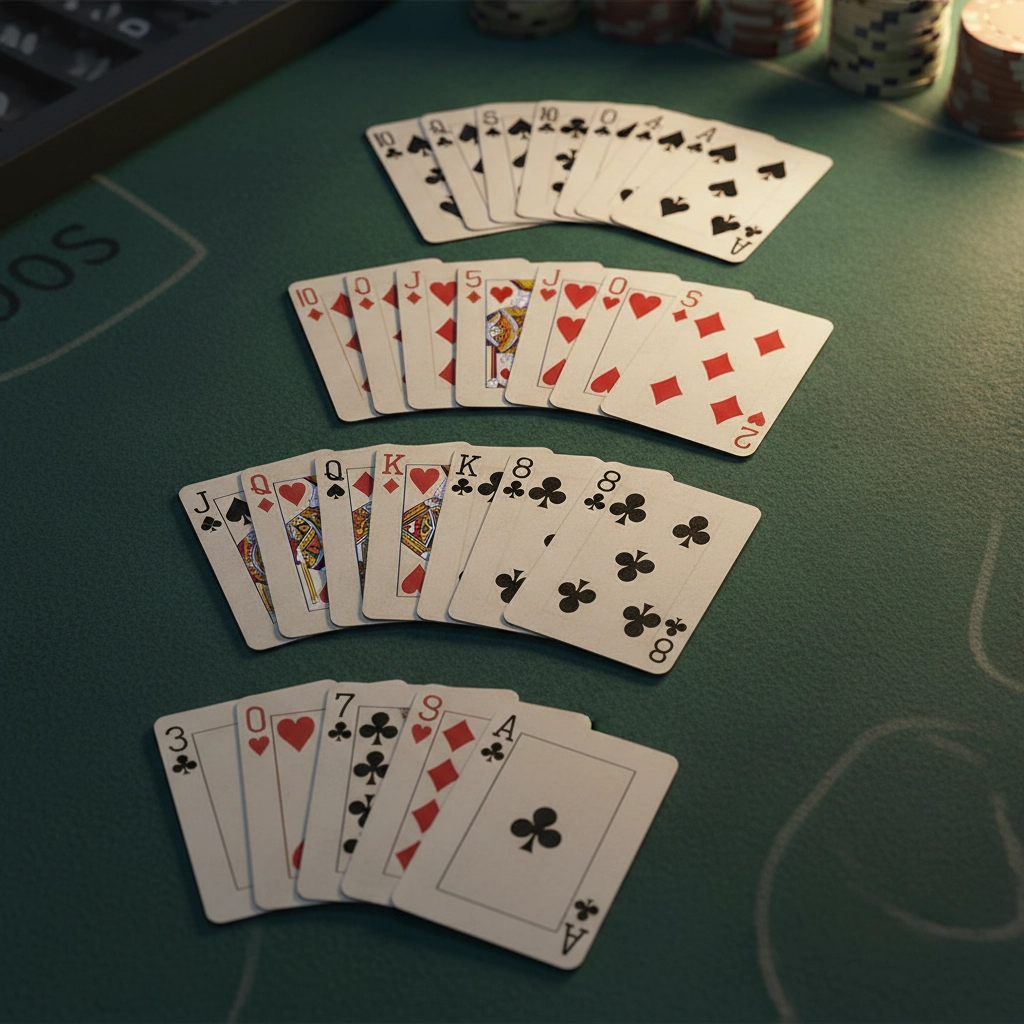
The top tier: Four of a Kind, Straight Flush, and the Royal Flush
These are the near-unbeatable hands. Four of a Kind (quads) consists of four cards of the same rank; quads compare by the rank of the four, with a kicker breaking ties if needed. Straight Flushes are five consecutive suited cards and only lose to higher straight flushes; the Royal Flush (A–K–Q–J–10 of the same suit) is the absolute top and cannot be beaten.
Because these hands are so rare, when you have them you should focus on extracting maximum value. However, be wary of board-induced ties: if the four-of-a-kind is made using community cards (e.g., quads on board), multiple players can share the best possible hand and the pot may be split. In high-action pots, consider slow-playing selectively to build the pot while avoiding giving free cards that could lead to split boards.
Knowing the hand rankings is only the first step — applying them at the table requires practice, observation, and adaptability. Pay attention to how boards develop, how opponents react to bets, and how your perceived range changes with each street. Over time, recognizing which hands dominate a given situation and which are vulnerable will become second nature.
Playing the Rankings: Next Steps
Treat poker hand rankings as a framework for decision-making rather than a rigid rulebook. Use them to inform bet sizing, to judge whether to protect or extract value, and to read likely opponent holdings. Practice in low-stakes games or online play, review hands after sessions, and study how board texture and position alter the practical strength of each hand. For structured lessons and deeper strategic reading, explore reputable resources such as poker strategy guides.
Frequently Asked Questions
How do kickers affect the outcome when hands have the same rank?
When two players share the same primary combination (for example, both have a pair or the same trips), the highest unrelated card(s) — kickers — determine the winner. Compare the highest kicker first; if tied, compare the next kicker, and so on. Kickers only matter when the principal part of the hand is identical.
When is slow-playing a powerful tactic and when is it risky?
Slow-playing can extract extra value when your hand is hidden and the board has few obvious draws, or when opponents are likely to bluff. It’s risky on coordinated boards where free cards can complete straights or flushes, or against aggressive players who will bet and charge you for draws. Use slow-play selectively and consider stack sizes and table dynamics.
Can multiple players share the best possible hand and split the pot?
Yes. If the best hand is formed entirely by community cards (for example, a straight or flush on the board) or if two players have identical five-card hands, the pot is split equally among those players. Be aware of board-induced ties when assessing how much value you can extract from a strong holding.