
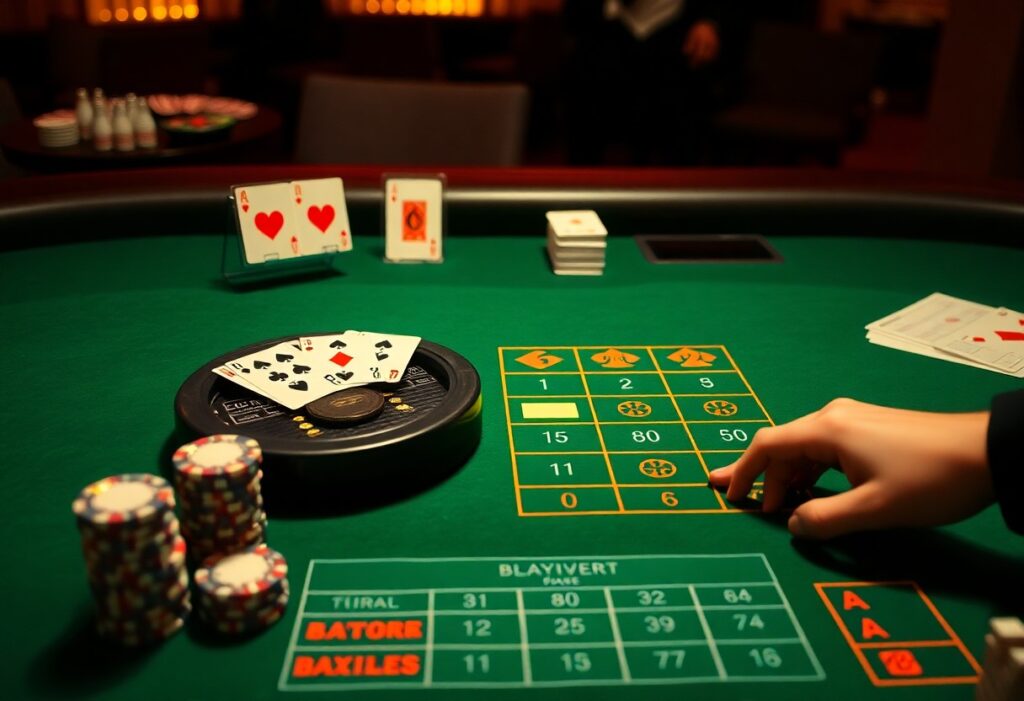
Strategy drives winning in baccarat: focus on the banker bet for the lowest house edge, practice disciplined bankroll management with preset loss and win limits, and avoid the high-variance tie bet that can rapidly deplete funds; treat streaks as noise, use odds-aware bets, and stop sessions when limits are reached to protect capital and sharpen long-term performance.
Understanding the Types of Baccarat
- Classic Baccarat
- Punto Banco
- Chemin de Fer
- Baccarat Banque
| Type | Quick facts |
|---|---|
| Classic Baccarat | Traditional European rules; typically played with a shoe of 6-8 decks and fixed third-card rules; house edge varies by bet. |
| Punto Banco | Most common in North America/online; bets limited to Banker, Player, Tie; banker edge ≈ 1.06%. |
| Chemin de Fer | French variant where players take turns as banker and can choose to draw; emphasizes player decision and psychology. |
| Baccarat Banque | Bank is more permanent (often held by a player or house); slower pace and higher-stakes, bank runs until funds exhausted. |
Classic Baccarat
Defined by fixed dealer rules and a focus on the Banker/Player contest, Classic Baccarat usually uses a 6-8 deck shoe; house edges mirror Punto Banco when commission is charged, so the smart bet often remains the banker due to its ~1.06% edge under standard 5% commission structures.
Punto Banco
Punto Banco is rule-driven: casinos enforce third-card mechanics, leaving only three betting choices – Banker, Player, Tie – with typical edges of ~1.06% (Banker), ~1.24% (Player) and ~14.36% (Tie paid 8:1); this makes tie bets expensive in the long run.
Punto Banco is normally dealt from a 6- or 8-deck shoe; some casinos lower commission to 4% or offer commission-free variants that pay reduced banker payouts (e.g., 1:1 except on a 6), which changes expected value calculations and alters optimal bet sizing for advantage-seeking players.
Chemin de Fer
Chemin de Fer hands control to players: the banker role rotates, and the chosen banker decides whether to draw a third card, so psychological play and bankroll management matter; historically played with 6 decks and favored for mid-to-high stakes social tables.
Because players make drawing decisions, skilled participants can influence outcomes; casinos typically take a commission or fee on banker wins, and the format is slower but offers strategic depth-good players who manage risk can reduce variance versus automated variants.
Baccarat Banque
Baccarat Banque places a more permanent bank that can be held by a player or the house until funds deplete; games are usually higher-stakes, the bank covers larger exposure, and rules for third-card play resemble Chemin de Fer but with different banking contracts.
Banker retention in Baccarat Banque creates longer stretches of bank advantage and larger swings; table minimums are commonly higher, and the bank’s backing arrangements (player-funded vs house-funded) materially affect liquidity and risk for others at the table.
Thou, choose the variant that fits your bankroll, preferred pace and edge tolerance.
Essential Tips for Playing Baccarat
Prioritize bets with the lowest house edge: the Banker (~1.06%) outperforms the Player (~1.24%), while the Tie (~14.36%) is the most dangerous. Set session goals-stop after 10-20% profit or a 30% loss-and use flat betting to control variance. Monitor commission rules and table limits closely. Assume that you factor commission and table specifics before increasing stakes.
- Bet Banker for the lowest long-term edge.
- Avoid Tie due to its high house edge.
- Flat betting (consistent wagers) reduces volatility.
- Set clear session limits: e.g., 10-20% profit target, 30% stop-loss.
- Check commission, deck count (6 vs 8), and table minimums.
- Treat side bets as entertainment, not value plays.
Bankroll Management
Allocate a session bankroll equal to 2-5% of your total gambling funds-for example, $1,000 total → $20-$50 per session-and cap individual wagers within that pool. Favor flat betting over progressions; a steady $25 bet on the Banker minimizes drawdown. Use a 30% stop-loss and a 15% profit-take rule to protect capital and extend play.
Choosing the Right Table
Prefer 6-deck games when available and verify the Banker commission-standard 5% commission yields the ~1.06% house edge; some high-limit tables offer reduced or altered commissions. Match table minimums to your session bankroll-$10-$250 suits casual players, $1,000+ for high rollers-and watch shoe speed, as faster shoes increase hands per hour and variance.
Also inspect dealer and shoe behavior: deeper shoe penetration or slower dealing reduces hands per hour and can ease variance for disciplined players. Compare side-bet payouts and their advertised probabilities-many payoffs carry house edges well above 10%. Finally, choose tables with transparent commission rules and visible limits to avoid unexpected rule changes that harm your bankroll or strategy.
Step-by-Step Guide to Playing Baccarat
| Step | Action / Key Detail |
|---|---|
| 1. Place Bets | Choose Player, Banker, or Tie; typical table limits run from $10 to $5,000 depending on casino. |
| 2. Deal | Two hands dealt from a 6-8 deck shoe, each receives two cards; totals calculated mod 10. |
| 3. Third-Card Rules | Drawing is automatic: Player draws on 0-5, stands on 6-7; Banker follows a deterministic table based on its total and Player’s third card. |
| 4. Payouts & Commission | Player pays 1:1 (house edge ~1.24%), Banker pays 1:1 minus 5% commission (house edge ~1.06%); Tie payouts vary-often 8:1 with a ~14.36% house edge. |
| 5. Settle & Shuffle | Winning bets paid; shoe is reshuffled when the cut card appears, typically after ~50-80 hands per shoe. |
How to Place Bets
Place bets before the dealer calls “no more bets”; casinos usually offer three options: Player (house edge ~1.24%), Banker (best option, ~1.06% after 5% commission), and Tie (high-risk, often ~14.36% on 8:1). For example, a $100 Banker wager pays $95 after 5% commission, while a $100 Tie at 8:1 returns $800 but carries a much larger house edge.
Understanding the Game Flow
Rounds proceed quickly: two hands dealt, totals checked, then third-card rules applied automatically; most live tables use a 6-8 deck shoe and deal roughly 40-80 hands per shoe, with each round taking about 20-40 seconds. Dealers follow fixed rules so player decisions only concern bets, not draws, making pace and shoe composition key factors for tracking patterns.
For deeper clarity: Player draws on totals 0-5 and stands on 6-7; Banker draws on 0-2 regardless, draws on 3 unless Player’s third card was 8, draws on 4 if Player’s third card was 2-7, draws on 5 if Player’s third card was 4-7, and draws on 6 only if Player’s third card was 6-7; Banker stands on 7. This deterministic chart eliminates judgment calls and defines every outcome once initial cards are dealt.
Factors Influencing Baccarat Outcomes
Variability comes from shoe composition, betting choices and game rules; most casinos use six to eight decks, which alters probabilities and dilutes card-pattern effects. Professionals track banker bet, player bet, tie bet and shoe depth to assess short-term trends. The most actionable variables are deck count, shuffle frequency and commission structure.
- Banker bet – lowest house edge in standard play (~1.06% with 5% commission)
- Player bet – slightly higher edge (~1.24%)
- Tie bet – high house edge (~14.36% at 8:1), often the most dangerous wager
- Shoe depth and number of decks – affect pattern visibility and any counting attempts
House Edge
Standard eight-deck baccarat yields a banker house edge of about 1.06% (with 5% commission), a player edge near 1.24%, and a tie bet edge around 14.36% when paid 8:1. Skillful bankroll management and favoring the banker wager are the primary ways to minimize losses over time.
Card Patterns
Patterns such as streaks and runs appear frequently-streaks of 4-6 hands commonly show up within a shoe-but they don’t alter the underlying probabilities. Players often consult the Big Road and derived “roads” to visualize results, yet relying solely on perceived patterns for wagers can be dangerous.
The Big Road, Bead Plate and derived charts (Big Eye Boy, Small Road, Cockroach Pig) translate outcomes into trend signals; each applies specific marking rules for ties and streaks. Casinos dealing 6-8 decks with periodic shuffles limit pattern persistence, and empirical analyses indicate card‑counting in multi‑deck baccarat rarely shifts the expected value by more than a few hundredths to a few tenths of a percent, so systematic pattern-chasing is generally unprofitable.
Pros and Cons of Playing Baccarat
| Pros | Cons |
|---|---|
| Low house edge on Banker (~1.06%) and Player (~1.24%). | Banker wins are reduced by a typical 5% commission. |
| Simple rules-easy for beginners to learn quickly. | Tie bet carries a very high edge (~14.36% with 8 decks). |
| Fast pace-many hands per hour suits active players. | Speed can accelerate losses and poor decisions. |
| Low skill requirement; strategy focuses on bet selection. | Limited strategic depth compared with poker or blackjack. |
| Works well with bankroll-management systems like flat betting. | Side bets often have edges > 20-30%, tempting players. |
| Common six-to-eight deck shoes provide predictable probabilities. | Shoe composition and commission rules vary by casino, affecting value. |
| Suitable for high rollers due to high table limits in VIP rooms. | Table limits can prevent recovery after large losses. |
| Lower variance on Banker/Player compared with many casino games. | Pattern-chasing systems are ineffective over long samples. |
Advantages of Baccarat
Banker bets provide the most mathematically favorable option with an approximate 1.06% house edge, slightly better than Player at ≈1.24%, so focusing on Banker reduces long-term loss rate. With straightforward draw rules and typical six-to-eight deck shoes, experienced players can play many hands per hour and exploit disciplined bankroll sizing; casual players benefit from low skill demands while serious players can still find value in consistent, low-variance staking plans.
Disadvantages of Baccarat
Commission on Banker wagers (commonly 5%) lowers effective returns, and the Tie bet is exceptionally costly-about 14.36% house edge on an eight-deck shoe-so aggressive side-betting quickly erodes bankrolls. Rapid gameplay increases variance, and casinos sometimes restrict strategies via table limits or modified commission rules, which can blunt player advantage in longer sessions.
In standard eight-deck Punto Banco probabilities are roughly: Banker win ≈ 45.86%, Player ≈ 44.62%, Tie ≈ 9.52%, aligning with the edges above. Empirical sessions show long streaks do occur-recorded runs of 10-12 consecutive wins happen-so systems like martingale face practical caps; focusing on disciplined bet sizing, exit rules, and avoiding high-edge side bets yields better expected outcomes over thousands of hands.
Advanced Strategies for Seasoned Players
Seasoned players prioritize marginal gains: disciplined bet sizing, selective shoe play, and exploiting rule nuances. For instance, the banker bet (~1.06% house edge) is statistically superior to player (~1.24%), while the tie (≈14.36% house edge) is a high-risk outlier; casinos commonly use 6-8 deck shoes and impose a 5% banker commission, both of which materially affect long-term expectancy.
- Track shoe composition and discard patterns to spot favorable sequences.
- Use conservative progressions (e.g., limited Paroli) to contain variance.
- Rotate tables and games to avoid detection when applying advantage plays.
- Combine small edges (rule choice, commission reductions) rather than chasing single big plays.
Table: Advanced Strategy Trade-offs
| Strategy | Effect / Notes |
|---|---|
| Banker bias tracking | Low variance; relies on detecting sustained banker frequency above expectation. |
| Progression systems | Can stabilize wins short-term but risk rapid bankroll depletion under streaks (e.g., 10 losses ≈ 2^10 multiplier). |
| Card/edge advantage plays | Potential small positive EV (<0.5%) in rare setups; aggressive casino countermeasures. |
Betting Systems
Structured progressions can manage volatility but don’t change expected value; for example, a 10-step Martingale requires a 1-unit base to reach a 1,023-unit exposure after 10 losses, creating bankroll-busting risk. Favor limited, stop-loss-driven systems like short Paroli or proportional staking (Kelly fraction ≈0.01-0.05 for tiny edges) to balance growth and drawdown.
Card Counting Techniques
Card tracking in baccarat focuses on shoe composition affecting third-card draws and naturals; with 6-8 decks, practical edge is tiny-typically under 0.5%. Skilled counters monitor the ratio of high-value cards (7-9) to low (0-6) and increase unit size only when the count indicates a measurable shift, while acknowledging frequent reshuffles blunt effectiveness.
In practice, methods include simplified running counts and selective play on shoes showing statistical anomalies; edge-sorting (famously used in high-profile cases like Phil Ivey) illustrates non-count advantage play but carries legal and ethical risk. Casinos counter with continuous shuffling, shorter shoe cycles, and surveillance, so achievable EVs are small and require strict execution to realize.
Final Words
Ultimately, mastering baccarat demands disciplined bankroll management, clear betting strategies, and an understanding of odds and house edge. Study patterns, favor banker bets statistically, and avoid progressive systems that inflate risk. Pair technical knowledge with patience and controlled play to increase consistency and long-term enjoyment at the casino table.
FAQ
Q: What are the basic rules and bet types I must know before playing Baccarat?
A: Baccarat has three primary bets: Banker, Player and Tie. Each hand is dealt according to fixed drawing rules – you do not choose to draw cards – and outcomes are determined by comparing two hands’ totals (last digit of the sum). Banker bets usually pay 19:20 after a commission (commonly 5%) because the Banker’s edge is slightly lower than the Player’s; typical house edges: Banker ≈ 1.06%, Player ≈ 1.24%, Tie much higher (often >10% depending on payout) and therefore far less favorable. Mini and full-table versions follow the same mechanics; commission structures and table limits can vary, so always check the payout and commission before betting. Avoid Tie bets for long-term play unless you accept much higher volatility for entertainment value.
Q: Which bankroll and betting strategies give the best long-term results in Baccarat?
A: The safest approach is disciplined bankroll management: set a session bankroll, size individual bets to a small percentage of that bankroll (commonly 1-2%), and establish clear stop-loss and take-profit limits. Flat betting (wagering the same amount each hand) minimizes the risk of ruin and eliminates compounding losses. Progressive systems like Martingale can work in short bursts but are dangerous because table limits and large variance can wipe out bankrolls quickly. Track results, split your play into timed sessions, and avoid increasing bet sizes after losses; reducing bet size during adverse runs preserves longevity. Treat baccarat as a low-edge game and plan bets around bankroll sustainability, not guaranteed streaks.
Q: How should I handle side bets, table etiquette, and knowing when to quit?
A: Side bets often have much higher house edges than main bets and are best viewed as entertainment rather than value plays; only place them with money set aside for fun. Observe basic table etiquette: place chips clearly inside betting areas, avoid interrupting the dealer, don’t touch cards or chips in other players’ boxes, and act quickly so the game flows. Be aware of dealer calls for “no more bets” and avoid late wagers. Quit when your pre-set session limits are reached, when play turns emotionally driven, or when variance overwhelms your plan. Short-term streaks are normal in baccarat and do not indicate a change in underlying probabilities; leaving on a planned win or loss threshold preserves capital and discipline.