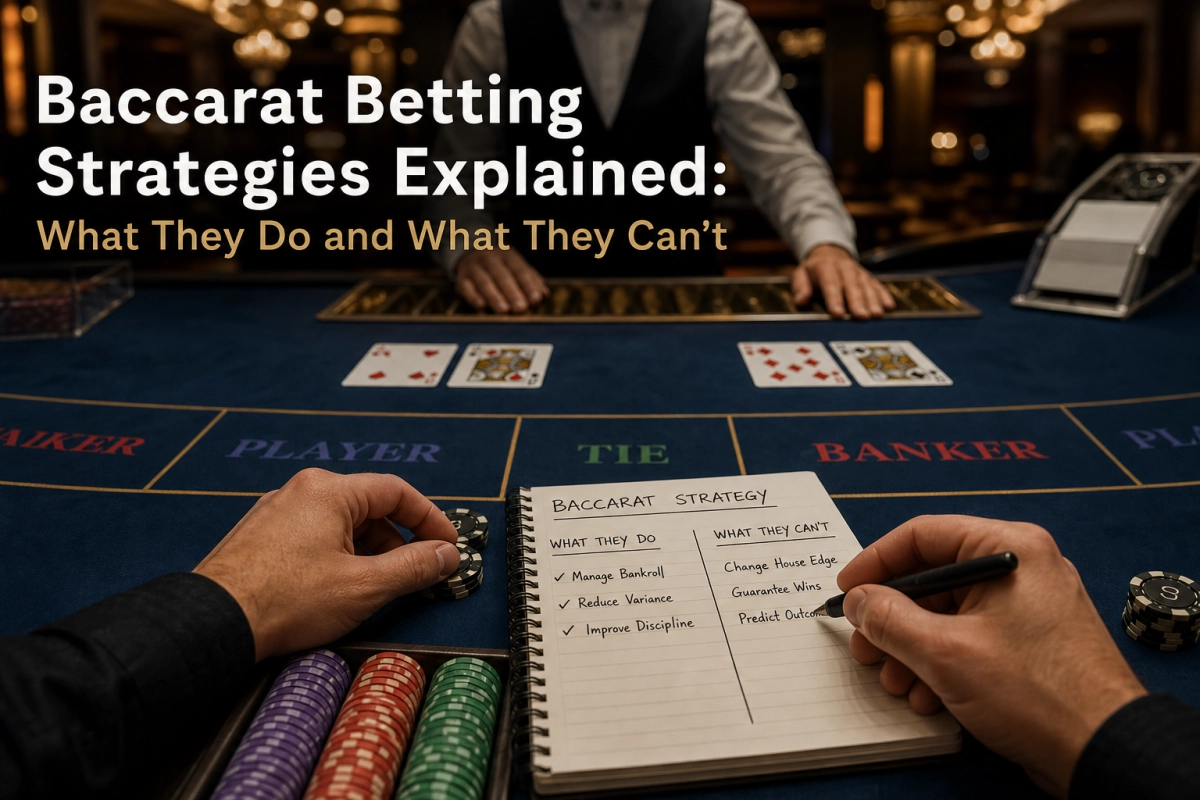
Casino baccarat’s simple gameplay belies the math behind betting choices; the Banker bet typically has the lowest house edge (even after the usual commission), the Player bet is a reasonable alternative, and Tie bets, despite attractive payouts, are the most dangerous with a much higher house edge, so understanding probabilities and commission effects is important for informed play.
Types of Baccarat
Tables split into several variants that change pace, betting limits and banker control; common options emphasize different skill and risk profiles. Key points to watch include the Player and Banker bet dynamics, the costly Tie payout, the typical 5% commission on Banker wins and the overall house edge.
- Player bets: 1.24% house edge (typical)
- Banker bets: ~1.06% after 5% commission
- Tie bets: ~14.36% house edge (8:1 payout)
- Commission usually 5% on Banker wins
- House edge varies by variant and rule set
| Variant | Key features / Typical metrics |
|---|---|
| Punto Banco (Classic) | Casino-driven shoe game, 6-8 decks, Banker 1.06% (5% commission), Player 1.24% |
| Mini Baccarat | Smaller table, faster rounds, lower minimums (often $5-$25), same basic odds as Punto Banco |
| Chemin de Fer | Players take turns as banker; more player decision-making, social format, fewer automatic draws |
| Baccarat Banque | Banker position more permanent and financed by a player or house, alters exposure and table strategy |
| EZ Baccarat | Modern variant removing some commissions or applying special rules to Banker wins; slightly different expected returns |
Classic Baccarat
Played as Punto Banco in most casinos, this full-size format uses a shoe with 6-8 decks, seats up to 12 and enforces a 5% commission on Banker wins; the statistical breakdown is Banker ≈1.06% house edge, Player ≈1.24%, and Tie ≈14.36% (8:1), making Banker the mathematically safest recurring bet.
Mini Baccarat
Designed for quicker play and lower stakes, Mini Baccarat compresses seating and dealing while retaining the same core rules and house-edge structure as classic Punto Banco; casinos favor it for higher turnover and players for lower minimums.
Tables run ties at the same high house edge, but Mini’s speed amplifies variance: shorter rounds mean more hands per hour and faster bankroll swings, so bankroll sizing matters-typical casino minimums hover around $5-$25 and the standard 5% commission on Banker still applies, preserving the ~1.06% advantage.
Thou, weigh the house edge, bet limits and table speed before selecting a variant.
Understanding the Odds
When weighing bets in baccarat it’s the math that guides smart play: standard six- or eight-deck games give Banker a win rate of about 45.86%, Player about 44.62% and Ties around 9.52%. That translates to a typical house edge of roughly 1.06% on Banker (with 5% commission), 1.24% on Player, and a very high ~14.36% on an 8:1 Tie. Small percentages create large differences over many hands.
Banker Bet Odds
The Banker bet delivers the lowest house edge: with a standard 5% commission casinos convert its raw win frequency into an effective edge of about 1.06%. Banker wins roughly 45.86% of hands, and although the commission reduces payouts, Banker remains the mathematically best single wager. For a $100 stake the expected long-term loss is about $1.06; over 1,000 bets that advantage for the house becomes substantial.
Player Bet Odds
By contrast, the Player bet pays 1:1 with no commission and wins about 44.62% of the time, producing a house edge near 1.24%. The gap versus Banker is small-roughly 0.18%-but compounds over many bets. Ties push the bet rather than pay, so a $100 Player wager averages about $1.24 lost in the long run.
Digging deeper, the Player bet’s slightly higher edge arises from the tie frequency (~9.52%) and standard payout rules; variance is marginally higher because pushes reduce paid wins. For perspective, switching from Player to Banker on repeated $100 wagers saves about $0.18 per bet, or roughly $180 over 1,000 bets, so even small percentage gaps matter in extended sessions.
Factors Influencing Outcomes
Several elements shift short-term outcomes in baccarat: shoe composition, betting patterns and table rules all influence variance and expected return. The number of decks affects card distributions, while commission rates and side bets alter the effective house advantage. Behavioral factors like stake progression change bankroll volatility without affecting underlying probabilities. Assume that even a small commission tweak or a different deck count can move expected returns by tenths of a percent.
- Banker
- Player
- Tie
- Deck count
- Commission
- Side bets
- Shoe composition
Card Rules
Third-card procedures determine most turn-by-turn outcomes: the Player draws on 0-5 and stands on 6-7, while the Banker draws on 0-2, and for totals 3-6 follows a conditional table based on the player’s third card; the Banker stands on 7. These deterministic rules eliminate player choice in draw decisions and set precise probabilities for each two- or three-card total.
House Edge
Numeric edges are straightforward: in standard six- or eight-deck games the Banker edge ≈1.06% (with a typical 5% commission), the Player edge ≈1.24%, and the Tie carries roughly a 14.4% house edge at an 8:1 payout, making tie bets the most hazardous despite tempting odds.
Deck count and commission details shift those figures by hundredths of a percent; for example, six- versus eight-deck shoes change outcomes marginally, while no-commission variants or altered payouts on banker wins adjust both edge and volatility. Also note that most side bets push house edges into double digits, markedly increasing long-term loss rates.
Tips for Successful Play
In tight-seat decisions focus on bets offering best expected value: in 8-deck baccarat the Banker wins ~45.8% versus the Player‘s ~44.6%, yielding a house edge near 1.06% on Banker after the standard 5% commission. Favoring Banker reduces variance compared with chasing ties (~9.6% occurrence). Recognizing commission-adjusted odds and payout structures will guide sensible staking choices.
- Banker
- Player
- Tie
- Bankroll Management
- Betting Strategies
- House Edge
Betting Strategies
Flat betting-sticking to a fixed unit, often 1% of your bankroll-limits downside; for a $1,000 bank that’s $10 bets. Systems like 1-3-2-6 protect winnings with limited progressions, while Martingale can demand 64× the base after six losses, hitting table limits fast. Use progressions sparingly and match strategy to table limits and personal volatility tolerance.
Bankroll Management
Set clear per-session rules: many players apply the 1% rule, keep a stop-loss of 3-5% (e.g., $30-$50 on $1,000) and a profit target of 10-20% to lock gains; quitting after a loss streak prevents catastrophic drains. Allocate units so one streak of 6-8 losses won’t deplete funds.
Track outcomes by session, limit hands per session (50-200) to reduce fatigue, and only raise unit sizes after consistent wins-cap increases to avoid exponential exposure. Given baccarat’s low edge but meaningful short-term variance, keep a replenishment plan and detailed logs before adding funds.
Step-by-Step Guide to Playing Baccarat
Follow a concise sequence to place bets, observe the shoe, and interpret results; each round usually finishes in under a minute. Choose a table with suitable limits-many casinos use 6-8 decks and minimums from $5-$25-then decide between Banker (≈1.06% house edge), Player (≈1.24% HE) or Tie (house edge ≈14% with 8:1 payout) before the deal.
Quick Steps
| Step | Action / Example |
|---|---|
| 1. Choose table | Confirm decks (6-8), commission (usually 5%) and limits, e.g., $10-$2,000 |
| 2. Place bet | Bet on Banker, Player, or Tie before the dealer burns and deals |
| 3. Deal & check | Two cards to each hand; naturals (8 or 9) end the round |
| 4. Apply third-card rules | Player draws on 0-5; Banker rules depend on Player’s third card |
| 5. Settle bets | Payouts: Player 1:1, Banker 1:1 minus commission, Tie commonly 8:1 |
Game Setup
Sit, buy chips, and verify the shoe-most casinos use 6 or 8 decks-along with the table’s posted min/max and commission rate (often 5%). Dealers label the two hands as Player and Banker; betting closes before the first card is exposed. High-limit tables speed play and sometimes alter commission or payout structure, so check rules before placing larger wagers.
Gameplay Mechanics
Two cards are dealt to each hand; values: Ace=1, 2-9 at face value, 10/J/Q/K=0, and totals keep only the unit digit (e.g., 7+8=5). A natural 8 or 9 ends the round immediately. Bets pay: Player 1:1, Banker 1:1 minus commission, Tie often 8:1; the deterministic nature of draw rules makes bet selection the main strategic choice.
More detail on the third-card rule: the Player draws on totals 0-5 and stands on 6-7. The Banker draws based on its total plus the Player’s third card: Banker draws on 0-2 always; on 3 unless Player’s third card is 8; on 4 if Player’s third card is 2-7; on 5 if Player’s third card is 4-7; on 6 if Player’s third card is 6-7; stands on 7. These fixed rules eliminate drawing decisions for players and concentrate advantage management on bet sizing and choosing the lower-house-edge Banker or Player options, while avoiding the high-risk Tie.
Pros and Cons of Playing Baccarat
Balancing advantages and drawbacks shows why the Banker remains mathematically preferred for many players. The Banker bet has about a 1.06% house edge, Player ~1.24%, while the Tie (8:1) carries ≈14.36%. Quick rounds (20-40 hands/hour) amplify variance, and table minimums or side bets can dramatically increase expected losses. Focus on table selection and stake sizing rather than chasing streaks.
| Pros | Cons |
|---|---|
| Low house edge on Banker and Player | Banker commission (commonly 5%) reduces payouts |
| Very simple rules; minimal learning curve | Tie bet has very poor odds (≈14.36% house edge) |
| Fast play pace keeps sessions short | Rapid losses possible due to quick hand turnover |
| Clear statistical edge: Banker is best single bet | Side bets (Pairs, Dragon) often carry ≈10%+ house edges |
| Easy bankroll management and flat-betting | Limited skill means little room to outplay the casino |
| Common in both low- and high-limit rooms | High-limit tables can force larger wagers |
| Social, spectator-friendly game | Table etiquette and dealer rules limit deviation |
| Consistent math allows sound betting strategy | Psychological traps: streak-chasing and confirmation bias |
Advantages
The biggest edge comes from the Banker bet (≈1.06% house edge), which statistically wins more often because of drawing rules; over thousands of hands this small advantage compounds. Players benefit from straightforward staking – flat bets work well – and low variance versus many casino games. For example, betting $100 on Banker across 100 hands yields an expected loss near $106, a modest figure compared with many table or electronic options.
Disadvantages
Commission on Banker payouts (typically 5%) and the Tie bet’s ≈14.36% house edge are the main drawbacks, quickly eroding returns. Side bets like Pair frequently show house edges around 10% or higher, and fast hand rates create volatility. Casinos also adjust deck counts and commission rules to protect margins, so small mathematical advantages can be muted in practice.
To quantify impact: a single $100 wager has an expected loss of ≈$1.06 on Banker, ≈$1.24 on Player, and ≈$14.36 on an 8:1 Tie. Running 100 hands at $25 on Banker (2,500 total wagered) produces an expected loss ≈$26.50, illustrating how even low edges add up and why disciplined bankroll limits matter.
To wrap up
Presently, understanding baccarat odds shows the Banker bet carries the lowest house edge and is statistically the best choice despite the commission; Player is close but slightly worse; Tie is unfavorable due to high house edge. Apply disciplined bankroll management and a consistent approach to improve long-term outcomes.
FAQ
Q: Which bet gives the best odds – Player or Banker?
A: Banker has a slightly better expected return. In standard multi-deck Baccarat with a typical 5% commission on winning Banker bets, the house edge on Banker is about 1.06% versus about 1.24% on Player. Both pay even money (1:1) before commission; Banker wins more often due to the drawing rules, which is why casinos apply a commission. Exact figures shift with the number of decks and any altered commission structure, but Banker is generally the mathematically superior single bet.
Q: Is it optimal to always bet Banker?
A: From a pure house-edge perspective, consistently betting Banker is the best single-bet strategy because it minimizes expected loss over many hands. That said, short-term variance can produce long losing or winning streaks, and betting systems (Martingale, progressive schemes) do not change the underlying house edge and can escalate losses. Also check table rules: reduced or no-commission Banker tables, or different pay tables, can change which bet is preferable. Manage your bankroll, set limits, and accept that no strategy eliminates the house advantage.
Q: How do tie bets and side bets affect the odds and what should I know before playing them?
A: Tie bets and other side wagers carry much worse expected values than the main Player/Banker bets. Standard tie payouts of 8:1 produce a very high house edge (commonly cited around 14.36%); a 9:1 payout lowers that edge but it still remains substantially higher than Banker or Player (around 4.8% in many rule sets). Pair and other proposition bets typically have even larger edges and greater volatility. Treat side bets as entertainment rather than sound strategy; if your goal is to minimize expected loss, stick to Banker (or Player if you prefer no commission tables) and avoid proposition bets that inflate the house advantage.