This guide outlines the most common pitfalls at the blackjack table and how to avoid them, focusing on practical, evidence-based advice you can apply immediately. Avoid deviating from basic strategy, chasing losses with larger bets, and the tempting but often dangerous insurance and side bets; manage your bankroll, set limits, and understand table rules. Learn to read dealer procedures, maintain discipline, and use proven tactics to protect your edge and enjoy longer sessions.
Types of Blackjack Mistakes
| Basic Rule Violations | Examples: taking insurance when dealer shows an Ace, splitting 10s, or standing on hard 16 vs dealer 10 – each error can swing expected return by about 1-1.5%. |
| Betting Mistakes | Chasing losses, using large progressions, or betting more than 1-5% of bankroll per hand increases volatility and risk of ruin quickly. |
| Strategy Errors | Deviating from basic strategy typically increases the house edge from ~0.5% to 2-3% or more depending on frequency of mistakes. |
| Table Etiquette & Payouts | Failing to confirm 3:2 vs 6:5 blackjacks or dealer rules (hit/stand on soft 17) can add ~1%+ to the house advantage. |
| Distraction & Tilt | Alcohol, phone use, and emotional tilt lead to rushed decisions, missed signals, and often larger, poorly timed bets. |
- Basic Rule Violations
- Betting Mistakes
- Strategy Errors
- Table Etiquette
- Tilt & Distraction
Basic Rule Violations
Players commonly take insurance (a sucker bet paying 2:1) or fail to split 8s and Aces, both of which hurt EV. Standing on a hard 16 versus a dealer 10 or hitting a soft 18 against a dealer 9 are concrete examples that cost measurable percentages of expected return; following basic, situation-specific rules restores much of the lost edge.
Betting Mistakes
Chasing losses with big raises, using naive progressions, or wagering a large portion of your bankroll in one hand are common faults. Practical play often limits the unit to 1-2% of bankroll to survive variance; failure to do so converts normal downswings into catastrophic bankroll depletion.
Adopt a clear unit-size plan: with a $1,000 bankroll a $10 unit (1%) keeps swings manageable and avoids ruin, while flat-betting preserves long-term expectation; progressive systems can briefly mask losses but raise the chance of catastrophic loss. Any disciplined approach to bet sizing and stop-loss rules will dramatically reduce the impact of variance.
Tips for Avoiding Common Mistakes
Sharpen focus on table-specific errors-misapplying basic strategy or overbetting when losing causes most losses; studies show following the chart reduces house edge to about 0.5%. Average casino play deals ~60-80 hands per hour, so fatigue and impulsive doubling escalate mistakes. Practice 500-1,000 simulated hands to internalize plays. The best defense pairs strict bankroll rules with disciplined bet sizing.
- Basic strategy
- Bankroll management
- Bet sizing
- Table selection
- Card counting
- Insurance/surrender
Study the Game
Drill the basic strategy for the exact rules you’re facing: mistakes on 12 vs 4 or 16 vs 10 can cost roughly 1-2% of your wager each time. Use apps or flashcards for 500-1,000 repetitions, and learn rule-dependent adjustments-whether the dealer hits soft 17, double-after-split is allowed, and how deck count affects variance. Focused practice reduces routine errors quickly.
Manage Your Bankroll
Adopt a fixed unit size of 1-2% of your total bankroll; with $1,000 that equals $10-$20 per hand. Set session stop-loss and stop-win limits (for example, a 30% session loss cap), log results in a spreadsheet, and never increase units to chase losses-progressive chasing multiplies variance and shortens play longevity.
Reserve funds separately: keep only your session buy-in on the table and stash the remainder to limit temptation. For example, split a $1,000 bankroll into three $300 sessions plus a $100 reserve for tips; this enforces discipline and lowers ruin risk. Avoid treating comps as cash-track them separately and do not up your wagers because of freebies.
Step-by-Step Approach to Playing Blackjack
Quick Play Checklist
| Step | Action |
|---|---|
| 1. Pre-game | Set a bankroll and bet 1-2% per hand; confirm table rules and payouts (3:2 vs 6:5). |
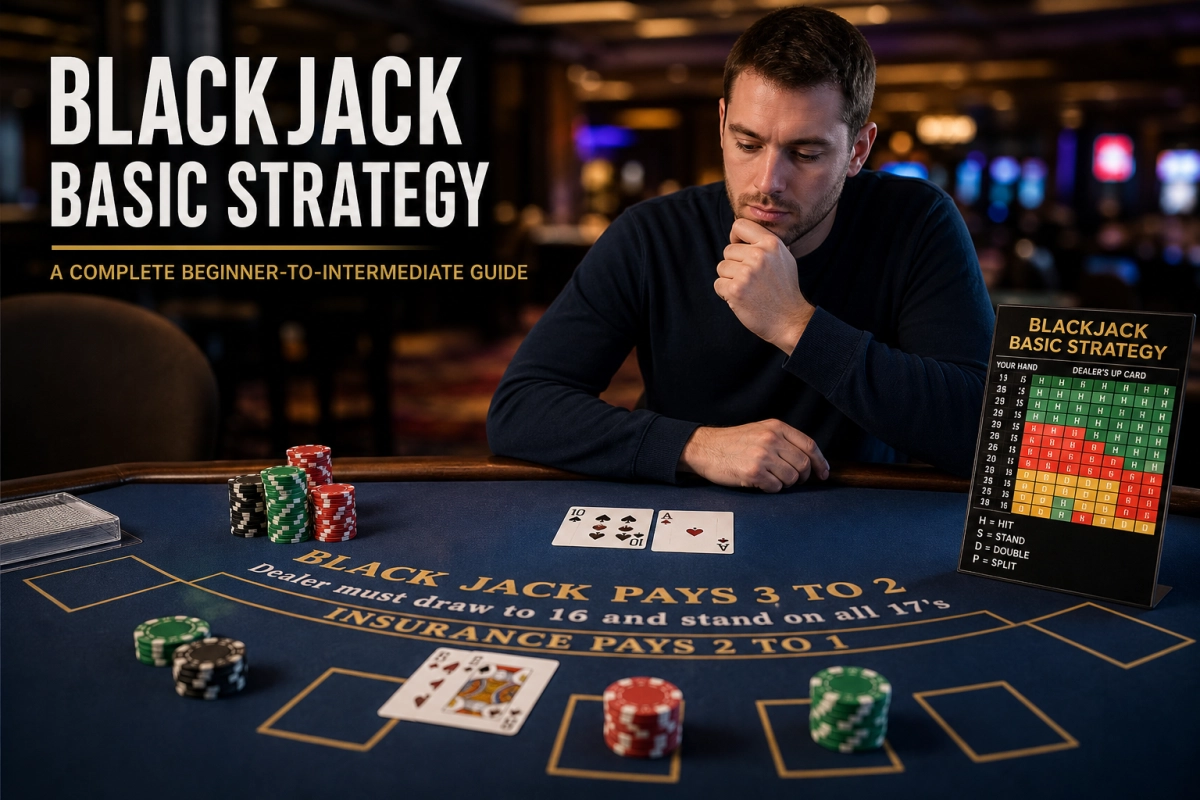
| 2. Learn the basics | Use a basic strategy chart to cut house edge to about 0.5%. |
| 3. Check mechanics | Note decks (single, double, 6-8) and whether dealer hits or stands on soft 17 (affects edge ≈0.2%). |
| 4. Bet plan | Flat bets are safest; only alter bets with reliable counts in shoe games; avoid insurance and side bets. |
| 5. In-play moves | Follow the chart: split Aces/8s, never split 10s, double when recommended. |
Understanding the Game Mechanics
Recognize that deck count and dealer rules change the math: single-deck games and a dealer who stands on soft 17 lower the house edge, while 6-8 deck shoes and dealer H17 raise it by roughly 0.1-0.3%. Blackjack pays 3:2 in full games but many casinos offer 6:5, which increases house edge dramatically. Dealer peek rules and shuffle frequency also affect variance and counting opportunities.
Playing Strategically
Adopt a basic strategy chart immediately-proper play trims the house edge to about 0.5%. Bet sizing should be conservative (1-2% of bankroll); decline insurance (a negative expectation bet) and most side bets. Card counting can yield advantage only in long shoe games and requires practice, stealth, and bankroll depth before varying bet sizes.
For concrete moves: stand on hard 12 versus dealer 4-6, hit 12 versus 2-3 and 7-A; always split Aces and 8s, never split 10s or 5s; double 11 against any dealer upcard and double 10 versus 2-9; soft 18 (A7) stands vs 2,7,8 but doubles vs 3-6. Following these specific plays consistently is how basic strategy converts into measurable edge reduction at the table.
Key Factors Affecting Your Success
Several variables determine your edge at the table, from rule permutations to bankroll discipline and seat position. Small changes – a dealer hitting soft 17, number of decks, or a shift from 3:2 to 6:5 payouts – can swing the house edge by tenths of a percent. The interplay between basic strategy, bankroll management, and table rules often decides whether you walk away ahead.
- basic strategy
- bankroll management
- table rules
- dealer behavior
Table Rules
House rule variations create the biggest measurable shifts in expected value: a six-deck shoe versus single-deck alters composition effects; dealer hitting soft 17 raises the house edge by about 0.2%, while changing blackjack payout from 3:2 to 6:5 increases the edge roughly 1.4-1.5%. Allowing double after split, re-splitting aces, and late surrender reduce the edge – confirm these before committing to a seat.
Player Behavior
Deviations from basic strategy, emotional betting, and playing while fatigued or intoxicated are among the fastest ways to lose expected value; a 0.5% edge can become 2%+ with consistent poor decisions. Talking through hands, taking long distractions, and chasing losses increase mistakes and variance, so maintain a focused, disciplined approach to actions and bet sizing.
More granularly, small behavior shifts compound: at a $10 average bet with ~100 hands per hour a 0.5% house edge produces about $5 expected loss per hour; raising effective edge to 2% via poor choices quadruples losses to ~$20/hour. Seat selection, predictable bet patterns, and tilt after swings magnify variance – do timed breaks and fixed bet spreads to protect your bankroll.
Pros and Cons of Different Strategies
Different methods trade simplicity, variance, and detectability: basic strategy minimizes house edge to roughly 0.5% with correct rules, while advantage plays can flip the edge by about 1% or more. Simple bankroll rules lower ruin risk, whereas aggressive tactics raise volatility and attract casino scrutiny. Use metrics-edge %, bet multiple, and required bankroll-to compare options before applying them at a live table.
| Strategy | Pros and Cons |
|---|---|
| Basic Strategy | Pros: Lowest house edge with optimal play (~0.5%). Cons: no positive expectation; small long-term gains only with rules variations. |
| Card Counting (Hi‑Lo) | Pros: can produce a +0.5-1.5% edge at favorable counts. Cons: requires concentration, bankroll, and risk of being restricted or banned. |
| Flat Betting | Pros: simple, low variance, easy bankroll control. Cons: misses opportunities to scale up when advantage exists. |
| Martingale (Negative Progression) | Pros: short-term recovery of small losses. Cons: huge ruin risk, table limits, and escalating bet sizes (exponential growth). |
| Paroli (Positive Progression) | Pros: caps downside while letting winners run. Cons: streaks reverse quickly; edge unchanged overall. |
| Kelly Criterion | Pros: mathematically optimal fraction for growth when edge is known. Cons: needs accurate edge estimate; volatile with small data. |
| Shuffle Tracking | Pros: can yield situational advantages on weak shuffles. Cons: complex, rare opportunities, and requires team coordination. |
| Team Play | Pros: distributes counting tasks and reduces individual exposure. Cons: coordination, trust issues, and increased detection risk if sloppy. |
| Insurance / Side Bets | Pros: occasional high payoff. Cons: generally long‑term negative EV; avoid unless mathematically justified. |
| Hole Carding / Illegitimate Advantage | Pros: immediate, large edges when possible. Cons: illegal/ethically wrong and can lead to ejection or legal trouble. |
Card Counting
Hi‑Lo counting assigns +1/0/−1 values and converts to a true count to size bets; a true count of +2 typically justifies betting several units instead of one. Experienced counters can shift the long‑term expectation by around 0.5-1.5%, but must manage a bankroll large enough to survive variance and accept that casinos will monitor for changes in bet patterns and may respond with countermeasures.
Progressive Betting Systems
Negative progressions like Martingale double after each loss to recover prior losses, while positive progressions like Paroli increase after wins to maximize streaks; neither alters expected value. A practical example: with a $10 base bet, six consecutive doubles require a $640 stake on the seventh round, exposing players to rapid bankroll depletion and table limits that break the system.
More detail: negative progression demands exponential capital-after n losses you need 2^n × base bet-so a modest losing run quickly exceeds most bankrolls and table caps; for instance, a 6‑loss string at 50% loss probability is 1/64. Positive progressions control downside but also limit upside unless you have a genuine, demonstrable edge. When you do have an edge, consider sizing using a fraction of your advantage (Kelly‑style) rather than fixed progressive doubling to balance growth against the probability of catastrophic drawdown.
Common Myths Debunked
Many beliefs at the table are misleading: following perfect basic strategy on a common 6-deck, dealer-stands-on-S17 game can cut the house edge to about 0.5%, while betting systems cannot change expected value. Card counting is legal but casinos will eject persistent counters, and progressive schemes like Martingale are dangerous-starting at $10, a six-loss streak requires a $640 bet to recover. Understanding math beats folklore every time.
Luck vs. Skill
Short sessions are dominated by variance: even a player using correct strategy faces large swings over 100 hands, so skill shows over volume. Card counters who convert a running count to a true count can gain about +1-2% edge in favorable shoes, and disciplined bankrolling-betting 1-2% per hand-lets that small edge compound without blowing the roll.
Superstitions in Blackjack
Rituals like rubbing chips, swapping seats, or wearing “lucky” items have no effect on card distribution or odds, yet they often trigger harmful choices: players who alter basic strategy after a perceived “cold” streak commonly increase their house edge. Treat superstitions as distractions that erode discipline and expected return.
Common behaviors include avoiding a dealer after a hot streak, tapping the table, or using specific chip colors; these are psychological comfort tactics, not performance enhancers. Casinos exploit ritual-driven betting by offering ATMs and comp incentives, so the measurable impact is real: deviating from strategy or increasing stake sizes based on superstition typically adds ~1-2% to the house edge, enough to turn a marginal player into a consistent loser.
Conclusion
Conclusively, avoid common blackjack errors by learning basic strategy, managing your bankroll, and knowing table rules and payouts; decline insurance and enticing side bets, resist chasing losses or playing fatigued or intoxicated, and make disciplined split/double decisions based on math rather than hunches. Consistent, informed play minimizes the house edge and improves long-term results.
FAQ
Q: What basic strategy mistakes do beginners most often make at a casino blackjack table?
A: Relying on guesswork instead of a basic strategy chart is the most common error. Players often hit when basic strategy calls for standing (for example, standing on 12 vs dealer 4-6) or stand when the chart recommends hitting (such as hitting a 16 vs a dealer 10 only in specific cases). Other frequent mistakes: splitting 10s or 5s (never split 10s; never split 5s-double 10 instead), failing to double down on favorable hands like 10 or 11 versus a weak dealer upcard, and misplaying soft hands (e.g., not doubling soft 18 vs dealer 3-6). Also avoid taking insurance or most side bets-these carry negative expected value unless you have specific, verifiable information about count and deck composition.
Q: How should I manage bets and my bankroll to avoid big losses?
A: Set a session bankroll and stake size before you sit down; a common approach is betting 1-2% of your total bankroll per hand to limit volatility. Avoid chasing losses by increasing bets after a losing streak-this magnifies downside and can quickly deplete funds. Use win and loss stop limits (predefined amounts at which you walk away) and adjust bet size only when your bankroll changes significantly. Choose tables whose minimum and maximum limits match your bankroll; playing at a table with a high minimum relative to your bankroll forces poor bet-sizing decisions. Finally, avoid mixing entertainment money with funds you can’t afford to lose.
Q: What procedural or etiquette errors can get you in trouble or cost you money in a casino?
A: Failing to follow table procedures can slow play or draw penalties. Always use the correct hand signals for hit/stand/double/split, and don’t touch hole cards in games where dealer deals face-up-touching cards can result in a penalty or mistrust. Speak quietly and avoid drawing attention to large bets or strategy decisions; obvious card-counting behavior or erratic bet patterns can lead to being watched or asked to leave. Verify table rules before play-number of decks, dealer hits/stands on soft 17, double after split, resplits, and blackjack payout (3:2 vs 6:5) all materially affect your edge. Tip dealers responsibly if you’re winning and respect local casino policies on phones and electronic devices at the table.