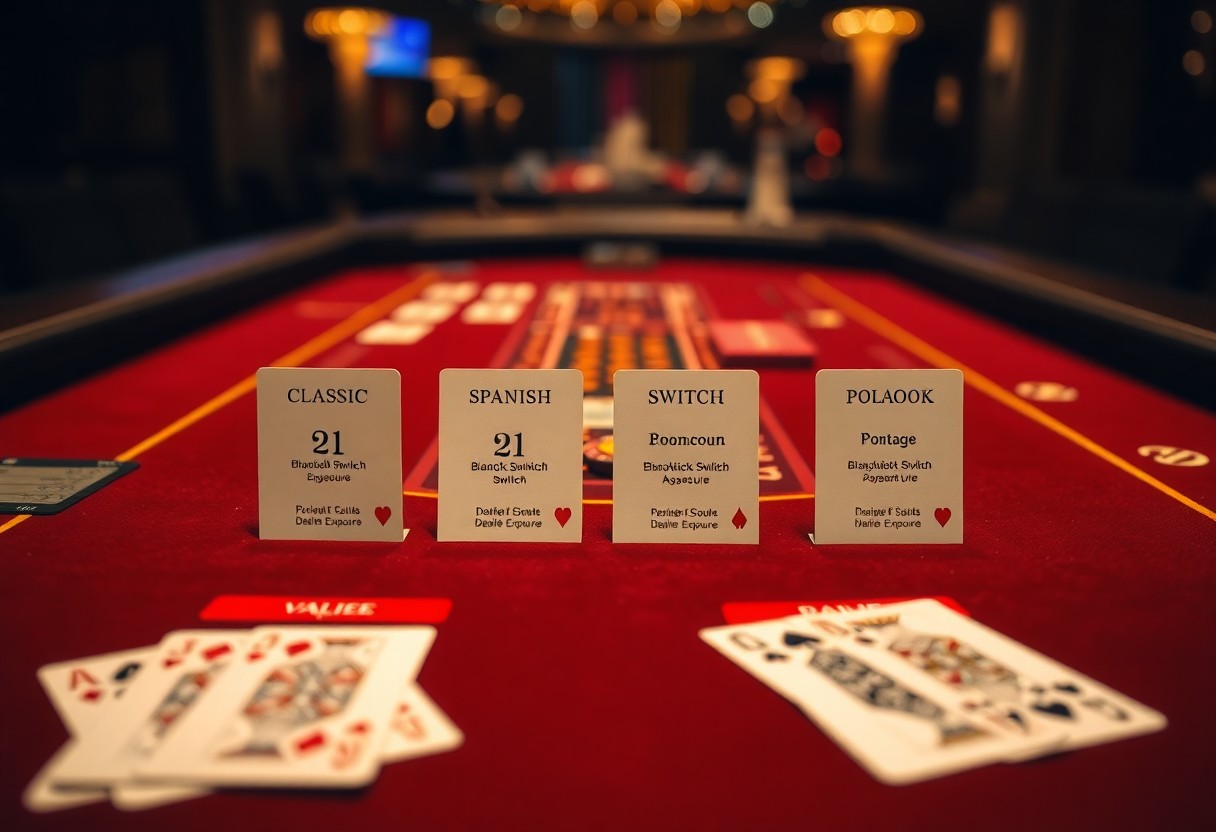
Casino players should weigh rule differences across Blackjack variants-single-deck games, dealer stands on soft 17, double after split, and surrender provide the best advantage, while multi-deck shoes, no resplits or double-after-split, and side bets raise the risk. Learn basic strategy, adjust for specific rules, and choose games that match your bankroll and skill to optimize long-term results.
Types of Casino Blackjack Variations
Casinos run many blackjack variants-Classic Blackjack, Spanish 21, Blackjack Switch, Perfect Pairs and others-that tweak decks, payouts and rule options to alter the house edge and strategy; single‑deck vs six‑deck changes expected return by tenths of a percent, and side bets can raise volatility while increasing house advantage. Any selection should weigh rule sets, payout rates and side‑bet odds against your bankroll and skill.
- Classic Blackjack
- Spanish 21
- Blackjack Switch
- Perfect Pairs
- Double Exposure
| Classic Blackjack | Standard rules, usually 3:2 blackjack payout; house edge can be ~0.15-1.5% depending on decks and hits on soft 17. |
| Spanish 21 | Uses 48‑card decks (tens removed), offers bonus payouts and liberal doubling/surrender rules; strategy diverges significantly. |
| Blackjack Switch | Play two hands and swap top cards; dealer 22 rule (pushes) offsets player advantage from switching. |
| Perfect Pairs | Side bet on initial two‑card pairs; high variance with typical paytables like 25:1/12:1/6:1 for perfect/colored/mixed pairs. |
| Double Exposure | Both dealer cards dealt face‑up; dealer wins all ties, so favorable information is offset by heavy dealer tie advantage. |
Classic Blackjack
Standard tables pay 3:2 for natural blackjacks and follow familiar plays: hit, stand, double, split. Single‑deck games with liberal rules can push the house edge below 0.2% with perfect basic strategy, while six‑deck shoes with dealer hitting soft 17 often raise it toward 0.5-1.0%.
Spanish 21
Spanish 21 removes all tens (48 cards) but compensates with player‑friendly rules: late surrender, doubling after splits and bonus payouts for 5+ card 21s; despite tens being gone, common rule sets produce house edges often near 0.4%-0.8% when bonuses are generous.
Deeper strategy note: tens removal alters card‑counting profiles and basic strategy-doubling frequencies and split decisions change markedly; bonus ladders (e.g., 5‑card 21 pays 3:2, 6+ cards higher) can flip the math, so evaluate exact payout tables and use a Spanish‑21 specific strategy chart for optimal EV.
Blackjack Switch
Players receive two hands and may switch the top cards between them, creating powerful play opportunities (e.g., converting two 8s into 18/18); to balance this the dealer often treats a dealer 22 as a push, which materially affects expected value and strategy.
More detail: switching increases expected return for skilled players but requires new decision rules and index plays; casinos commonly keep blackjack at 3:2 while the dealer‑22 push rule typically raises the house edge back to around the mid‑tenths of a percent depending on rules and deck count.
Perfect Pairs
This is a side bet on your first two cards forming a pair; typical paytables pay roughly 25:1 for a perfect pair, 12:1 colored and 6:1 mixed, giving high variance and a significantly larger house edge than main game wagers.
Additional info: expected return varies with decks and paytable-single‑deck tables with 25/12/6 pay can still have a house edge of several percent; professional players treat Perfect Pairs as a pure volatility tool rather than a long‑term value bet unless they exploit specific weak paytables.
Tips for Choosing the Right Blackjack Variation
Prioritize table rules, payouts and betting limits-small shifts like a 3:2 versus 6:5 blackjack payout or availability of double after split (DAS) can alter expected return substantially. Compare number of decks and surrender options, and watch for rule combos that boost volatility or reduce skill edge. Any choice should align with bankroll, skill level and tolerance for variance.
- Check blackjack variations for payoff differences (3:2 vs 6:5).
- Confirm rules: dealer hits/stands on soft 17, DAS, surrender.
- Note betting limits and side bets that inflate variance.
- Prefer single-deck or fewer decks when 3:2 is offered for lower house edge.
Understanding the Rules
Study specific rule items: whether the dealer hits on soft 17, if double after split is allowed, resplitting aces, and availability of surrender. For example, a single-deck game that pays 3:2, allows DAS and offers late surrender typically lowers the house advantage versus a multi-deck table that pays 6:5. Pay attention to how side-bet mechanics and dealer peek rules change optimal strategy.
Evaluating House Edge
Quantify impacts: with perfect basic strategy a favorable multi-deck 3:2 game often yields a house edge around 0.3%-0.6%, while switching blackjack payout to 6:5 commonly adds about +1.4%, pushing the edge well over 1%. Rule removals like no DAS or no surrender typically add tenths of a percent; use these benchmarks when comparing tables.
For a practical example, start from a ~0.5% baseline: converting that table to a 6:5 payout can raise the house edge to roughly ~1.9%-2.0%. Removing DAS or disallowing surrender might add ~0.1-0.5% each, while generous bonus rules in variants like Spanish 21 can offset some penalties; tally these changes to estimate net expected return before playing.
Step-by-Step Guide to Playing Blackjack
| Step | What to do |
|---|---|
| Setting Up Your Game |
Choose a table with rules that favor the player-common good signs are a 6-deck shoe, dealer stands on soft 17, and a 3:2 payout for blackjack. Confirm table minimums, maximums, and if late surrender, double after split, or resplit aces are allowed; these details can change the house edge by tenths of a percent. |
| Placing Bets and Card Dealing |
Place a wager between the posted limits; chips must be in the betting circle before deal. Dealer gives each player two cards and one dealer upcard; one upcard drives most strategy choices. Watch for continuous shufflers or cut-card penetration-deeper penetration benefits card counters. |
| Making Strategic Decisions |
Use a basic strategy chart adjusted to the table rules: always split aces and eights, never split tens, double 11 against most dealer upcards. Proper play can reduce the house edge to around 0.5% from roughly 2% with naive play. |
Setting Up Your Game
Pick a table with favorable rules-many casinos use 6 or 8 decks; 6-deck games generally offer better player odds than 8-deck. Check whether the dealer hits or stands on soft 17, whether blackjack pays 3:2 or the inferior 6:5, and confirm doubling and splitting permissions since each rule shifts the house edge by measurable amounts.
Placing Bets and Card Dealing
Match your bet to bankroll management-common guidance is 1-2% per hand for steady play-and place chips before the first card. Dealer deals two cards to each player and one upcard to the dealer; that upcard, especially a 10 or Ace, should immediately influence whether you play aggressively or conservatively.
For deeper detail: use unit-based bet sizing (for example, a $500 bankroll with 1% units = $5 bets) and adjust only for short-term variance; avoid max-bet swings. Note that insurance is a side bet paying 2:1 but generally carries a negative expectation unless counting; similarly, deeper shoe penetration (e.g., 75% dealt before reshuffle) increases advantage for counters and affects optimal bet ramps.
Making Strategic Decisions
Rely on a basic strategy chart tailored to the table rules: common prescriptions include splitting Aces and 8s, never splitting tens, doubling 11 versus most dealer upcards, and standing on hard 12-16 versus dealer 4-6. Adhering to the chart converts small edges in specific situations into a meaningful reduction in house advantage.
More specifics: against a dealer 6 you should often stand on hard 12-16 because the dealer bust probability is high; double 9 versus dealer 3-6, double 10 versus dealer 2-9, and surrender 16 versus a dealer 9-10 when surrender is allowed. These rule-based decisions shift EV by tenths of a percent per situation and add up over sessions.
Key Factors to Consider When Choosing a Variation
Weigh table rules, bet sizes, and volatility when selecting a variant: small rule tweaks like dealer stands on soft 17 vs hits on soft 17 shift house edge by ~0.2-0.4%; single-deck versus six-deck can change edge by ~0.1%; and side bets often add 2-10% house edge. Also compare typical table pace (50-100 hands/hour) and minimums-a $5 min changes bankroll needs vs $100. Perceiving how these elements interact points to the best fit for your goals.
- House Edge
- Bet Limits
- Rule Variations
- Dealer Rules
- Side Bets
- Player Skill
Skill Level
Beginners do best with classic tables offering 3:2 blackjack payouts and surrender allowed, where basic strategy cuts house edge to about 0.5%. Intermediate players can use advanced plays-doubling after split or late surrender-to shave more edge, while advanced players exploit single-deck or favorable shoe rules and, when permitted, counting to gain up to a 1-2% edge. Match variant complexity to your technique and study time.
Bankroll Management
Set unit size around 1-2% of your bankroll-so a $1,000 roll means $10-$20 bets-and avoid side bets that spike variance; these often increase short-term drawdowns even if occasional payouts are large. Use flat or modestly proportional betting to survive typical swings and preserve time for favorable situations.
For perspective, at 100 hands/hour with a $10 bet and a 0.5% house edge the expected loss is roughly $5/hour (100 × $10 × 0.005). Volatility can produce swings of several hundred dollars in short sessions if you play high-variance variants or chase side bets; therefore set loss limits and session stop points-for example, a 20% session loss rule protects longevity and prevents emotional betting.
Game Environment
Table speed, player count, and shuffle method materially affect outcomes: full tables slow play to ~50 hands/hour which lowers hourly loss but increases session time, while heads-up or online play reaches 120+ hands/hour. Continuous shufflers negate counting; dealer behavior and local tipping norms influence net wins. Choose a setting that fits your patience, countability needs, and social tolerance.
Live casinos often have looser promotions but more distractions and variability in dealer execution; for instance, Vegas strip rules commonly use H17 and six decks, raising edge slightly. Online casinos may offer S17 single-shoe tables or signup bonuses (e.g., 100% up to $200) that temporarily improve expected value, yet auto-shuffling eliminates counting opportunities-pick the environment that matches your strategy and risk appetite.
Pros and Cons of Each Variation
Comparing variants side-by-side reveals how small rule tweaks change edges and strategy. For example, a typical 6-deck classic blackjack with 3:2 pays can have a house edge around 0.5% with basic strategy, while many side bets and 6:5 payouts add >1%-2% to the house edge. The table below summarizes common strengths and pitfalls so you can match risk tolerance to rules quickly.
| Pros | Cons |
| Low house edge with basic strategy (≈0.5%) | Rule changes (6:5 payout) can add ~1.4% edge |
| Simple strategy widely available | Many variants require complex charts |
| Good tables for card counters (single/ double-deck) | Continuous shufflers negate counting advantage |
| Standard splits/doubles favor experienced players | Side bets carry high house edges (3%-10%+) |
| Consistent rules across casinos | Some games (Switch, Spanish) alter payouts and pushes |
| Familiar bankroll management applies | Higher variance in bonus-heavy variants |
| Easy to find training and simulators | Learning curve for variant-specific strategies |
| Bonuses in Spanish 21 can improve EV in spots | Removal of 10s raises house edge unless offset |
Advantages of Classic Blackjack
Classic blackjack offers predictable math: single- or double-deck tables with 3:2 payouts can drop the house edge to about 0.5% with proper basic strategy. Players benefit from straightforward split/double rules, abundant strategy charts, and lower variance versus bonus-heavy games; a 3:2 blackjack payout alone improves long-term ROI by roughly 1.4% compared with a 6:5 payout.
Disadvantages of Alternative Variations
Alternative games often trade simplicity for novelty, introducing rule twists that inflate the house edge or require new strategies. Examples include 6:5 blackjack (adds ~1.4% house edge), side bets with 3%-10% expected losses, and mechanics like dealer 22 pushing in Blackjack Switch that fundamentally change optimal play and bankroll risk.
Take Blackjack Switch: the ability to swap cards is offset by the common rule that a dealer 22 pushes, turning many winning hands into ties and raising the effective house edge by a few tenths of a percent; similarly, Perfect Pairs side bets can show negative expected value from 3% up to double digits depending on pay tables, making them long-term money losers despite short-term excitement.
Recommended Strategies for Popular Variations
Target each variant with its tailored plan: use a classic basic-strategy chart to cut the house edge to about 0.5%, switch to specialized charts for altered-deck games, and avoid side bets that often carry a high house edge (3-10%+). Pay attention to rule details – dealer hits/stands on soft 17, double-after-split, and surrender options can swing the edge by 0.2-0.6%, so pick games where favorable rules offset rule-driven disadvantages.
Basic Strategy for Classic Blackjack
Follow a proven chart: always split Aces and 8s, never split 10s, double 11 versus dealer 2-10, double 10 versus dealer 2-9, and double 9 versus dealer 3-6. Stand on 12-16 versus dealer 4-6, hit versus stronger upcards, and surrender 16 versus dealer 9-Ace when allowed. With perfect chart play and favorable rules you can approach a 0.5% house edge and minimize long-term losses.
Unique Strategies for Spanish 21 and Others
Spanish 21 uses a 48-card deck (no tens), which raises base edge by roughly ~0.4% unless offset by liberal bonuses and rules (double-any, late surrender, re-splits). Use a Spanish-21-specific strategy chart, play more aggressively with doubles and splits to exploit bonus payouts, and prioritize tables offering player-friendly pays for multi-card 21s or dealer 21 ties lost. As always, decline side bets with very poor returns.
For example, a common Spanish-21 rule set-double on any two cards, double after split, late surrender, and bonus payouts for 5+ card 21s-can reduce the effective house edge to around 0.4-0.8% versus a standard deck. In such games, double 9 against dealer 3-7 and double 10 versus dealer 2-9 more often, split small pairs more frequently when re-splits are allowed, and use surrender sparingly because bonus rules frequently compensate marginal hands.
To wrap up
Taking this into account, mastering the differences between blackjack variants-rules on dealer stands, splitting, doubling, and payouts-lets players choose games with the best expected value and manage risk through strategy adaptation; prioritize single-deck or favorable-rule games, learn variant-specific strategy, and adjust bankroll plans to optimize long-term results.
FAQ
Q: What are the main blackjack variations I’ll encounter and how do their rules change the game?
A: Common variants include Classic (Vegas) Blackjack, European Blackjack, Spanish 21, Blackjack Switch, Double Exposure and Pontoon. Differences that change strategy and house edge are number of decks, dealer behavior on soft 17 (S17 vs H17), whether a hole card is dealt (European often deals second card only after players act), availability of doubling after split (DAS), ability to resplit aces, surrender options (late/early), blackjack payout (3:2 vs 6:5), and special rules/bonuses (Spanish 21 removes tens but adds player-friendly bonus pays; Blackjack Switch lets you swap cards but often treats dealer 22 as a push). Small rule shifts can move house edge by tenths of a percent or more, so variant-specific strategy is required for optimal play.
Q: Which specific rules should I prioritize when choosing a blackjack table?
A: Prioritize a 3:2 blackjack payout over 6:5, DAS over no DAS, S17 (dealer stands on soft 17) over H17, and availability of late surrender. Fewer decks generally lower the house edge if other rules are favorable, but a single-deck game with bad payout or no DAS can be worse than a fair six-deck game. Re-splitting aces and permitting doubling after split are player-friendly. Avoid tables with heavy side-bet emphasis unless you know the house edge for those bets. Always check the full rule sheet-one unfavorable rule can negate several favorable ones.
Q: Given my skill level and bankroll, which variation should I play?
A: If you’re a basic-strategy player seeking lowest edge, choose a standard 3:2 game with DAS, S17 and late surrender; multiple decks are fine if those rules hold. If you can learn variant-specific charts, Spanish 21 can offer a lower effective house edge because of bonus pays and liberal doubling/surrender rules despite the lack of tens. If you enjoy advanced play and switching tactics, try Blackjack Switch with correct strategy, but account for rule trade-offs (push on dealer 22, altered payouts). Avoid 6:5 blackjack and heavy side-bet tables if you want a steady, low-variance experience. Match table limits to your bankroll and practice the appropriate basic strategy for that variant before wagering real money.